
Would you like to take a journey with me? Grab your Bible and I will give you an insider’s view on what my brain wonders and thinks while I travel through the prophetic Scriptures.
I started with the desire to read Ezekiel – after reading Revelation and Zechariah earlier this year (Began December 14th, 2025). And as I opened the Bible to read, I wondered about how and why the Jews were in Babylon. Where were they before?
So Abraham is the first Jew, he is called out from Ur of the Chaldees. This nation was full of idol worship, and stemmed from the nation of Shem
Based on biblical chronology, the period from Abraham to King David spans approximately 900 to 1,100 years
The calculation is typically broken down into these major eras:
- Abraham to the Exodus (~430 to 645 years): Biblical scholars debate this timeframe based on different interpretations of Exodus 12:40 and Galatians 3:17.
- The 430-year view: Many traditions, including the Septuagint and some New Testament interpretations, count 430 years from the original promise given to Abraham until the Exodus from Egypt.
- The 645-year view: Other interpretations add the years of the Patriarchs (Abraham, Isaac, and Jacob) in Canaan (approx. 215 years) to a full 430-year stay in Egypt.
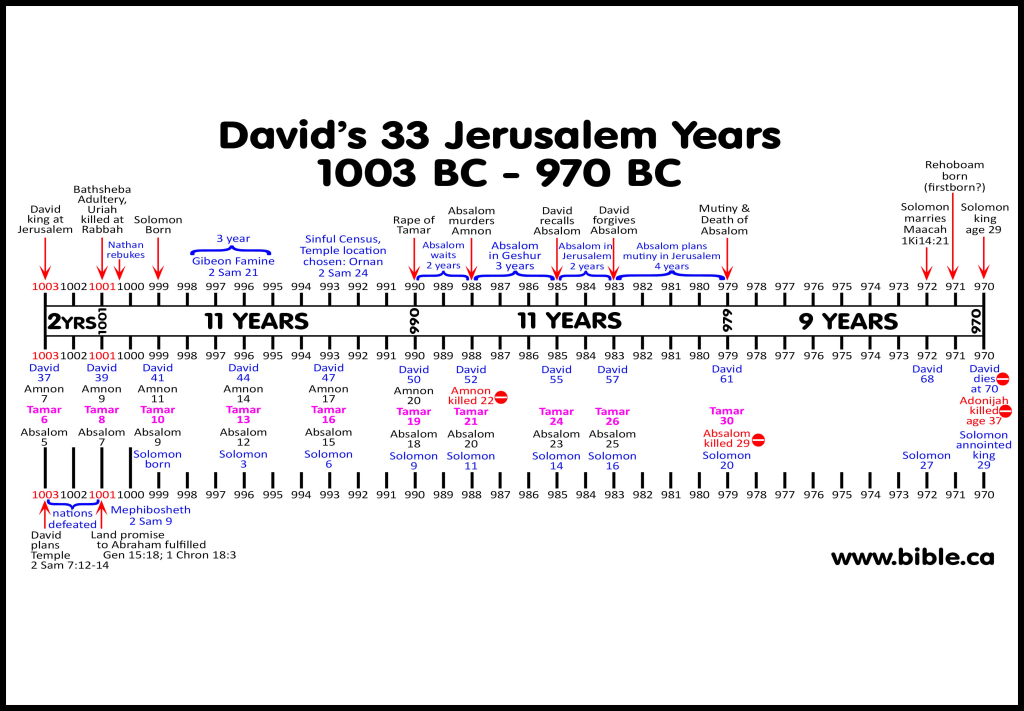
- The Exodus to King David (~480 years): According to 1 Kings 6:1, there were 480 years between the Exodus and the start of Solomon’s Temple (which began in the fourth year of his reign). Since David reigned for 40 years immediately preceding Solomon, his reign began roughly 440 years after the Exodus.
From Abraham to King David, the Jewish people transitioned from nomadic patriarchs to a united nation under a monarchy, a period spanning roughly 600-800 years, marked by the covenant with Abraham (c. 18th century BCE), the Exodus from Egypt (c. 13th century BCE), the forty years in the wilderness, the conquest and Judges period (c. 1200-1000 BCE), and finally the establishment of the united monarchy under David (c. 1000 BCE)
Jews were a nation for roughly 1200 years in ancient times (c. 1200 BCE – 70 CE) with periods of kingdoms, followed by exile and diaspora, then re-establishing sovereignty in modern Israel in 1948, making their continuous national connection to the land over 3,000 years, but with breaks in full statehood. Their national identity began with the Israelites in Canaan, forming kingdoms (Israel & Judah) until destruction by Assyrians (722 BCE) and Babylonians (586 BCE), with Roman rule ending the Second Temple era (70 CE) and scattering most Jews.
Abraham is widely considered the first Jew in religious tradition, as he was the first to recognize and covenant with one God, initiating the Jewish lineage, though the term “Jew” (from Judah) appears later in the Bible, referring to people of the Kingdom of Judah after the split of Israel. While Abraham was the spiritual founder and patriarch, some scholars note he was called “Abraham the Hebrew,” with the specific identity of “Jew” evolving later from the tribe of Judah.
Why Abraham is called the first Jew:
- Monotheistic Discovery: Abraham used reason to discover and embrace the one God (monotheism), rejecting polytheism.
- Covenant with God: God made a covenant with Abraham, promising land and descendants, establishing a unique relationship that forms the basis of Judaism.
- Initiation of Jewish Practice: He accepted divine commandments (mitzvot), including circumcision, marking the start of specific Jewish practices.
- Spiritual Ancestor: His lineage (through Isaac and Jacob) passed down these traditions, making him the patriarch of the Jewish people.
Nuances of the term “Jew”:
- “Hebrew” vs. “Jew”: Abraham is often called “Abraham the Hebrew,” with the word “Jew” (from “Yehudi”) emerging later in biblical texts, particularly after the division of the Israelite kingdoms.
- Historical vs. Religious Identity: While Abraham was the first Israelite and patriarch, “Judaism” as a distinct religion with developed practices evolved centuries after him, with the term “Jew” formally appearing around the time of the Kingdom of Judah.
In the Bible, Abraham was a descendant of Noah, specifically through Noah’s son Shem, making him part of the Semitic lineage, and tracing back through generations to Adam, with his immediate father being Terah. His story begins in Ur of the Chaldees, and he is a pivotal figure, considered the patriarch of the Hebrew-Israelite and Arab nations through his sons Isaac and Ishmael.
Abraham’s Lineage:
- Adam
- Enoch (Adam’s descendant)
- Noah (descendant of Enoch)
- Shem (Noah’s son)
- Arphaxad (Shem’s son)
- Salah (Arphaxad’s son)
- Eber (Salah’s son)
- Peleg (Eber’s son)
- Reu (Peleg’s son)
- Serug (Reu’s son)
- Nahor (Serug’s son)
- Terah (Nahor’s son, Abraham’s father)
- Abraham (Terah’s son)
“Semitic” refers to a family of languages (like Arabic, Hebrew, Aramaic) and the ancient peoples who spoke them (including Akkadians, Phoenicians, Hebrews, Arabs), deriving from Noah’s son Shem in the Bible, but the term is now primarily used in linguistics for languages, as the “racial” concept is considered outdated and often misused. It describes cultural and linguistic connections, encompassing diverse Middle Eastern and North African groups, though its racial application is obsolete.
Linguistic Context (Most Common Use)
- Semitic Languages: A branch of the Afro-Asiatic language family, including Arabic, Hebrew, Aramaic, Amharic, and Tigrinya.
- Semitic Family: Refers to these languages and their shared history, spreading across the Middle East, Horn of Africa, and North Africa.
Historical & Cultural Context
- Biblical Origin: The term comes from Shem, son of Noah, in the Book of Genesis, used by 18th-century scholars to group ancient peoples like Assyrians, Babylonians, Arameans, Canaanites (including Israelites, Phoenicians), and Arabs.
- Modern Usage: While historically used as a racial term (e.g., “Anti-Semitism”), this usage is largely rejected as pseudoscientific, with “Semitic” now better understood as a linguistic and cultural descriptor for peoples sharing ancient Semitic roots.
Key Takeaway
When you hear “Semitic,” think of a linguistic family and associated cultures (like Arab, Jewish, Ethiopian), not a single race, as it’s rooted in language rather than biology.
In the Bible, Terah (or Terach) is a significant figure in Genesis, known as the father of the patriarchs Abraham, Nahor, and Haran, and the ancestor of the Israelites. He led his family from Ur of the Chaldeans toward Canaan but stopped and settled in Haran, where he lived and died before God called Abraham to complete the journey, marking Terah as a transitional figure from idolatry (worshiping idols) to the one true God.
Key Facts about Terah:
- Family: Son of Nahor, father of Abram (Abraham), Nahor, and Haran; grandfather of Lot (Haran’s son).
- Origin: He originated from Ur of the Chaldeans, a Mesopotamian city.
- Journey: He initiated the migration to Canaan but settled in Haran.
- Idolatry: He was an idol worshipper, a practice his son Abraham later abandoned.
- Legacy: Although he didn’t reach Canaan, his family’s departure from Ur set the stage for God’s covenant with Abraham.
- Mentions: He’s listed in Genesis 11, Joshua 24, 1 Chronicles 1, and Luke 3 (in Jesus’ genealogy).
Significance:
Terah serves as the link between the ancient world of idol worship and the new path of faith initiated by his son, Abraham, making him a crucial ancestor in biblical history
Ur of the Chaldees (or Ur Kasdim) was a major ancient Sumerian city in Mesopotamia, famous as the biblical birthplace of Abraham, located near modern-day Nasiriyah in Iraq, with its ruins featuring a massive Ziggurat dedicated to the moon god Nanna. While historically known as a thriving city and trade center, its association with the later-arriving Chaldean people solidified its biblical name, though some alternative theories place it in Turkey, but the Iraqi site is the widely accepted scholarly identification.
Location & Identification
- Archaeological Site: Tell el-Muqayyar (modern-day Iraq) is the site excavated by Sir Leonard Woolley and identified as Ur.
- Biblical Context: Mentioned in Genesis as the departure point for Abraham, Haran, and Lot.
- Chaldean Connection: The name “Ur of the Chaldees” reflects when the Semitic Chaldeans settled in southern Mesopotamia, though they weren’t dominant until centuries after Abraham’s time, leading to scholarly debate.
Significance
- Abraham’s Homeland: It was the prosperous, yet idolatrous, home from which Abraham was called by God to leave for Canaan.
- Religious Hub: A significant religious center with a large Ziggurat dedicated to the moon god Nanna (Sin).
- Cultural Center: A wealthy city known for its textiles, agriculture (grain, dates), and extensive trade.
Alternative Theories
- Some traditions and scholars suggest an alternative location for Abraham’s Ur in or near modern-day Şanlıurfa (Urfa) in southeastern Turkey, pointing to local traditions and geographical descriptions.
While Ezekiel’s vision of a divine throne-chariot with four-faced living creatures (cherubim) was uniquely detailed and immersive, other prophets like Daniel (who saw a similar blazing throne with wheels) and Moses (who saw God’s glory cloud) had comparable encounters with the divine glory, with Ezekiel providing a more intimate, interior view of God’s heavenly court. No one else saw exactly what Ezekiel saw, but his vision echoed earlier encounters and shared similarities with later New Testament visions, like John’s in Revelation, showing a progression of prophetic understanding of God’s majestic presence.
Who else saw something similar?
- Moses: Saw God’s glory cloud and experienced God’s presence on Sinai, though without the detailed vision of creatures and wheels.
- Daniel: In Babylon, Daniel also saw a fiery throne with wheels and blazing light, similar to Ezekiel’s vision of the Merkabah (throne chariot).
- John (Revelation): Saw a throne surrounded by four living creatures and elders, echoing Ezekiel’s imagery of heavenly attendants and divine glory.
What was unique about Ezekiel’s vision?
- Up-Close Experience: Ezekiel was in exile in Babylon, not the temple, giving him an unprecedented, internal view of God’s throne-chariot moving from place to place.
- Detailed Description: He described the cherubim’s four faces (man, lion, ox, eagle), wings, bronze legs, and the complex, eye-filled wheels, symbolizing God’s sovereignty over creation.
- Personal Impact: The vision was overwhelming, leaving Ezekiel speechless and profoundly affected, showing the intense, transformative nature of direct divine encounter.
In essence: Ezekiel’s vision was a pivotal, detailed revelation of God’s heavenly reality, building on earlier biblical encounters and foreshadowing later prophetic descriptions of God’s awesome presence.
HOW OLD WAS ADAM WHEN THE FLOOD HAPPENED?
According to biblical chronology found in Genesis 5, Adam was not alive during the Great Flood. He died approximately 726 years before the flood began.
Based on the genealogies in the Masoretic Text (the basis for most modern Bibles):
- Adam’s Age at Death: Adam lived for 930 years and then died.
- Time from Creation to Flood: The flood occurred 1,656 years after the creation of Adam (when Noah was 600 years old).
- Adam’s “Age” at the Flood: Had Adam lived until the flood, he would have been 1,656 years old.
Timeline Summary (Years from Creation)
- Year 0: Creation of Adam.
- Year 130: Adam fathers Seth.
- Year 930: Adam dies.
- Year 1056: Noah is born.
- Year 1656: The Great Flood begins.
While Adam died centuries before the deluge, his direct descendant Methuselah (the oldest person recorded in the Bible) died in the same year the flood started, at the age of 969.




 SIMPLY SWANK
You must be logged in to post a comment.