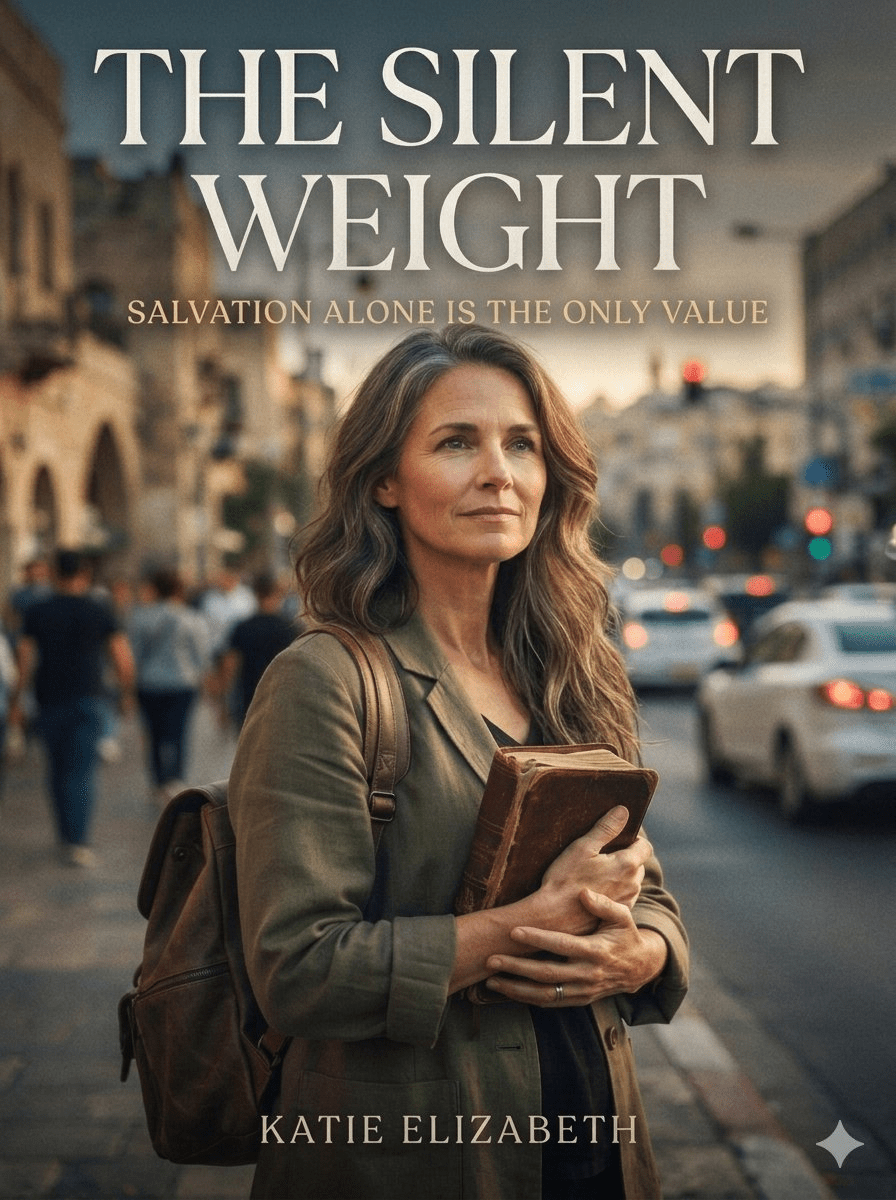
The Silent Weight by Katie Swank

The Shadow of the Bazaar

The rhythmic crash of the Pacific surf against the concrete pillars of the Oceanside Pier had always been Katie’s anchor. At forty-five, her life looked picture-perfect to the outside world—a beautiful home in the hills of South O, a successful career, and a calendar packed with social obligations. Yet, standing on the strand with the salty California breeze tugging at her long, silver-streaked hair, she felt a profound, aching emptiness. Her faith had become a routine of comfortable rituals, numbed by a culture obsessed with material success, coastal luxury, and the relentless pursuit of more.

“Is this all there is?” she whispered, her fingers tracing the edge of the antique leather journal she had bought at a vintage shop off Coast Highway.

The journal was a strange piece, cold to the touch despite the midday heat, its blank parchment pages smelling of ancient dust and myrrh. Her friend had facetiously called it a relic, but Katie felt strangely drawn to it. Seeking a quiet place to read, she walked up the wooden planks of the pier, past the fishermen and the tourists. She sat on a bench at the very end, looking out toward the horizon where the blue sky met the endless sea.

She opened the journal. The moment her pen touched the first page, the ocean breeze died instantly. A suffocating heat slammed into her chest, thick with the stench of animal sweat, dung, and burning wood. The sound of crashing waves vanished, replaced by a deafening roar of shouting voices and clinking metal.

Katie gasped, stumbling off the bench. The wooden planks beneath her feet were gone, replaced by smooth, massive stone tiles. The vast blue horizon of the Pacific had vanished behind towering walls of white marble and gleaming gold leaf. She was standing in a massive, crowded courtyard packed with frantic people in ancient tunics.

“The Temple,” she breathed, her heart hammering against her ribs. She wasn’t in Oceanside anymore. The journal had pulled her across centuries, dropping her directly into the Court of the Gentiles in Jerusalem.

The heavy, suffocating air of Jerusalem’s outer courtyard pressed against Katie’s chest like a physical weight. Her fingers curled tightly around the leather strap of her modern pack—a jarring anomaly against the coarse linen tunic she wore to blend in. For months, she had wrestled with a quiet, hollow skepticism, a numbness born from a world obsessed with material gain and superficial success. She had traveled across centuries seeking an answer to a single, nagging question: Is there anything in this existence that truly matters?

Now, she stood in the Court of the Gentiles, and the sight sickened her. The sacred precinct had been transformed into a chaotic, screaming marketplace. To her left, heavy wooden tables groaned under the weight of silver Tyrian shekels, the only currency accepted for the Temple tax. Money changers argued aggressively with destitute travelers, charging exorbitant exchange rates that stripped widows of their last coins. To her right, massive wooden crates stacked six feet high rattled violently with the frantic flapping of white doves, their feathers drifting through the dust-laden air like snow.

“The Bazaar of Annas,” Katie whispered, her voice tightening with anger. She recognized the political machinery at play. The High Priest Annas and his corrupt family had monopolized the sacrificial system, turning a house of prayer into a lucrative corporate empire. They were selling salvation, branding unblemished lambs at inflated prices, and convincing the desperate that God’s love was a commodity to be bought. Katie felt a familiar, cold despair creeping back into her heart. If religion was just another transaction, another hustle for power and coin, then her search for absolute truth was meaningless.

“They have turned piety into a industry,” a sharp, weary voice muttered beside her.

Katie turned her head to see two women standing in the shadow of a towering white marble pillar. One was adjusting a faded woolen shawl, her fingers calloused and rough from domestic labor, her eyes scanning the crowd with practical vigilance. The other sat on a low, smooth stone step, her hands resting quietly in her lap, staring into the heart of the market with a gaze so deep and sorrowful it seemed to pierce through the noise.

“They have forgotten the heart of the Torah, Mary,” the standing woman said, her jaw clenched as she watched a money changer cheat an elderly man. “They care more for the clinking of copper than the covenant of the Almighty.”

“Be patient, Martha,” Mary replied softly, her voice carrying a resonant, unshakeable peace that made Katie stop breathing. “The Lord sees. He will not let His house be desecrated forever. There is a weight coming that these scales cannot measure.”

Katie took a step closer, her heart hammering against her ribs. Mary and Martha. The sisters of Bethany. Before she could speak, a sudden, unnatural stillness rippled outward from the eastern gate. The shouting of the merchants faltered, and the air grew instantly cold with anticipation.


Chapter 2: The Scourge of Small Cords

Katie pushed through a cluster of arguing traders, her eyes locked on a man who had just stepped into the center of the courtyard. He did not wear the elaborate, fringed robes of the Pharisees or the fine linen of the Sadducees. He wore the simple clothes of a laborer, yet the authority radiating from Him was so intense that the crowd parted before Him like water. His face was set like flint, His jaw tight, and His eyes burned with a pure, terrifyingly righteous fire.

As Katie watched, paralyzed by His presence, the man bent down and gathered several thick, coarse packing ropes discarded on the stone tiles. With swift, deliberate movements, His strong hands wove them together, fashioning a whip of small cords. It wasn’t a weapon meant to draw blood, but an instrument of absolute eviction.

With a deafening crack that echoed off the massive stone walls of the Temple, He brought the whip down onto the nearest currency table.

“Take these things away!” His voice thundered, a magnificent, resonant sound that shook Katie to her very soul. “Do not make My Father’s house a house of merchandise!”

With a violent, sweeping motion, He gripped the edge of a heavy oak table and flipped it completely over. Thousands of silver coins spilled onto the stone floor, creating a frantic, metallic rain that rang out like an alarm. Men screamed and scrambled on their hands and knees, desperately clawing at the rolling silver, but Jesus did not stop. He moved like a storm through the courtyard, overturning the benches of those who sold doves, opening the gates of the cattle pens, and driving the sheep and oxen out into the streets. The powerful merchants fled before Him, terrified not by the whip of ropes, but by the undeniable, heavenly sovereignty that flashed in His eyes.

Katie stumbled backward, her back hitting the marble pillar beside Mary and Martha. She looked at Jesus, and in that moment of chaotic upheaval, a blinding light shattered her internal skepticism. He wasn’t just clearing a room; He was declaring war on everything human beings used to distract themselves from God. He was tearing down the money, the commerce, the status, and the security of the world.

Martha stepped in front of her sister protectively, her breath coming in short gasps. “He has challenged the family of Annas,” she whispered, her voice trembling. “They will never forgive Him for this. He is destroying their wealth.”

But Mary stood up, her face illuminated by a profound, radiant recognition. She looked at the scattered coins on the ground as if they were worthless pebbles. “Let them keep their wealth,” Mary said, her eyes locked on Jesus. “He is revealing what is real. Everything else is dust.”

Katie stared at the silver coins rolling into the gutters. For the first time in her life, she saw them for what they truly were: illusions. Jesus was revealing that the systems of the world—wealth, power, and religious performance—were entirely worthless. Salvation could not be bartered, and life had no value outside of Him. Her knees shook as the truth began to take root in her heart.


Chapter 3: The Questions of Authority

The courtyard was a landscape of absolute ruin. Feathers floated through the air like gray smoke, broken wooden crates littered the floor, and the smell of panicked livestock lingered in the heat. Yet, Jesus remained in the center of the clearing, completely calm, His chest rising and falling evenly as He stood amidst the wreckage of a multi-million-dollar religious monopoly. The Temple guards stood at a distance, their hands resting nervously on the hilts of their swords, completely paralyzed by the sheer spiritual weight of the man before them.

Suddenly, a contingent of religious leaders stepped forward from the inner courts. Their long, fine robes swept through the dirt, and their faces were twisted with a toxic mix of rage and panic. They were emissaries from the Sanhedrin, sent directly from the palace of Annas to protect their ruined bottom line.

“What sign do You show us, since You do these things?” the chief priest demanded, his voice shaking with a desperate attempt to regain control. “By what authority do You destroy our livelihood?”

Jesus looked at them, His gaze stripping away their titles, their wealth, and their pride until they stood transparently bankrupt before Him. “Destroy this temple,” He answered with quiet, absolute certainty, “and in three days I will raise it up.”

The leaders erupted into mocking, defensive laughter, looking around at the massive, gold-plated stones of Herod’s Temple. “It has taken forty-six years to build this magnificent sanctuary,” they sneered, “and will You raise it up in three days?”

Standing near Martha, Katie felt a sudden, electric shock of revelation open her mind. She didn’t just see the historical event anymore; she saw the cosmic reality. Jesus wasn’t talking about the physical stones, the gold leaf, or the earthly architecture that Annas used to extract wealth from human souls. He was talking about His own body. He was revealing that He was the true Temple—the only place where a human soul could meet God.

Katie looked down at her hands, then back at Jesus. She realized that everything human beings spent their lives building—their careers, their reputations, their earthly kingdoms—was destined to be destroyed. Only He would endure. The religious leaders were fighting for a dead building and a dying income, entirely blind to the fact that the Author of life was standing in front of them. Katie felt a fierce, burning desire ignite in her chest. She didn’t want the world’s wealth anymore. She wanted Him. She wanted to know the Man who was Himself the sanctuary, the only true anchor in a universe of shifting sand.


Chapter 4: The Midnight Conversation

The news of the Temple cleansing ripped through the narrow streets of Jerusalem like a wildfire, sparking intense whispers of revolution and fear. That night, seeking refuge from the tense city atmosphere, Katie walked up the rocky, moonlit paths of the Mount of Olives to a small stone house where Mary and Martha had offered her shelter. The sprawling city of Jerusalem glowed below them, illuminated by the thousands of cooking fires of Passover pilgrims, a vast sea of humanity searching for meaning but trapped in ritual.

Late into the night, as the cold wind rustled the silver leaves of the olive trees, a frantic, rhythmic knock sounded at the heavy wooden door. Martha opened it cautiously, her hand gripping an oil lamp. A man wrapped tightly in a dark, expensive wool cloak stepped into the courtyard, his breath coming in hurried gasps. It was Nicodemus, a prominent ruler of the Jews and a wealthy member of the Sanhedrin. He had risked his entire reputation, his seat of power, and his life to come here in the dark.

“Is the Teacher here?” Nicodemus asked, his eyes darting anxiously back toward the road.

Jesus stepped out from the shadows of the small stone room, the faint glow of the oil lamp catching the profound kindness in His eyes. He did not mock the ruler’s fear or turn him away. He invited him to sit on a low bench under the starry Judean sky. Katie sat quietly on the dirt floor in the corner, her heart racing as she listened.

“Rabbi,” Nicodemus said, his voice trembling with a genuine, desperate hunger. “We know that You are a teacher come from God; for no one can do these signs that You do unless God is with him. But the Temple… the laws… how do we truly reach the Father?”

Jesus leaned forward, His voice dropping to a powerful, intimate whisper that bypassed all of Nicodemus’s theological training. “Most assuredly, I say to you, unless one is born again, he cannot see the kingdom of God.”

Nicodemus looked bewildered, trapped in his physical understanding. “How can a man be born when he is old?”

As Katie watched, she saw Jesus gently dismantle the final defense of a highly educated, wealthy man. He explained that physical birth, earthly status, and intellectual achievement meant absolutely nothing in the economy of heaven. “That which is born of the flesh is flesh,” Jesus said, “and that which is born of the Spirit is spirit.” Then, looking deeply into the ruler’s eyes, He delivered the core truth of existence: “For God so loved the world that He gave His only begotten Son, that whoever believes in Him should not perish but have everlasting life.”

Sitting in the dark, Katie felt a profound wave of grief mixed with overwhelming joy. She saw the absolute exclusivity of salvation. Nicodemus had all the wealth and religious status the world could offer, yet he was spiritually dead. Jesus was revealing that human souls were in a state of desperate peril, hurtling toward eternal destruction, and that He was the only rescue boat. The single, burning objective of life wasn’t to achieve success or find comfort, but to be rescued by Him and then spend every remaining breath pulling other drowning souls into that same grace. Salvation wasn’t a part of life; it was the only value life possessed.


Chapter 5: The Well in the Desert

Leaving the volatile atmosphere of Judea behind, Jesus led His disciples north toward Galilee. To the shock of His followers, He chose a route that took them directly through Samaria—a barren, hostile land filled with deep-seated racial and religious hatred. The midday sun beat down relentlessly on the dusty paths, waves of heat rising from the chalky earth. Katie’s throat felt like sandpaper, her lips cracked, and her body ached from the brutal pace of the trek.

By noon, they reached a historic plot of ground: Jacob’s Well, situated near the ancient town of Sychar. Exhausted and dehydrated, Jesus sat heavily on the stone rim of the well. The disciples, uncomfortable and anxious to leave the territory, hurried into the nearby village to buy food, leaving Katie standing in the sparse shade of a gnarled olive tree, watching the Master.

Through the shimmering heat waves, a lone figure approached. It was a Samaritan woman, carrying a heavy clay water jar on her shoulder. Katie immediately realized the tragedy of her situation; no woman drew water at the absolute hottest hour of the day unless she was an outcast, deeply ashamed, and desperate to avoid the judgmental glares of her neighbors.

Jesus looked up at her, His eyes filled with an intense, intentional focus. “Give Me a drink,” He said quietly.

The woman stopped dead in her tracks, her expression hardening with defensive shock. “How is it that You, being a Jew, ask a drink from me, a Samaritan woman? For Jews have no dealings with Samaritans.”

Katie leaned forward, ignoring her own thirst as she watched Jesus completely shatter every social, racial, and religious barrier constructed by human pride. He didn’t see a Samaritan or an outcast; He saw a dying soul on the brink of eternal separation from God.

“If you knew the gift of God,” Jesus replied, His voice full of a beautiful, compelling urgency, “and who it is who says to you, ‘Give Me a drink,’ you would have asked Him, and He would have given you living water.”

The woman mocked Him gently, pointing out that He had no bucket and the well was deep. But Jesus pressed past her armor. “Whoever drinks of this water will thirst again,” He said, gesturing to the physical well, “but whoever drinks of the water that I shall give him will never thirst. But the water that I shall give him will become in him a fountain of water springing up into everlasting life.”

When the woman eagerly asked for this water, Jesus looked into her soul and said, “Go, call your husband, and come here.”

“I have no husband,” she whispered, looking at the ground.

“You have well said,” Jesus answered gently, without an ounce of condemnation. “For you have had five husbands, and the one whom you now have is not your husband.”

The woman’s jar slipped slightly from her hand. Her past was laid bare, her deepest shames exposed to a stranger. Yet, she didn’t see hatred in His eyes; she saw a love so massive it terrified her. She realized she was standing before the Messiah.

Katie watched from the shadows, tears streaming down her dusty cheeks, mixing with the sweat on her face. Her faith surged into a violent, beautiful flame. She saw that Jesus had traveled through the dangerous desert heat for one broken, sinful soul. He didn’t care about the religious politics of Jerusalem or the social standards of the day. He cared about salvation alone. The woman dropped her expensive water jar completely, letting it shatter or roll away, and ran back to the village, her voice echoing through the hills: “Come, see a man who told me all things that I ever did! Could this be the Christ?”

Katie looked at the abandoned jar and knew her life could never be the same. The only true adventure, the only worthy pursuit on earth, was to lose everything for the sake of knowing Jesus and running into the highways and byways to tell dying souls that living water was free.


Chapter 6: The Bread of Life

Months swept by in a blur of dust, miracles, and escalating spiritual warfare. Katie followed the growing movement north to the lush, green hillsides surrounding the Sea of Galilee. But the atmosphere had shifted; the crowds were no longer just curious onlookers. They were desperate, numbering over five thousand men, not counting the thousands of women and children who had tracked Jesus on foot around the lake. They were physically starving, their bodies weak from a long day in the wilderness, but their spiritual starvation was far worse.

As the sun began to dip below the Galilean hills, casting long, purple shadows across the grass, the disciples panicked. There was no food, no money, and no markets nearby. Katie sat in the grass, surrounded by crying children and anxious parents, feeling the heavy weight of human helplessness.

She watched as a young boy was led to Jesus by Andrew. The boy held a tiny basket containing five small barley loaves—the dry, cheap bread of the ultra-poor—and two small fish. It was a joke compared to the massive sea of hunger before them.

Jesus took the bread, stood before the multi-layered crowd, and lifted His eyes to heaven. He gave thanks, broke the loaves, and handed the pieces to His disciples.

What followed was an absolute defiance of physical reality. Katie watched, her eyes wide with astonishment, as the disciples walked through the thousands of people, reaching into their baskets again and again. The bread never ran out. It multiplied in their hands, fresh, warm, and fragrant. A disciple handed Katie a chunk of the barley bread and a portion of fish. As she ate, the physical nourishment filled her body, but her mind was fixed on the sheer creative power of the Man on the hill. Everyone ate until they were completely satisfied, and twelve baskets of leftovers were gathered.

The next morning, the crowd tracked Jesus to the opposite side of the sea at Capernaum. They were wild with excitement, wanting to crown Him king on the spot. They saw Him as a political savior who could provide free food, defeat the Romans, and make their earthly lives comfortable.

But Jesus turned on them with sharp, devastating candor. “Most assuredly, I say to you, you seek Me, not because you saw the signs, but because you ate of the loaves and were filled. Do not labor for the food which perishes, but for the food which endures to everlasting life.”

The crowd murmured, demanding another physical sign. Jesus drew Himself up, His voice ringing with an absolute, unyielding exclusivity that shocked the listeners. “I am the bread of life,” He declared. “He who comes to Me shall never hunger, and he who believes in Me shall never thirst… Most assuredly, I say to you, unless you eat the flesh of the Son of Man and drink His blood, you have no life in you.”

The crowd gasped. The words were difficult, intentionally offensive to their earthly desires. They wanted a king to fix their temporary circumstances; Jesus was offering His very life to save their eternal souls. Katie watched in heartbreak as hundreds of people turned their backs on Him, grumbling, and walked away. The massive crowd withered down to a tiny remnant.

Jesus turned to the twelve, and then His eyes drifted to Katie, standing nearby. “Do you also want to go away?” He asked, His voice heavy with the sorrow of a Savior watching souls choose destruction.

Peter stepped forward, his eyes shining. “Lord, to whom shall we go? You have the words of eternal life.”

Katie fell to her knees in the dirt, her heart bursting with an intense, protective love for Jesus. She didn’t want the world’s bread. She didn’t want a comfortable earthly life. She saw clearly now that human existence without Jesus was a slow, agonizing starvation. Salvation was the only food that mattered, and she vowed to spend her life pointing starving people to the Bread that came down from heaven.


Chapter 7: Light in the Darkness

Katie returned to Jerusalem for the Feast of Tabernacles, finding a city engulfed in intense, dramatic ritual. Every evening, the Temple’s Court of the Women was illuminated by four colossal, seventy-foot-tall golden lampstands. Huge vats of oil were ignited, casting a brilliant, blinding light that reflected off the white marble and gold leaf of the sanctuary, illuminating the entire city of Jerusalem to commemorate the pillar of fire that had guided Israel through the dark wilderness.

In the very middle of this dazzling display, amidst the chanting priests and blowing silver trumpets, Jesus stood near the treasury. He pointed at the massive, flickering flames and shouted with absolute defiance: “I am the light of the world. He who follows Me shall not walk in darkness, but have the light of life.”

The Pharisees erupted in fury, accusing Him of blasphemy, but Jesus didn’t just speak the truth—He acted it out. A few days later, as He walked through the narrow, stone-paved alleys of the city, He stopped before a beggar who had been blind from birth. The disciples immediately began a theological debate, asking whose sin caused the blindness—the man’s or his parents’.

“Neither this man nor his parents sinned,” Jesus said, His voice full of deep, sovereign purpose, “but that the works of God should be revealed in him. I must work the works of Him who sent Me while it is day; the night is coming when no one can work.”

Katie watched, her breath catching as Jesus spat on the dusty ground, mixed the saliva with the dirt to form a thick clay, and gently smeared it over the sightless, scarred eyes of the beggar.

“Go, wash in the pool of Siloam,” Jesus commanded.

Katie didn’t hesitate. She turned and ran through the winding streets, following the blind man as he stumbled and groped his way down the steep steps to the southern edge of the city. He reached the cool, clear waters of the pool of Siloam and splashed the water over his mud-caked face.

When he wiped the water from his eyes and blinked against the harsh sunlight, a collective gasp went up from the watching crowd. The cloudy, lifeless eyes had cleared. His pupils dilated, focusing for the first time in his entire existence. He stared at his own hands, crying out in sheer, unadulterated shock, then looked up at the sky, laughing and weeping as he took in the colors of the world.

Later that afternoon, the religious elite hauled the healed man into their court, trying desperately to intimidate him into calling Jesus a sinner. They were terrified of losing their spiritual grip on the people. But the beggar, standing tall with clear, bright eyes, shattered their sophisticated arguments with a single sentence: “One thing I know: that though I was blind, now I see.”

Watching from the back of the courtroom, Katie felt the final scales fall from her own heart. She saw that the entire world was a massive valley of spiritual blindness, with millions of people groping in the dark, chasing wealth, approval, and temporary pleasures that would ultimately lead them into eternal night. Jesus was the only light. There was no other source of truth or safety in the universe. Her faith solidified into an unshakeable rock. She knew her only purpose left on earth was to reflect His light into the darkest corners of human experience, warning souls of the coming night and pointing them to the Savior who could give them sight.


Chapter 8: The Tears of Bethany

A devastating message reached Jesus while He was preaching beyond the Jordan: His dear friend Lazarus, the brother of Mary and Martha, was dying in Bethany. To the absolute bewilderment and distress of His disciples, Jesus did not rush to his side. He stayed where He was for two agonizing days, letting the clock run down. By the time He finally walked up the dusty paths to the village of Bethany, Lazarus had been dead, buried, and decomposing in a limestone tomb for four full days.

Katie arrived in the village ahead of Him, finding a house completely torn apart by grief. Professional mourners wailed in the courtyard, and the air was thick with sorrow. When word came that Jesus was finally approaching, Martha ran out to meet Him on the road, her face pale, her eyes red-lined from sleepless nights of weeping.

“Lord, if You had been here, my brother would not have died,” she cried, her voice a mix of deep pain and surviving faith.

Jesus looked at her, His presence radiating an intense, cosmic authority that seemed to challenge death itself. “Your brother will rise again… I am the resurrection and the life. He who believes in Me, though he may die, he shall live. And whoever lives and believes in Me shall never die. Do you believe this?”

Martha nodded through her tears, and then went to call her sister. Mary came running out of the house, throwing herself recklessly at Jesus’ feet, her body shaking with violent, broken sobs. “Lord, if You had been here, my brother would not have died.”

Seeing her profound collapse into grief, and the weeping of the crowd around her, something extraordinary happened to the Creator of the universe. Jesus groaned in His spirit and was deeply troubled. Katie watched from a few feet away, her heart fracturing as she saw heavy, brilliant tears well up in the eyes of the Son of God. Jesus wept. He wasn’t crying because He lacked power; He was weeping over the sheer, brutal devastation that sin and death had inflicted upon the human souls He loved so deeply.

They walked to the edge of the village, stopping before a cave carved into the limestone hillside. A massive, heavy stone was rolled across the entrance.

“Take away the stone,” Jesus commanded, His voice shaking with an intense, holy anger against death.

Martha gasped, stepping forward. “Lord, by this time there is a stench; for he has been dead four days.”

“Did I not say to you that if you would believe you would see the glory of God?” Jesus responded, His gaze burning through her doubt.

Men strained against the heavy stone, crying out as they rolled it back, exposing the dark, pitch-black maw of the sepulcher. A faint, sickening smell of decay drifted into the warm air. Jesus stepped to the mouth of the tomb, lifted His eyes to heaven, prayed briefly to His Father, and then cried out with a loud, terrifyingly powerful voice that seemed to command the universe:

“Lazarus, come forth!”

An absolute, breathless silence fell over the hillside. For a second, nothing happened. Then, from the deep darkness of the cave, a rhythmic, dragging sound emerged. A figure shuffled into the blinding sunlight. He was wrapped from head to toe in strips of white burial linen, his face covered with a sweatcloth.

“Loose him, and let him go,” Jesus commanded quietly.

As Mary and Martha tore at the linen, revealing the healthy, flushed skin of their living brother, the crowd erupted into screams of terror and joy. But Katie stood completely frozen, staring at Jesus. In that breathtaking moment, she saw the absolute, terrifying stakes of human existence. Jesus had just demonstrated His complete sovereignty over life and death. He was the only door out of the grave.

She realized that every single human soul she met was like Lazarus—dead in their sins, decaying in a dark tomb of spiritual separation, completely helpless until they heard the voice of Jesus. There was no middle ground, no alternative value in life. Salvation from eternal death was the only thing that mattered. She looked at the resurrected Lazarus and knew she would spend the rest of her days shouting His name to a dead world, desperate to see more souls loosed from their grave clothes.


Chapter 7: The Final Passover

The political atmosphere in Jerusalem had reached a toxic, explosive boiling point. The chief priests and Pharisees, completely humiliated by the destruction of their Temple bazaar years prior and utterly terrified of losing their power after the undeniable resurrection of Lazarus, had issued a formal decree for Jesus’ immediate arrest and execution. The shadow of the cross hung low over the city.

Katie sat in the dark shadows of a large, hidden upper room, where Jesus had gathered His disciples to celebrate a final, intimate Passover meal. The flickering light of oil lamps cast long, dancing silhouettes against the stone walls. The air was thick with an intense, suffocating tension; they all knew the authorities were closing in.

Suddenly, Jesus rose from the supper table. He laid aside His outer garments, took a long linen towel, and girded Himself like the lowest household slave. He poured water into a wide copper basin, knelt down on the hard floor, and began to wash the dusty, sweat-stained feet of His disciples, wiping them with the towel.

Katie watched in a state of absolute, broken awe as the King of Glory knelt before Peter, and then, most horrifyingly, before Judas Iscariot. He knew exactly what Judas was about to do. He knew the silver had already changed hands. Yet, He washed the feet of His betrayer with the same tender, desperate love. He was demonstrating that His kingdom was not of this world; it was a kingdom of radical, self-sacrificing love designed to rescue human souls at any cost.

“A new commandment I give to you,” Jesus said as He broke the unleavened bread and poured the red wine, His voice laced with an eternal weight. “That you love one another; as I have loved you… Greater love has no one than this, than to lay down one’s life for his friends.”

Later that night, the small group walked out into the cold, midnight air, crossing the Kidron Valley to the dark, gnarled grove of the Garden of Gethsemane. The city across the valley was dead silent, but the spiritual atmosphere was a raging storm. Jesus withdrew a stone’s throw away from the disciples, falling face down on the cold, hard earth.

Katie hid behind an ancient, twisted olive tree, her heart breaking as she listened to the agonized, muffled cries of the Savior. He was staring into the cup of God’s wrath against human sin. The weight of every murder, every theft, every betrayal, and every dark thought of humanity was pressing down on Him. His sweat became like great drops of thick blood, falling heavily to the ground. “Father, if it is Your will, take this cup away from Me; nevertheless not My will, but Yours, be done.”

He was choosing to die. He was choosing the cross because it was the only way to pay the price for the souls He loved. Katie wept silently in the dark, her face pressed against the rough bark of the olive tree. She saw the absolute, terrifying cost of salvation. If the Son of God had to sweat blood to purchase human souls, then a single soul was worth more than all the gold, empires, and status of the earth combined.

Suddenly, the dark garden was illuminated by the flickering, orange glare of approaching torches. A large mob of Roman soldiers and Temple guards, armed with swords and clubs, marched through the trees, led by Judas. The betrayer stepped forward, sealing the betrayal with a kiss. Jesus did not resist. He allowed Himself to be bound in heavy iron chains and led away into the dark night. Katie stood alone among the olive trees, trembling violently through her tears, knowing the hour of cosmic sacrifice had arrived.


Chapter 10: The New Temple Built

Three agonizing days had passed since the sky over Jerusalem turned pitch black at noon, since the earth shook so violently that rocks split, and the massive, thick veil of the Temple tore in half from top to bottom. Katie sat in a cramped, dark, locked upper room alongside Mary, Martha, and the remaining disciples. The doors were bolted out of fear of the authorities. The silence was suffocating, a heavy, dead numbness weighing down their limbs. The Teacher was dead. His body had been mangled on a Roman cross, pierced with a spear, and buried in a sealed stone tomb. The corrupt family of Annas and the religious elite seemed to have won an absolute victory. The light of the world had been extinguished.

Katie stared at the floor, her mind racing through the journey. Had it all been for nothing? Was the world’s cynicism right after all?

Suddenly, the heavy wooden door burst open, rattling on its hinges. Mary Magdalene stood in the doorway, her hair wild, her breath coming in frantic, gasps, her face completely radiant with an impossible, blinding light that shattered the gloom of the room.

“He is risen!” she cried, her voice cracking with pure, ecstatic joy. “The tomb is empty! I have seen the Lord! He spoke to me!”

An electric shock of supernatural revelation charged through Katie’s chest, burning away the grief and doubt instantly. She didn’t wait for the disciples to argue. She turned and ran out of the room, sprinting through the narrow, waking streets of Jerusalem, out through the city gates, and into the mist-shrouded garden tomb.

The scene was breathtaking. The massive, multi-ton stone had been violently ripped away from the entrance, lying flat on the grass. The Roman seals were shattered. Katie stumbled through the low opening into the cool, limestone burial chamber. The heavy stone bench where His body had lain was empty. The linen burial cloths were folded neatly, and the face cloth was rolled up by itself in a corner. The grave could not hold Him. Death had been completely defeated.

Katie stepped backward out of the dark tomb into the brilliant, golden rays of the early morning sunrise. She turned down a garden path and froze.

Standing near an olive tree was Jesus. He wasn’t a ghost; He was physically alive, His body radiating a vibrant, immortal glory that defied the laws of the universe. The scars in His hands and feet shone like trophies of absolute victory. He looked at His followers, and then His eyes locked onto Katie with an infinite, burning love.

In that glorious, blinding moment, the grand, eternal arc of Katie’s journey became beautifully complete. She finally understood everything. Jesus had cleared the physical Temple of its corrupt marketplace years ago because that entire old system of dead stones, physical coins, and animal sacrifices was a shadow. He had torn it down to build a new, living Temple—an eternal sanctuary made of redeemed human lives, bought with His own blood.

The world and all its treasures were an absolute illusion. The family of Annas, the Roman Empire, the wealth of Jerusalem—it was all dust, destined to pass away. The only real and absolute value in human existence was loving Jesus with every fiber of one’s being and spending every single breath seeking more lost, dying souls to be saved from the coming judgment. Salvation alone was the only currency that mattered in eternity.

Katie fell to her knees in the wet grass, her hands lifted, her heart overflowing with a fierce, unshakeable faith. The skeptic was gone. The modern girl was transformed into an eternal evangelist. As she prepared to return to her own time, she knew she was carrying the living water and the bread of life within her soul. She had found the only thing worth living and dying for: the beautiful, risen Savior, and the urgent, glorious mission to bring his lost children home.

The Return to the Pier

Emerging into the sunrise, she had seen Him standing there, physically alive, the scars in His hands shining with absolute victory over death.

He had looked at Katie one last time, His gaze burning with an infinite commission. “Go,” His voice echoed in her spirit. “Tell them.”

As the weight of His words settled into her soul, the garden began to blur. The ancient limestone walls faded, and the hot Judean air suddenly grew cool and moist. The smell of myrrh vanished, replaced by the sharp, familiar scent of saltwater.

Katie blinked, gasping for air.

She was sitting on the wooden bench at the very end of the Oceanside Pier. The Southern California sun was beating down, and a couple of local fishermen were casting their lines nearby, completely oblivious to her cosmic journey. Below her, the Pacific surf crashed rhythmically against the wooden pillars. She looked down at her hands; she was wearing her modern clothes again, and the antique journal lay open in her lap, its pages now completely blank.

She sat in silence for a long time, watching the tourists walk by, laughing and checking their phones. A few days ago, she would have envied their carefree, affluent coastal lifestyle. Now, she felt a profound, burning urgency tearing at her heart.

She looked at the sprawling city of Oceanside rising up from the coast—the surf shops, the luxury condos, the bustling restaurants. It was a beautiful place, but beneath the sun-kissed surface, she saw it clearly now. It was a valley of dry bones. It was a city of people who were spiritually blind, starving for the Bread of Life, and trapped in a modern-day bazaar of materialism, entirely unaware that their souls were in desperate peril.

Katie closed the journal and stood up, her long hair whipping in the coastal wind. The numbness that had plagued her forty-five years of life was entirely gone, replaced by an unshakeable rock of faith. She finally understood the true value of existence. The coastal estates, the bank accounts, the social status—they were all illusions destined to turn to dust.

The only real value in life was loving Jesus and seeking more lost souls to be saved. Salvation alone was the only currency that mattered in eternity. Walking off the pier toward the crowded strand, Katie smiled, ready to spend every remaining breath sharing the living water with a thirsty world.

August 2026
M T W T F S S
 12
3456789
10111213141516
17181920212223
24252627282930
31