
A Journey Through Time: The Freedom of Galatians
Chapter 1: Redirection of the Grid
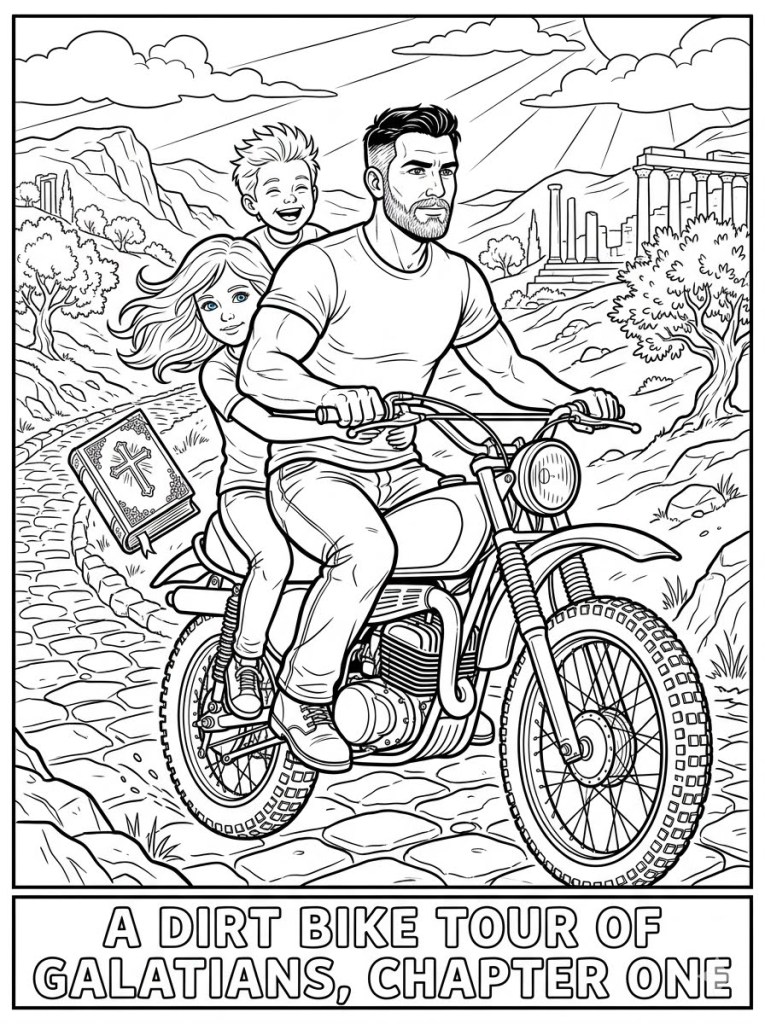
The cold, misty wooden dock of the Viking era vanished as quickly as it had appeared, replaced by a roaring tunnel of pure history. The time-traveling book in Madison’s lap didn’t just pulse; it violently flipped its own pages, the yellowed parchment crackling with brilliant white electricity that cast long, dancing shadows across their faces.
“The coordinates are resetting on their own!” Madison screamed over the howling wind. Her long, blonde hair whipped wildly across her face, tangling in the straps of her backpack. She squeezed her eyes shut for a second, trying to read the glowing text beneath her fingertips. “It’s bypassing our home garage entirely!”
Daddy Swank braced his large, muscular frame over the back of the dirtbike. His scuffed brown workboots were locked onto the footpegs behind Cash, his calves tense beneath his pulled-up socks. “Hold steady, son! Keep your weight centered! The engine torque is fluctuating against the temporal drag!”
Cash gripped the handlebars with white knuckles. His spiky strawberry blonde hair was flattened completely by the sheer force of the time-vortex wind, but his amazing blue eyes remained locked on the digital display mounted to the crossbar. The numbers spun frantically through the decades, shedding centuries like autumn leaves, before finally locking onto an ancient destination: Antioch, Syrian Province. 48 A.D.
With a final, explosive crack of thunder that sounded like tearing canvas, the swirling vortex dissolved. The bike slammed downward, its suspension bottoming out as they skidded onto a dusty clay road under a searing, brilliant Mediterranean sun.
Chapter 2: The Gates of Antioch
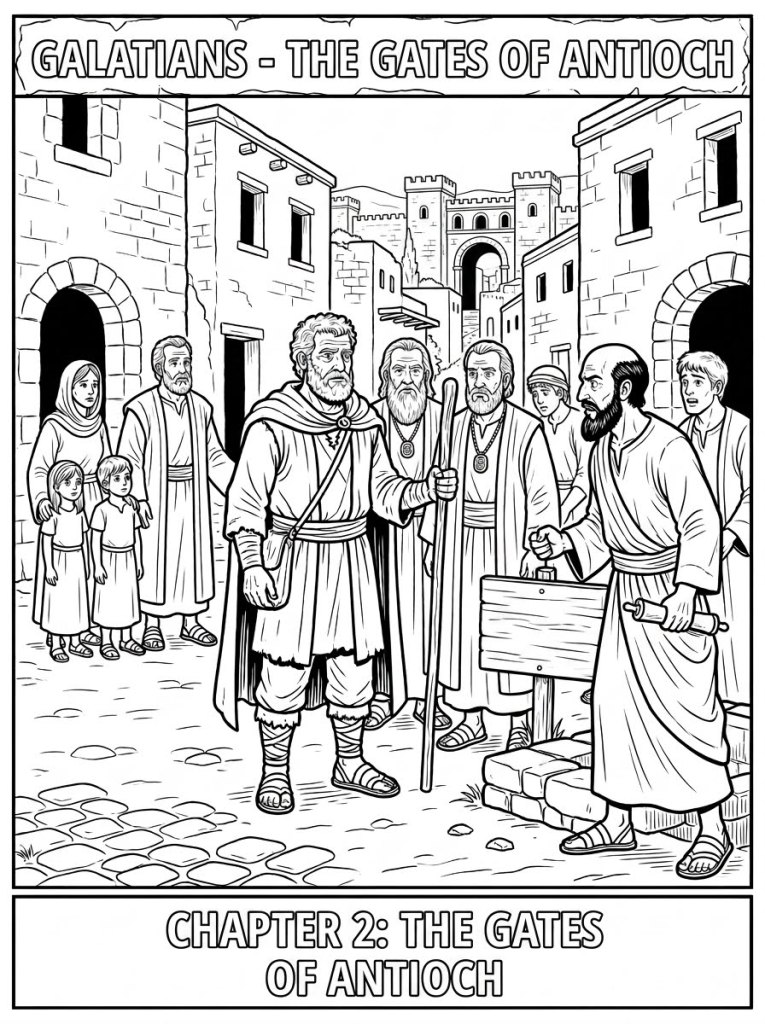
The heavy, suffocating smell of roasted lamb, bitter herbs, dried manure, and hot dust immediately hit Cash’s nose. He kicked the dirtbike stand down, coughing heavily as a caravan of laden camels plodded past. The riders, draped in flowing linen tunics, glared in utter astonishment at the strange metallic machine and its bizarrely dressed riders.
“We aren’t in the second century anymore,” Madison said, wiping a mixture of sweat and ancient dust from her forehead. She leaned over the bike, pointing her stunning blue eyes toward the massive stone walls of Antioch looming just a quarter-mile ahead. She consulted the ancient book, where fresh black ink was currently drying. “The Province of Syria. Paul’s home base.”
Daddy Swank stepped off the back of the bike, carefully checking his cargo shorts pockets. His mechanical tools were safe in their side pouch, and his heavy leather belt was securely fastened. He stood at his full height, his striking blue eyes tracking the Roman legionaries patrolling the city gates alongside Jewish merchants and Greek scholars.
“This is a massive ancient hub,” Daddy Swank observed, his strong jaw tightening as he analyzed their surroundings. “If we’re here to see the Apostle Paul, we need to locate the local gathering place without causing a public riot with this bike. Cash, let’s get this thing under cover.”
“Dad, look at the stonework on those walls,” Cash whispered, his eyes wide as he pushed the handlebars. “It looks exactly like the diagrams in our history textbooks, but it’s completely real. Every single detail is exactly where it’s supposed to be.”
As they edged closer to the heavy stone fortifications near the main gateway, Madison gasped, pulling Cash toward a shaded recess in the limestone masonry. Chiseled deeply into the monumental blocks were official Roman inscriptions, legal decrees, and trade tallies written in bold Latin and Greek script.
“Look right there,” Madison whispered excitedly, her long blonde hair brushing against the ancient rock as she pointed to a prominent legal plaque embedded in the gatehouse. “That inscription names Lucius Sergius Paulus, a prominent Roman official, and references the exact local administrative framework mentioned in the Book of Acts. And right below it, look at the carved trade manifests—they list goods coming directly from Tarsus, Cyprus, and the Galatian highlands.” In 1929, archaeologists excavating near the theater of Corinth discovered a large 1st-century Roman pavement stone. Inlaid in the stone was a Latin inscription reading: ERASTVS PRO AEDILITATE S P STRAVIT (“Erastus, in return for his aedileship, laid this pavement at his own expense”). This directly verifies that a high-ranking civic official named Erastus existed in Corinth at the exact time Paul was writing his letters there.
“They line up perfectly with the biblical records,” Daddy Swank remarked, running his thumb over the deep, weathered grooves of the chiseled letters. “The Bible didn’t just guess who was in charge or which trade routes were active. It recorded the exact civic infrastructure of Antioch. These stone blocks are like a permanent database, locking the history of the Bible into a specific time and place. It matches perfectly because the author of Acts was actually walking these exact streets.”
“There is so much proof,” Daddy explained, “In Delphi, Greece, archaeologists discovered a collection of stone fragments containing a letter from the Emperor Claudius. The text explicitly mentions “Junius Gallio, my friend and proconsul” and securely dates his brief legal term to precisely 51–52 A.D. This discovery provided historians with a rock-solid, absolute chronological anchor point that aligns perfectly with the biblical timeline of Paul’s second missionary journey.”
“History isn’t a fairy tale, Cash,” Madison said gently, clutching the heavy book to her chest. “The places, the people, the dates… they all line up perfectly.”
“I remember from my memory verse from Sunday School,” declared Cash excitedly, “the Bible talks about this in Romans 16:23, where Paul writes a greeting from Erastus, whom he describes as the city’s director of public works (or city treasurer) in Corinth.”
“According to the historical scripts here in my book,” Madison continued, “there are multiple independent stone inscriptions bearing the name of the Sergius Paulus family have been unearthed by modern archaeologists—one in Soloi, Cyprus, and another monumental inscription in Pisidian Antioch. The inscriptions confirm that this specific aristocratic family held immense governing authority in Asia Minor during the mid-1st century, exactly as recorded in the Book of Acts.”
“Also,” Daddy explained, “I was just recently reading in n Acts 19, about a massive riot breaks out in Ephesus because Paul’s preaching threatened the economic market centered around the silver shrines of the goddess Artemis. The Bible mentions the specific layout of the city, the theater, and the immense power of the temple.”As Daddy was explaining this part of Scripture, Madion’s time traveling book began writing more historical proof, she read the text aloud, “Excavations at Ephesus have uncovered the massive, 25,000-seat theater where the riot took place, along with official boundary stones and inscriptions dedicated to the silversmith guilds and the temple wardens of Artemis, confirming the exact economic and religious flashpoints described in Scripture.”
Chapter 3: Meeting the Son of Encouragement
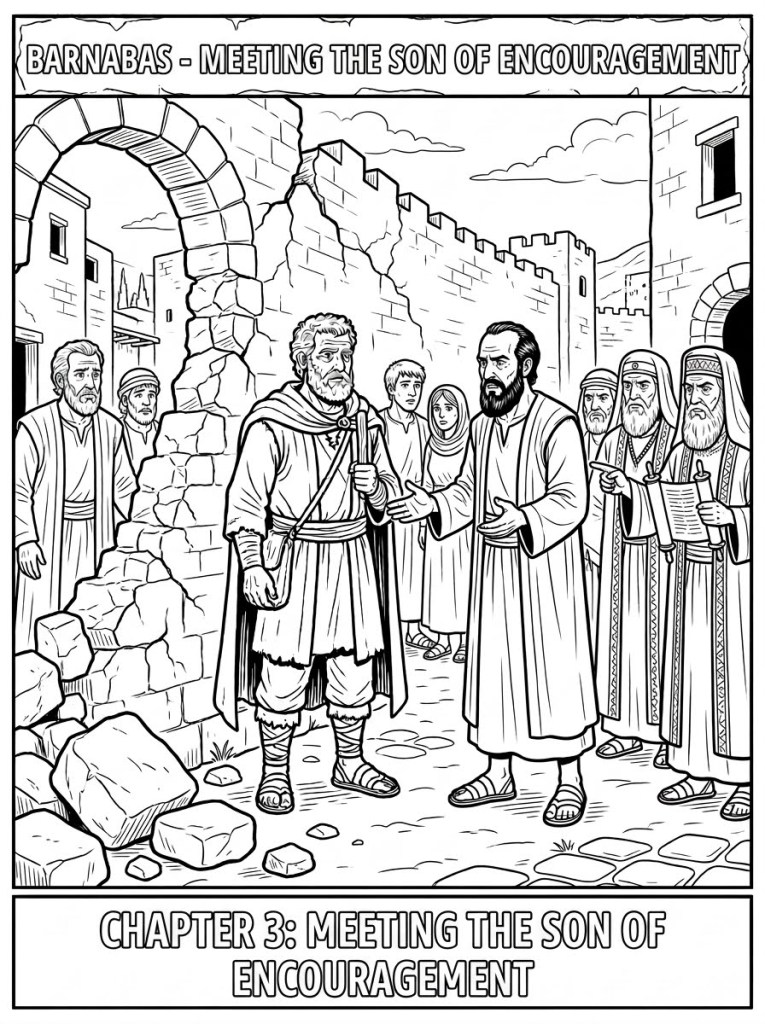
They pushed the dirtbike through the bustling, narrow alleys of the city, keeping it hidden under a rough burlap tarp they managed to scavenge near an empty market cart. As they approached a modest stone courtyard filled with the sound of laughter and shared meals, a large, broad-shouldered man with an exceptionally kind face and warm, brown eyes stepped out into the alley.
“Peace be with you, strangers,” the man said in clear, formal Greek. Through the supernatural power of Madison’s book, the words translated instantly into perfect English in their minds. “I am Barnabas. You look as though you have traveled a great distance through perilous lands.”
Madison stepped forward, tilting the book so the man could see the simple fish symbol scratched into the weathered leather corner. Barnabas’s eyes widened with a profound mixture of warmth and relief. He looked at Cash’s spiky hair and Daddy Swank’s modern brown t-shirt, but instead of questioning their bizarre attire, he gestured for them to enter quickly.
“Come inside out of the heat,” Barnabas urged. “You have arrived at a critical, historic hour. Saul of Tarsus—whom we call Paul—has just returned from the highlands of Galatia, and the church is gathering to hear his report.”
Inside the courtyard, the air was cooler, shaded by a canopy of dried palm leaves. Dozens of believers from different backgrounds—some wearing wealthy Roman rings, others in the simple tunics of slaves—sat together, talking animatedly.
As they waited near the edge of the courtyard, Cash leaned in toward Madison. “Maddy, how long have Paul and Barnabas been working together? Did they just meet here?”
Madison opened her book to a beautifully illustrated map of the Mediterranean, the text detailing their incredible history together. “No, Cash. Their partnership is actually the only reason Paul was accepted by the church in the first place. About ten or eleven years ago, right after Paul was miraculously converted on the road to Damascus, he came to Jerusalem to join the disciples. But everyone was terrified of him. They remembered how he used to hunt down and imprison Christians, and they thought his conversion was just a trick to infiltrate the church.”
“So what happened?” Cash asked, his amazing blue eyes wide.
“Barnabas stepped in,” Madison whispered, pointing to a passage in the book. “His name actually means ‘Son of Encouragement.’ He was a Levite from Cyprus who had sold his own land to give the money to the poor. He had so much integrity that when he took Paul by the hand, brought him directly to the other apostles, and vouched for him, they finally believed him. Barnabas risked his own reputation to save Paul’s.”
Daddy Swank nodded, his striking blue eyes fixed on Barnabas as the man walked over to hand them clean cups of water. “That’s a real leader right there,” Daddy Swank whispered. “He saw the value in a broken machine and helped rebuild it. What did they do after that, Maddy?”
“Well, after Paul had to flee Jerusalem because his life was in danger, he went back home to Tarsus for a few years,” Madison continued. “Meanwhile, the church here in Antioch started exploding with new Greek and Gentile believers. The apostles in Jerusalem sent Barnabas here to check on things. When Barnabas saw how fast it was growing, he realized he couldn’t handle it alone. He traveled all the way to Tarsus to find Paul, brought him back here to Antioch, and the two of them spent a whole year teaching the church together. This is actually the exact place where believers were first called ‘Christians’ in history.”
“And they didn’t just stay here,” Daddy Swank added, recalling his own knowledge of church history. “Didn’t they just finish their first major missionary journey together?”
“Yes!” Madison nodded excitedly. “They sailed out to Cyprus, Barnabas’s home island, and then traveled deep into the dangerous mountains of Asia Minor—through Perga, Pisidian Antioch, Iconium, and Lystra. They faced malaria, stoning, and angry mobs, but they successfully planted the very churches in Galatia that are under attack right now. They’ve been through literal life-and-death battles together up to this exact moment in history.”
Barnabas walked back over to their table, a gentle smile warming his rugged features. “I see you are discussing our journeys,” he said softly, looking at the glowing pages of Madison’s book. “The road has been long, and the scars are real. But the grace of our Lord Jesus has sustained us through every mountain pass. Come, let me introduce you to Paul himself.”
Chapter 4: The Tentmaker’s Workshop
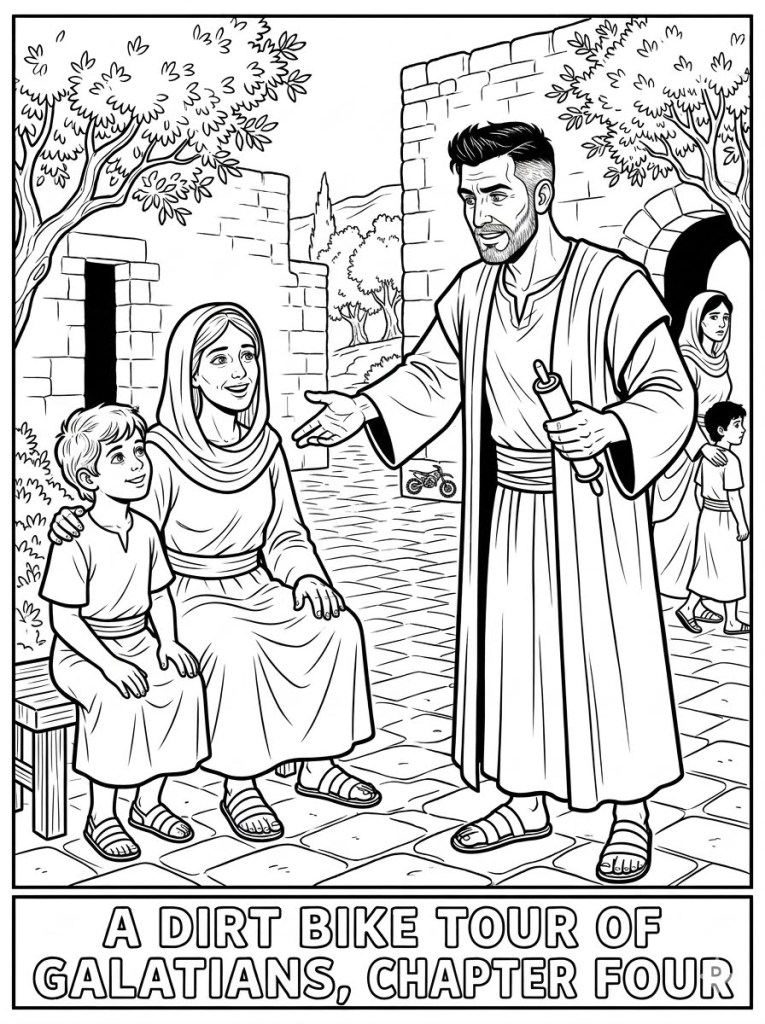
Sitting on a low stool at the back of the courtyard, completely surrounded by coarse goat-hair fabric, heavy leather cutting tools, and iron awls, was a small, wire-framed man with sharp, intense dark eyes. His hands were calloused, deeply lined, and stained with the dark, pungent oils used to treat heavy Mediterranean hides. Yet when he looked up, his gaze carried a profound intellectual and spiritual weight that made the bustling room feel instantly smaller.
“Paul,” Barnabas called out gently, crossing the courtyard. “We have guests who carry the mark of The Way. They appear from distant lands, yet they seek the truth.”
Paul stood up, wiping his ink-and-oil-stained hands on a coarse linen rag. He looked at Daddy Swank’s muscular build, his striking blue eyes, and the mechanical tools peeking out of his cargo pouch. “A builder? A fellow craftsman?” Paul asked, a faint, genuine smile touching his lips.
“Mechanical technician,” Daddy Swank replied, stepping forward and shaking Paul’s calloused hand with a firm, respectful grip. “I fix things that break. And right now, my kids and I are trying to understand how this whole timeline holds together. We know your letters, Paul. We’ve read them in the future.”
Paul’s eyes sharpened with sudden, intense curiosity. He gestured toward three overturned wooden crates, inviting them to sit among the piles of unrolled black goat-hair cloth.
“You work with your hands to sustain your life, just as I do,” Paul said, looking at Daddy Swank’s tool pouch with deep mutual respect.
Cash leaned forward, his amazing blue eyes tracking the heavy iron needles scattered across the workbench. “Mr. Paul, if you’re a brilliant scholar and an apostle chosen by God, why are you making tents? Shouldn’t the churches just pay you so you can preach full-time?”
Paul let out a soft, patient laugh, running a calloused hand over a freshly cut strip of coarse leather. “It is a fair question, young man. In our culture, a student of the Law is expected to learn a practical trade so he never burdens the community. I learned the craft of weaving and stitching heavy Cilician goat-hair cloth—what we call cilicium—back in my hometown of Tarsus. It is brutal, exhausting work, but I have made a deliberate decision to support myself financially on all my missions.”
He paused, his intense gaze shifting to Daddy Swank, his face hardening with the sheer weight of the spiritual burden he carried.
“I choose to work for two vital reasons,” Paul explained, his voice low and resolute. “First, the pagan world is full of traveling philosophers and deceptive street preachers who preach only to swindle money from the crowds. They demand high wages for their so-called wisdom. If I took money from the people I preach to, my enemies would immediately claim that I am just a greedy merchant hawking a new god for personal profit. By working with my own hands, cutting hides and sewing tents until my fingers bleed, I silence their slander. I prove that the Gospel is a completely free gift. No one can ever accuse me of selling the grace of God.”
“And what’s the second reason, Paul?” Madison asked, her stunning blue eyes reflecting the flickering light of the workshop’s oil lamp.
“The second reason is the heavy burden of setting an example,” Paul said, pointing an ink-stained finger at the courtyard where the believers gathered. “Many of our new converts are poor laborers and slaves. If I, an apostle, sat around demanding to be fed and housed without contributing anything to the workshop, I would be setting a trap of laziness. I tell the churches that if a man will not work, he shall not eat. Therefore, I must model that discipline myself. I labor night and day so that I am never a financial burden to a single soul. My true reward is not coin or comfort—it is the unchecked freedom to preach Christ without a hint of greed hanging over my head.”
Daddy Swank nodded in deep, profound agreement, his strong jaw tightening. “That’s standard-setting integrity right there. If you’re building a network that’s meant to survive thousands of years, the founder can’t have any hidden leaks or conflicts of interest in his own operating costs. By paying your own way, Paul, you keep your motives completely clean and unshakeable. That’s exactly why nobody in our century can ever look back at your history and claim you did it for the money.”
Paul smiled, a spark of fierce joy in his dark eyes as he picked up his heavy iron awl. “Exactly. The worker is worthy of his wages, but I gladly surrender my rights so that the cross of Christ is never hindered by human suspicion.”
Chapter 5: The Report from Galatia
As they sat around a low wooden table eating green olives, dried figs, and coarse flatbread, the peaceful atmosphere of the tentmaker’s workshop was cut short. The heavy cedar door rattled on its hinges, and a young man named Timothy burst into the courtyard. His face was flushed, his sandals were cracked from leagues of rough mountain travel, and his linen tunic was completely soaked with the dust and sweat of the highway. He dropped a heavy, weathered leather bag onto the table with a dull thud.
“The news from the churches in Iconium, Derbe, and Lystra is deeply troubling, Paul,” Timothy said breathlessly, leaning over the table to catch his breath. “The reports are worse than we feared. The assemblies are fracturing.”
Cash looked at the young traveler, noticing how deeply he respected Paul, standing by like an assistant but speaking with the worry of a true son. “Maddy,” Cash whispered, his spiky strawberry blond hair tilting to the side. “Who is Timothy? He looks pretty young to be traveling across entire countries.”
Madison quickly glanced at her ancient book, which was already updating its historical pages with vibrant details. “Timothy is from Lystra, Cash,” she whispered back, her stunning blue eyes scanning the script. “His mother, Eunice, and his grandmother, Lois, are devout Jewish believers who taught him the Scriptures from the time he was a little boy, but his father was a Greek. When Paul visited Lystra on his first missionary journey, he saw Timothy’s incredible faith and his excellent reputation among the local believers. Paul basically adopted him as his spiritual son and protégé. Timothy left his home to follow Paul into the ministry because he saw the undeniable power of the Gospel firsthand.”
“And that’s exactly why this Galatian situation is tearing both of them apart,” Daddy Swank added, his striking blue eyes focused intensely on Timothy’s map. “Timothy represents the exact bridge between Jew and Gentile that these legalists are trying to blow up.”
Timothy nodded anxiously, confirming Daddy Swank’s analysis as he unrolled a worn piece of parchment. “Paul, the legalistic teachers who came down from Judea are targeting our exact footsteps. In Iconium, where we narrowly escaped a stoning, they are telling our Gentile converts that their faith is completely invalid. In Derbe and Lystra—the very place where the crowds once tried to worship you as a god and then dragged you out of the city to die—these false teachers are preying on the young believers. They are explicitly claiming that unless these Greek and Roman Christians undergo circumcision and pledge complete obedience to the traditional ritual Law of Moses, they are entirely excluded from the covenant of God.”
Paul’s hand slammed down onto the wooden table, making the clay water jars rattle. His eyes flashed with a righteous, burning anger that made his small frame look towering.
“Are they so quickly deserting the one who called them by the grace of Christ?” Paul’s voice boomed through the small workshop. “This is not a minor disagreement over tradition, Timothy! If these young churches give in, they are trading the ultimate victory of the cross for a system of human performance. To tell a Gentile believer that Christ’s sacrifice isn’t enough to save them on its own is to preach a completely false gospel—a counterfeit that strips the church of its spiritual power!”
Timothy looked at Paul with absolute loyalty, his own fears vanishing in the presence of Paul’s unshakeable conviction. Madison watched in absolute awe, holding her book tight against her chest. She realized she wasn’t just reading history; she was standing in the exact engine room where the foundational truth of Christian liberty was being fought for and preserved for all generations to come.

Chapter 6: An Evening Conversation on Truth
Later that evening, after the oppressive heat of the Syrian day had vanished, the Swank family retreated to a quiet corner of the courtyard roof. The ancient city of Antioch stretched out beneath them, an sprawling expanse of stone flat-roofs and Roman columns lit by thousands of tiny, flickering clay oil lamps. Cash sat on a limestone ledge, his amazing blue eyes tracking the slow movement of the constellations, while Madison carefully traced the edges of her book.
“Dad,” Cash said quietly, his spiky strawberry blond hair catching the faint amber glow of a distant street torch. “Seeing Paul and Timothy get that worried… it makes you realize how real this all is. But what Timothy said about his dad being a Greek and his mom being Jewish—that must make him feel caught right in the middle of this entire fight.”
Daddy Swank sat down next to his son, his strong jaw setting as he leaned back against the stone parapet. He stretched out his legs, his scuffed brown workboots clicking softly together, his socks pulled up tight against his calves.
“You hit the nail on the head, Cash,” Daddy Swank said, his striking blue eyes reflecting the faint starlight. “Timothy is the ultimate living example of what the Gospel is trying to build, and he’s also the exact target of what the legalists want to tear down. Because his mom was Jewish, Timothy grew up learning the Old Testament scriptures. But because his dad was a Greek, he was never circumcised as a baby. To the legalists from Judea, Timothy is a walking violation of their rules—an outsider who isn’t ‘pure.’ But to Paul, Timothy is a son. He proves that God doesn’t care about a perfect genetic pedigree or matching cultural rituals anymore. The cross leveled the playing field.”
Madison shifted her heavy book in her lap, her long blonde hair falling down to her waist as she turned a page. “It’s amazing because Timothy’s unique background actually proves how authentic the New Testament records are. Think about it: if someone was making up a fake story about perfect Christian heroes, they wouldn’t choose a mixed-heritage kid who fell into a massive religious gray area to be Paul’s right-hand man. They’d make up characters who fit perfectly into neat little boxes.”
She looked up at Cash, her stunning blue eyes bright with conviction. “And that brings up what you asked earlier, Cash—about how we know the Bible is absolutely true. For hundreds of years, some of the smartest people in the world have tried to prove the Bible wrong, and every single one of them has failed.”
“Like who?” Cash asked, leaning forward on his knees. “Give me some examples.”
“Well, take a famous writer from the 19th century named Sir William Mitchell Ramsay,” Madison said, pointing to a historical footnote actively writing itself in her book. “He was a brilliant, wealthy scholar who went to Asia Minor—the exact place where Timothy is from—with the explicit goal of proving that the Book of Acts was a complete fairy tale written hundreds of years after the apostles died. He figured that if he mapped out Paul’s journeys, he’d find massive historical errors.”
“Did he find any?” Cash asked.
“The exact opposite happened,” Madison smiled. “Ramsay spent years digging up ancient ruins, reading Roman border stones, and tracking ancient roads. He discovered that the author of Acts got every single obscure geographical detail, political title, and local custom 100% correct. He was so overwhelmed by the sheer, undeniable evidence that he actually converted to Christianity and wrote books defending the absolute accuracy of Luke’s writings.”
“And it’s not just him,” Daddy Swank added, his voice low and confident. “Think about the famous French skeptic Voltaire back in the 1700s. He famously boasted that within one hundred years of his death, Christianity would be swept from existence and the Bible would be forgotten by history, replaced by human reason.”
Cash grinned. “I’m guessing that didn’t happen.”
“Not even close,” Daddy Swank chuckled. “Not only did the Bible continue to spread across the globe, but ironically, just decades after Voltaire died, the Geneva Bible Society actually purchased his old house and used his very printing presses to print and distribute thousands of copies of the Holy Scriptures. You see, Cash, human philosophies and critics come and go like the morning mist. People try to break the Bible, but the Bible ends up breaking them against the anvil of historical facts. It has survived empires, book-burnings, and brilliant critics, and it still stands completely undefeated.”
Madison tapped the glowing parchment of her time-traveling volume. “The Bible has never been proven wrong about a single historical fact, Cash. When Paul writes about freedom, and when Timothy leaves his family to follow him into danger, they aren’t dying for a myth. They are standing on a historical foundation that is as solid as the stone beneath our feet.”
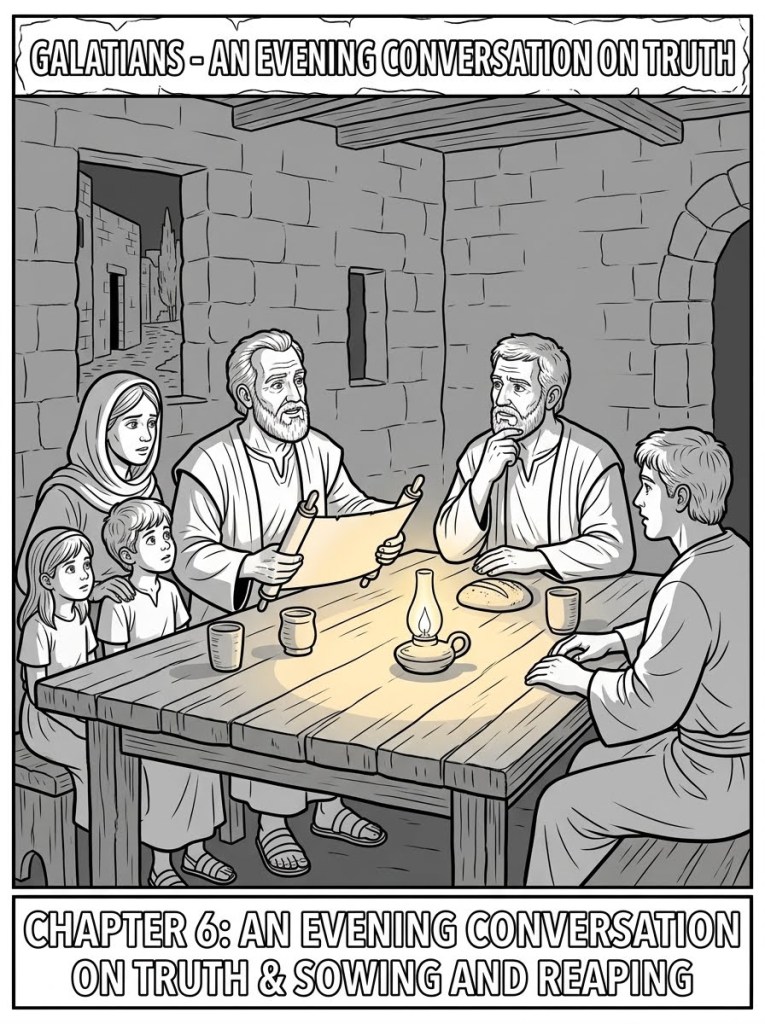
Chapter 7: The Reliability of the Letters
The peace of the rooftop vanished the next morning as a chilling, rigid atmosphere descended upon the courtyard. A formal delegation of men arrived from Jerusalem, claiming to represent James. They wore heavy, immaculate legalistic garments, their fringes precisely measured according to tradition. They looked upon the Greek and Roman converts with an icy, public disdain that instantly froze the laughter in the air.
“It is entirely unlawful to eat with the uncircumcised!” the leader of the Jerusalem faction declared, his booming voice echoing off the stone walls. “You are corrupting the holiness of the covenant!”
As the courtyard erupted into a chaotic sea of raised voices and worried whispers, the Swank family retreated to a quiet alcove near the tentmaker’s workshop. Cash watched the unfolding argument, his amazing blue eyes narrowed with deep frustration.
“Dad,” Cash said, running a hand through his spiky strawberry blond hair. “Those guys from Jerusalem talk like they own the history of the world. They think they can just rewrite the rules because they came from the main church.”
Daddy Swank sat down on an overturned packing crate, his scuffed brown workboots kicking up a tiny puff of ancient dust. He leaned forward, resting his elbows on his cargo shorts, his striking blue eyes focused intensely on his children.
“They can try to control it, Cash, but God built a preservation system into the Bible that makes human manipulation completely impossible,” Daddy Swank said, his voice low and steady. “Think about the sheer logistics of how the New Testament is unfolding right now. Paul is writing letters here in Antioch. Peter is preaching. Soon, these words will be copied onto papyrus and parchment and sent like wildfire across the civilized world.”
Madison sat beside her father, her long blonde hair falling to her waist as she adjusted the heavy time-traveling volume in her lap. “Dad is right, Cash. In our century, archaeologists have dug up thousands of ancient manuscript pieces found all over Egypt, Syria, and Greece. We have over 5,800 ancient Greek manuscripts of the New Testament alone, and when you add other early translations like Latin and Syriac, there are over 25,000 copies!”
“Why does having so many copies matter?” Cash asked.
“Because it makes fabrication completely impossible,” Daddy Swank explained, gesturing with his calloused hand. “Imagine if an engine manufacturer sent out one single instruction manual to one factory, and a corrupt manager changed a line of text to suit his needs. Nobody would know. But if that manufacturer broadcasts tens of thousands of identical blueprints to thousands of factories all over Egypt, Greece, and Rome simultaneously, no single person can ever change the design. If a corrupt manager in Rome tries to alter a verse to gain power, his copy will instantly clash with the thousands of copies sitting in Egypt and Syria. The sheer, massive web of geographic distribution acts like a global security network. The text protects itself.”
Madison tapped the parchment of her book, her stunning blue eyes bright with awe. “And think about how the Bible is actually constructed, Cash. It’s an intricate web of sixty-six books, written by forty different authors over fifteen hundred years across three continents. They write about the most controversial topics in human history—politics, religion, morality, and God—yet every single thread connects back perfectly to a single point: Jesus Christ. It is statistically and psychologically impossible for human beings to fabricate a conspiracy that spans fifteen centuries without a single contradiction. If it were a human invention, the whole thing would have collapsed under its own weight long ago.”
“It’s so reliable,” Daddy Swank smiled, “that even non-Christian historians and modern secular scientists have to respect it. Today, secular experts actively use the Bible as a literal map for modern-day archaeology. They don’t even have to believe the theological message to know that the historical geography is completely flawless. When the Bible says a city wall, a specific water tunnel, or a king’s palace was in a certain spot, archaeologists dig right there and find it every single time. It has a track record that has never been proven wrong.”
Paul walked past their alcove, carrying a fresh bundle of writing parchment, his jaw set with a fierce determination to keep that flawless blueprint pure. Cash watched him go, finally understanding that the battle in the courtyard wasn’t just a local argument—it was a test of a historical record that would outlast the Roman Empire itself.
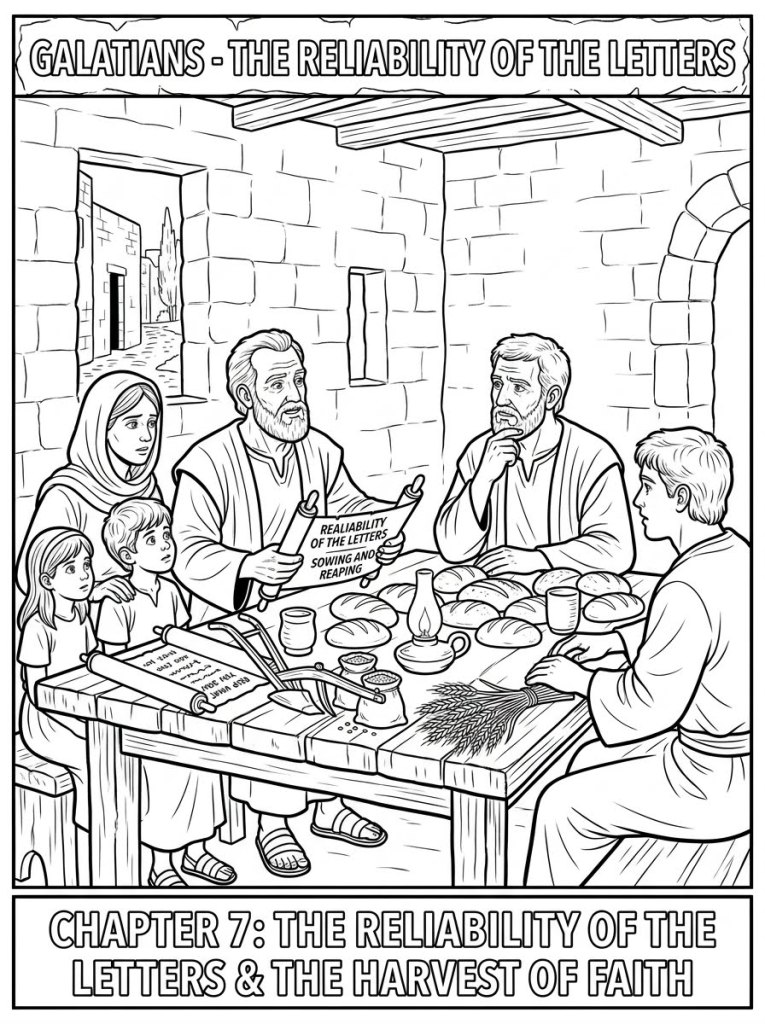
Chapter 8: The Arrival of the Rock
The intellectual peace of the rooftop conversation was shattered the next morning by a massive, joyful commotion at the main gates of Antioch. Word spread like wildfire through the bustling local markets that Simon Peter—Cephas, the leading apostle who had walked on the stormy Sea of Galilee with Jesus—had officially arrived in the city.
“Maddy, where is Peter coming from?” Cash asked, his amazing blue eyes widening as he craned his neck over the stone balcony. He ran a hand through his spiky strawberry blond hair, trying to catch a glimpse of the legendary fisherman.
Madison quickly flipped through her ancient volume, her stunning blue eyes scanning the fresh historical annotations. “He’s arriving directly from Jerusalem, Cash. After the intense persecution there, and after his miraculous escape from Herod’s prison, Peter has been traveling to strengthen the different church hubs. He came up through the coastal regions straight to Antioch to see how the Gentile mission was expanding.”
Cash and Madison hurried down into the crowded courtyard to watch his entry. Peter was an imposing, broad-shouldered man, heavily weathered by decades of brutal, physical labor as a Galilean fisherman. He had a thick chest, calloused hands, and a booming, joyous laugh that seemed to fill the entire square. When he entered the gates, he immediately spotted Paul and Barnabas, rushing forward to embrace both men in massive, emotional bear hugs.
“Welcome to Antioch, Simon!” Barnabas roared, his exceptionally kind face beaming with relief.
That very evening, a magnificent welcome feast was held in the central stone hall. Peter sat directly on the packed earthen floor, completely ignoring the rigid, traditional rules of Jewish ceremonial separation. He sat elbow-to-elbow with Greek, Roman, and Syrian converts, laughing heartily, dipping his bread into the same communal bowls, and embracing them as absolute equals in the family of God.
As they ate dinner together that evening, the conversation around the table turned deep, rich, and historically profound. With Cash, Madison, and Daddy Swank listening intently from the edge of the pavilion, Paul, Barnabas, and Peter began recounting the undeniable, physical facts of the Gospel’s journey so far.
“We were just telling the children about your vision in Joppa, Simon,” Barnabas said, passing a bowl of green olives down the table. “About how the Lord shattered the old boundaries before you went to the house of Cornelius.”
Peter nodded, his face turning solemn but filled with a deep, reverent awe. “Ah, the sheet lowered from heaven,” Peter said, his deep voice silencing the immediate tables. “I was blind, brothers. My whole life, my culture told me that to touch a Gentile was to be defiled. But when the Holy Spirit fell upon Cornelius and his household—before they ever practiced a single Jewish ritual—I saw with my own eyes that God makes no distinction. He cleanses the heart by faith alone. How can I call unclean what the Almighty has declared pure?”
Paul leaned forward, his sharp, intense dark eyes reflecting the warm amber glow of the oil lamps. He looked at Peter with immense respect, but also with a quiet, watchful gravity.
“That is the exact blueprint we are fighting for in Galatia, Simon,” Paul said, his voice low and firm. “Barnabas and I saw the exact same Spirit move through the mountains of Pisidian Antioch and Lystra. The Greek believers there received the message with pure joy. They didn’t need to become citizens of Judea to become citizens of heaven. The historical records of what Jesus did on the cross completely paid the debt for every nation under heaven.”
“Amen, Paul,” Peter boomed, tearing off a piece of coarse flatbread and handing it directly to a young Greek believer sitting right next to him. “The Law was a heavy yoke that neither our fathers nor we were able to bear. Why should we ever try to place it on the necks of these disciples? Christ has made us free.”
Daddy Swank stood just a few feet away, his strong jaw setting as he took in the scene. He looked at his kids, his striking blue eyes reflecting a mix of admiration and careful thought. “Listen to them talk, kids,” Daddy Swank whispered, adjusting his heavy leather tool belt. “They are laying down the exact eyewitness testimony that forms the foundation of our New Testament. They are verifying the historical facts to each other, face-to-face, over a common meal. There’s no myth here—just real men who saw a real resurrection, establishing a culture of absolute equality.”
Madison smiled, watching Peter laugh as he shared his dinner with the Gentile converts. It was a beautiful picture of perfect Christian freedom—making the devastating betrayal that was coming just days later all the more heartbreaking to foresee.
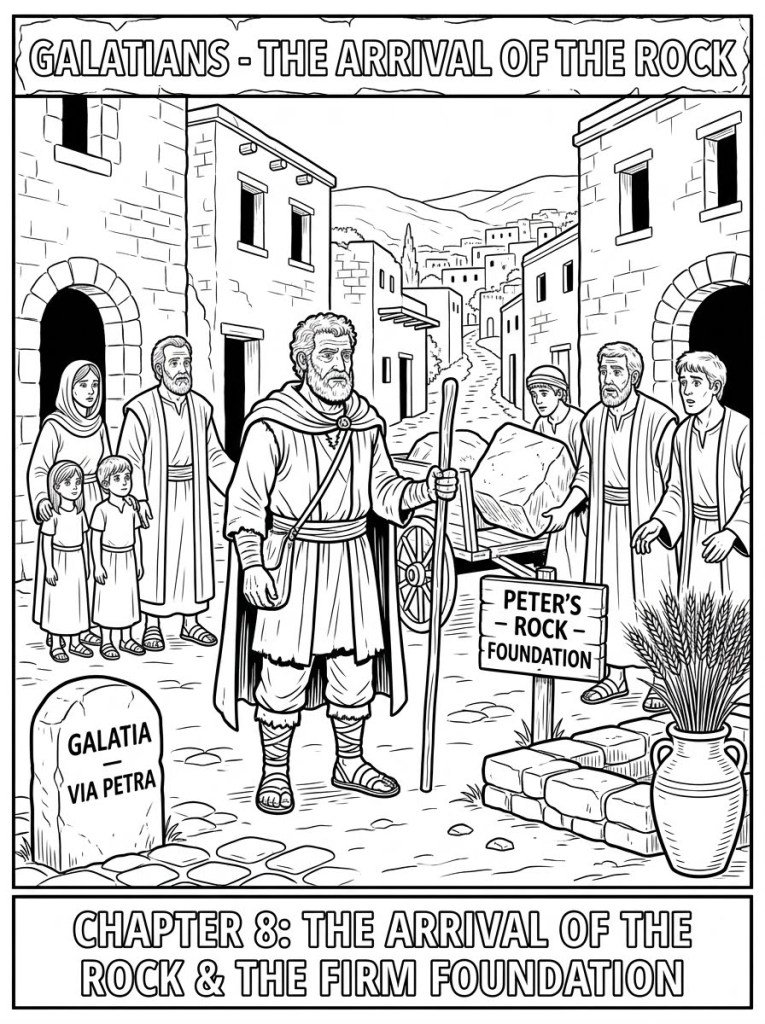
Chapter 9: The Men from James
The beautiful, cross-cultural unity of the Antioch church was violently fractured a few days later by a sudden arrival at the city gates. A strict, ultraconservative delegation of Jewish believers entered the courtyard. They claimed to speak with the direct authority of James, the brother of Jesus and the primary leader of the mother church back in Jerusalem.
“Maddy, who exactly are these guys?” Cash whispered, his amazing blue eyes locked onto the newcomers as he nervously ran a hand through his spiky strawberry blond hair. “They look like they’re ready to start a trial.”
Madison quickly opened her ancient time-traveling volume, her stunning blue eyes scanning the margins as fresh, historical commentary rapidly inked itself onto the parchment.
“They’re known historically as the Circumcision Faction, Cash,” Madison explained in a hushed, urgent tone. “This faction started shortly after the gospel began spreading outside Jerusalem. When Jewish legalists saw that Romans and Greeks were coming to faith in Christ, they panicked. They believed that because Jesus was the Jewish Messiah, anyone who followed Him had to fully convert to traditional Judaism first. They traveled all the way here to Antioch specifically to spy on the church and enforce their legalistic rules.”
The arrival of these visitors instantly sparked an intense, unfolding controversy right in the middle of the public courtyard. The men from James openly criticized the way the church was operating, demanding to know why Jewish believers were eating meals at the same table as uncircumcised Gentiles. They argued fiercely that according to the ancestral laws of Leviticus, such close fellowship with non-Jews made the Jewish Christians ceremonially unclean.
To Cash and Madison’s absolute horror, the social pressure from this rigid delegation triggered a massive compromise. Fearing the fierce disapproval, political backlash, and potential rumors that would be carried back to Jerusalem, Simon Peter quietly stood up from the Gentile table. He moved his plate to sit exclusively with the strict Judean elite.
“Look at that,” Cash said, his voice laced with shock and disappointment. “Even Barnabas is walking away from the Greek believers now. Everyone is splitting up into groups.”
“This is the big turning point, Cash,” Madison whispered, her heart aching as she watched the courtyard divide. “This meeting just turned into a massive battlefield over the true meaning of Christian freedom.”
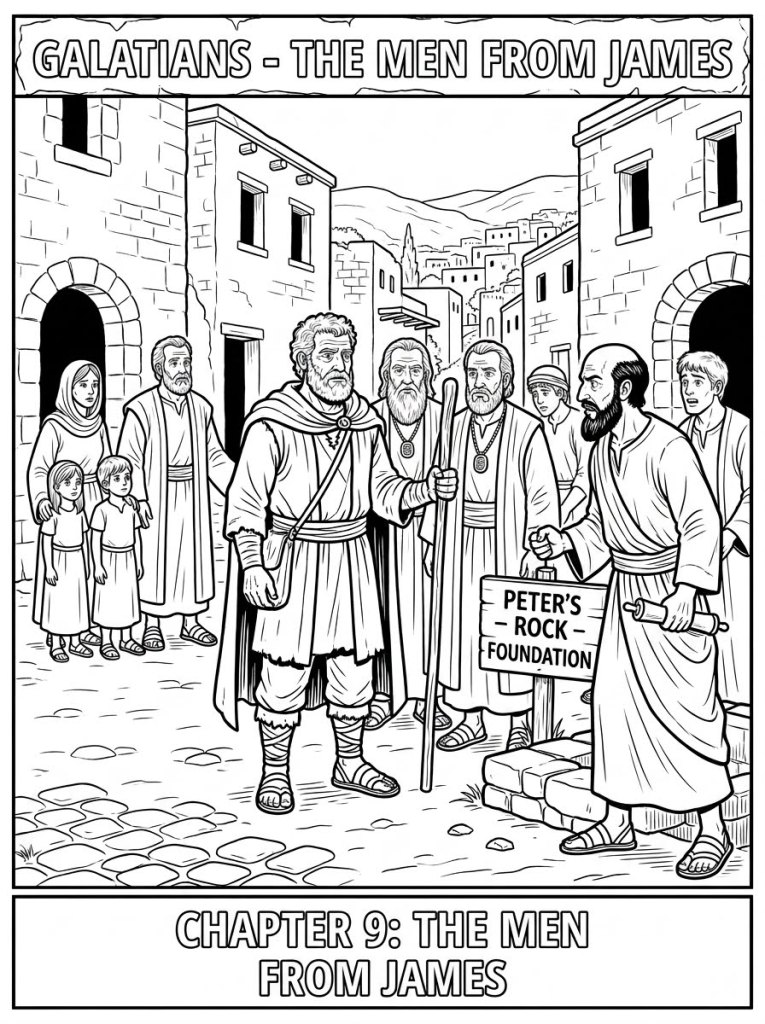
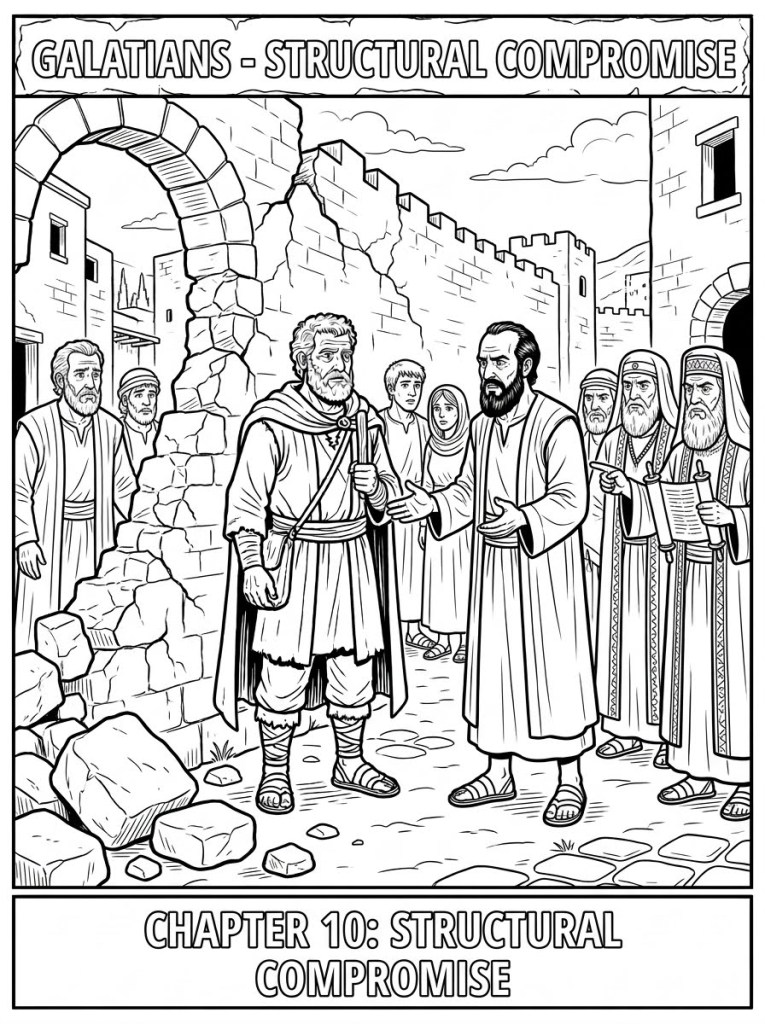
Chapter 10: Structural Compromise
Daddy Swank stood by the covered dirtbike, his jaw tight and his blue eyes blazing with a mixture of disappointment and intense analytical focus as he watched the unfolding social segregation.
“It’s a catastrophic structural failure, kids,” Daddy Swank said, his voice low and firm. “If you add human performance, race, or rituals to a blueprint of pure grace, the entire mechanism fails. Peter is compromising the core foundation of the faith out of fear of what a few strict people think.”
“It makes me sick,” Madison said, her long blonde hair shielding her face as she looked down at the isolated Gentile converts. “They look so confused, like they aren’t good enough for God anymore just because of where they were born.”
“That’s exactly why the Bible is so brutally honest, Maddy,” Daddy Swank explained, turning to her. “Think about it. If the Bible was just a manufactured myth made up by the church to make their leaders look good, they would have edited this fight out. They would never show Peter, their top apostle, messing up this badly. The fact that the Bible records the flaws of its greatest heroes proves it’s telling the absolute truth.”
Cash leaned against the brick wall, watching a group of legalists whisper to one another across the courtyard. “But Dad, if God wanted everything to be perfectly clear, why did He design the Bible the way He did? Why have it written by forty different people over fifteen hundred years instead of just handing down one perfect, magic book from the sky all at once?”
Daddy Swank knelt down next to Cash, his scuffed workboots squeaking against the dry dirt. “Think about how we test a mechanical design, Cash. If one single engineer builds a machine in a closed room, you only have one guy’s word that it works. But God did something infinitely more brilliant. He chose kings, prophets, fishermen, and scholars—separated by thousands of miles and centuries of history—to write down His message piece by piece. Yet, when you put all sixty-six books together, they tell one single, flawless, unbroken story pointing directly to Jesus. No human committee could ever coordinate a conspiracy over fifteen hundred years. The long timeline and the massive variety of writers is God’s ultimate proof that a single, divine Author was directing the blueprint the whole time. It’s a design that cannot be disproven by history.”
Madison looked down at her glowing time-traveling volume, her thumb tracing the edges of the parchment. “And the center of that entire blueprint is grace, isn’t it, Dad? Everything changed the moment Christ died on that cross.”
“Exactly, Maddy,” Daddy Swank said, his striking blue eyes softening with deep reverence. “Before the cross, the Law was like a mirror showing humanity its flaws, but it could never fix the engine. Christ’s death paid the ultimate debt once and for all. Grace means that our standing with God is a 100% free gift, fully paid for. There are no more hoops to jump through, no cultural rituals required, and no second-class citizens. To try and earn God’s favor by our own works now is like trying to pay a debt that has already been erased with infinite riches.”
He gestured out toward the fractured courtyard, his face growing serious again. “That’s why this new, legalistic culture arising so quickly after Christ’s death was such a lethal threat to the early church. If Peter and the legalists won this argument, they would have successfully re-shackled the entire world. They would have turned a global message of unconditional love and freedom right back into an exclusive, performance-based club. It would have suffocated the church in its infancy. Paul isn’t just fighting a minor social disagreement here, kids—he’s fighting to protect the literal lifeline of human history.”
Chapter 11: The Confrontation at Antioch
The tension reached its absolute boiling point during the evening love feast. The large stone hall was packed with hundreds of believers, the air heavy with an uncomfortable, thick silence that choked the room far more than the smoke from the oil lamps.
Paul stood quietly under the shadow of the courtyard colonnade, his sharp, dark eyes fixed entirely on Peter. He watched as Peter adjusted his posture, straightening his spine and shifting his weight with a rigid formality that Paul recognized all too well. It was a physical demeanor that reminded Paul instantly of the proud, exclusionary legalism of the Pharisees—a past that both men had supposedly left behind. Peter was speaking in low, guarded tones, using formal Hebrew idioms instead of the common Greek he had been using all week, carefully nodding along with the strict Judean visitors.
“Look at the room, kids,” Daddy Swank whispered, his striking blue eyes narrowing as he analyzed the space like a structural engineer diagnosing a shifting foundation. “The whole hall is fracturing right down the center.”
The division of the people in the room had happened with terrifying ease, dictated by a deeply entrenched culture that had separated Jew and Gentile for fifteen hundred years. The ancient world was built on these strict boundaries; Roman laws, Greek pride, and Jewish ceremonial purity regulations made it incredibly easy for people to retreat back into their safe, familiar cultural silos the moment social pressure was applied. The Judean legalists sat proudly at an elevated head table, their immaculate garments looking, well, very immaculate, thought Cash with a smile, while Peter and Barnabas sat uncomfortably beside them. Decades of cultural conditioning had reasserted themselves in a matter of days, pushing the Greek and Roman converts outward until they sat isolated, rejected, and confused at the very back of the room.
Paul walked straight out from the shadows into the center of the hall, standing directly opposite Peter. The entire room fell dead silent.
“Peter!” Paul’s voice rang out like a hammer striking an iron anvil, cracking through the social tension. “If you, though a Jew, live like a Gentile and not like a Jew, how can you force the Gentiles to live like Jews?”
Peter flinched, his weathered fisherman’s face turning a deep crimson. But Paul did not stop there. He stepped closer, his voice carrying the immense weight of the historical facts they had both witnessed.
“Have you forgotten the words of the Master so soon, Peter?” Paul asked, his voice vibrating with a mix of grief and righteous fury. “Have you forgotten what happened in Matthew eighteen, when the disciples came to Jesus and asked, ‘Who is the greatest in the Kingdom of Heaven?’ Have you forgotten how He called a little child over, stood that child right in the middle of them, and said that unless we humble ourselves like children, we will never even enter the Kingdom?”
Madison held her breath, gripping Cash’s shoulder as she watched the profound conviction hit Peter’s face.
“You were there, Peter!” Paul pressed on, refusing to back down in front of the legalists. “You heard Him say that whoever humbles himself is the greatest. Yet here you sit, elevated at the head table, allowing these men to make our Greek brothers feel like second-class citizens! You are acting as if righteousness is earned by a cultural pedigree. We know that a person is not justified by works of the law, but by faith! If righteousness could be gained through legalistic pride and cultural divisions, then Christ died for absolutely nothing!”
Chapter 12: The Victory of Grace
The words hung in the air like heavy iron weights. Peter sat completely still on his bench, his weathered face flushing a deep crimson as the absolute, piercing truth of Paul’s words cut straight through his political fear. The legalists from Jerusalem muttered angrily, but Peter raised his large, scarred fisherman’s hand, silencing them instantly.
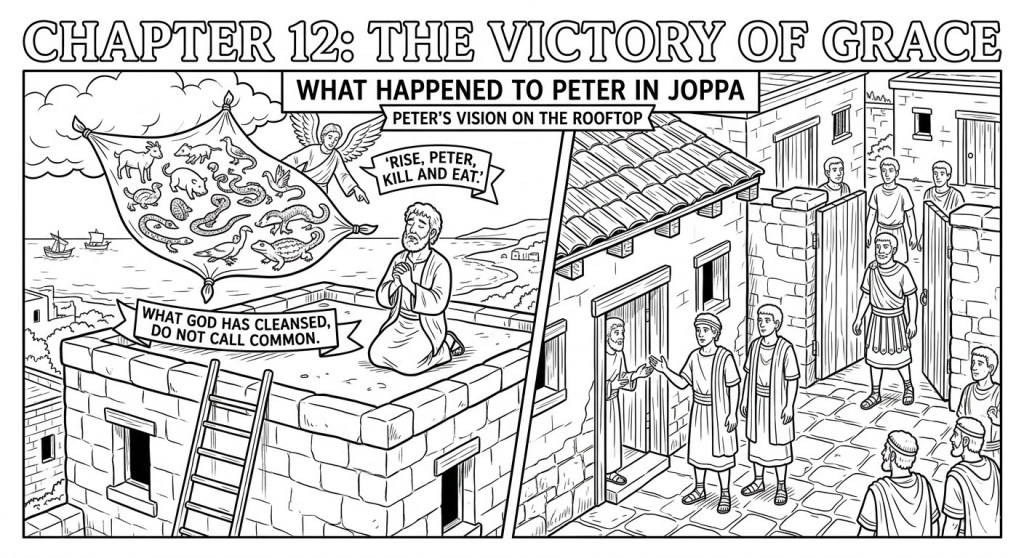
He looked at Paul, then looked back at the Greek believers sitting in the dark back rows. The heavy silence stretched across the stone hall, broken only by the crackle of the oil lamps. In that quiet space, Peter’s mind raced backward to a rooftop in Joppa, a coastal town where this entire internal battle had first truly begun years earlier.
“He’s remembering, kids,” Daddy Swank whispered softly, his striking blue eyes locking onto the shifting expressions on Peter’s face. He leaned down toward Cash and Madison. “Look at his hands. He’s wrestling with his own history.”
“What happened in Joppa, Dad?” Cash asked quietly, his spiky strawberry blonde hair catching the amber glow of a nearby torch.
Madison shifted her heavy book in her lap, her stunning blue eyes scanning the blank margins where historical footnotes were actively appearing in real-time. “It was at the house of Simon the Tanner,” she explained, her voice a hushed whisper so as not to disturb the heavy atmosphere of the room. “Peter went up on the roof to pray while lunch was being fixed. He fell into a trance and saw heaven open up. This massive object, like a huge linen sheet held by its four corners, was lowered down to earth.”
“And what was inside it?” Cash asked.
“Every kind of animal, reptile, and bird that the traditional Jewish law called unclean,” Madison whispered, pointing to the glowing text in her book. “A voice from heaven told him, ‘Get up, Peter. Kill and eat.’ But Peter refused. He said he had never eaten anything common or unclean in his entire life. The voice answered him three times: ‘Do not call anything unclean that God has made clean.’ Right after that vision, Roman soldiers arrived from a Gentile centurion named Cornelius, asking Peter to come preach to them. That’s when Peter realized the vision wasn’t about food at all—it was about people. God was telling him that the Gospel belonged to the Gentiles, too, without them needing to become Jews first.”
Cash watched Peter intently. “If he had that amazing vision, and if he literally walked on water with Jesus, why is he still making mistakes? Why did Paul have to yell at him to remind him?”
Daddy Swank placed a large, reassuring hand on Cash’s shoulder. “Because learning a lesson from God isn’t a one-time mechanical fix, son. It’s a lifelong process. Think about it: Peter spent his entire childhood, decades of his life, being conditioned by strict cultural and religious rules. Even after his experience with Jesus, after seeing the resurrection, and after the vision in Joppa, human nature still fights back. It took years of traveling, preaching, and confronting his own deep-seated fears for the truth to fully sink in. When the pressure got high and those strict legalists from Jerusalem showed up, Peter defaulted back to his old habits out of fear of rejection. It shows us that even the greatest heroes of the Bible had to continuously learn and re-learn the historical facts of what Jesus actually accomplished on the cross.”
“It takes time for our hearts to catch up to what our eyes have seen,” Madison added thoughtfully. “The Bible doesn’t hide how long it took Peter to truly understand. It took years of trial and error, and it required a friend like Paul to have the courage to look him in the eye and say, ‘Remember what is true.’”
Peter let out a long, heavy sigh that seemed to carry the weight of his entire journey—from the shores of Galilee to the rooftop in Joppa, right to this tense room in Antioch. The memory of his vision, paired with the undeniable historical reality of his years spent with Jesus, smashed through his temporary lapse in courage. He recognized that Paul’s public rebuke was a necessary calibration to keep the church’s structural integrity intact.
“You are right, brother,” Peter said softly, his booming voice breaking with genuine humility.
He stood up from the elite table, turned his back entirely on the legalists from Jerusalem, and walked straight down the center aisle to the back of the room. He sat down squarely on the dirt floor next to a young Greek slave, broke a piece of common bread, and shared it with him. The wall of division had been permanently shattered, cemented by a lesson years in the making.
Chapter 13: Writing the Eternal Word
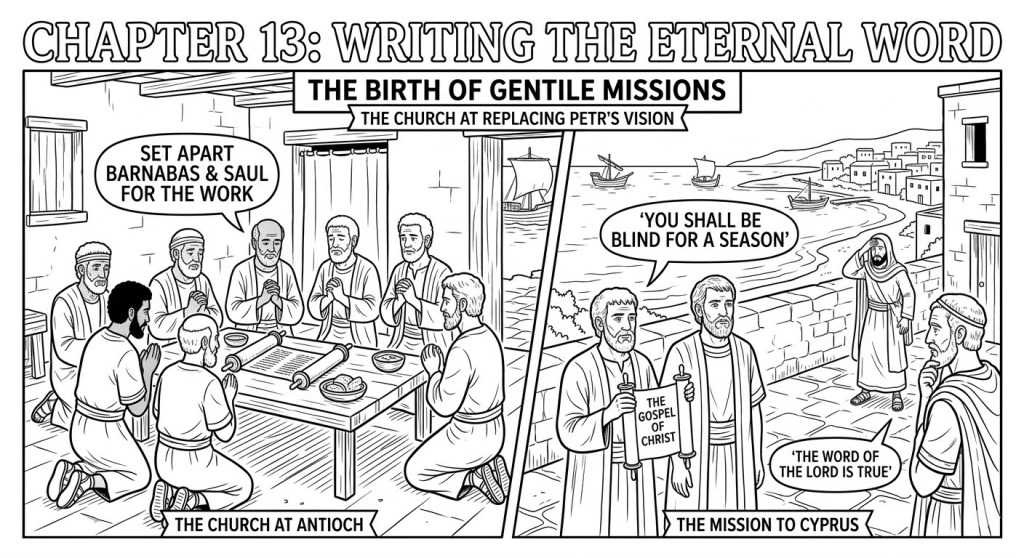
With the intense conflict in Antioch beautifully resolved, a quiet gravity settled over the workshop. The morning sun crept through the wooden lattices, casting sharp patterns of light and shadow across the floor. Paul sat down at his low wooden table, his face a mask of intense concentration. His calloused, ink-stained hands smoothed out a fresh sheet of heavy papyrus. He dipped his reed pen into the dark ink, his movements deliberate, driven by a fierce urgency to protect the young assemblies in Galatia before the legalists could poison their faith completely.
Madison sat nearby on a rolled-up bale of goat hair, her long blonde hair falling past her waist as she held her ancient time-traveling volume open. Beside her, Cash leaned his chin in his hands, his spiky strawberry blonde hair catching the morning light, while Daddy Swank stood near the doorway, keeping a watchful eye on the alley outside.
“Maddy, look at the text,” Cash whispered, pointing his amazing blue eyes toward the parchment in Madison’s lap.
The ancient book was actively mirroring Paul’s Greek script in real-time, translating the bold strokes into English. But as Madison read the opening lines, her stunning blue eyes widened in surprise. She leaned closer, her brow furrowing.
“Dad, this is completely different,” Madison said, her voice filled with analytical wonder. “I’ve read Paul’s other letters in youth group, but the tone he’s taking right here is completely unique. He doesn’t start with his usual greetings or compliments. He doesn’t praise their faith or thank God for them. He goes straight into a rebuke.”
“Why’s that, Maddy?” Cash asked, shifting closer.
“Because right now, Paul is writing in absolute, unrestricted freedom,” Madison explained, her fingers tracing the sharp, urgent lines of text. “He is writing from a place of liberty here in Antioch, fiercely defending the freedom of the Gospel. He’s angry that anyone would try to put chains back on people who have been set free by Christ. He writes with this intense, raw energy: ‘I am astonished that you are so quickly deserting the one who called you!’ It’s a fiery defense of liberty.”
Madison’s expression grew solemn as a sudden, shifting shadow passed over the pages of her time-traveling book. The parchment vibrated slightly, and a faint, spectral image of iron bars and damp stone walls briefly superimposed itself over the text before vanishing.
“But look at what the book is foreshadowing,” Madison whispered, her voice dropping to a reverent hush. “This is the tragedy of what’s to come. Right now, Paul is completely free to walk the streets and preach. But the book is showing me that his future letters—the ones he will write to the Ephesians, the Philippians, and to Timothy—will be penned from the dark, cramped confines of a Roman prison cell.”
Cash looked from Madison to the small, intense man writing at the table. “Does the tone change when he’s in jail?”
“Completely,” Madison nodded, her heart swelling with emotion. “When he’s locked up in chains, facing execution under Nero, he doesn’t write with this kind of sharp panic. Instead, his prison letters are filled with this unbelievable, supernatural peace. He writes about joy, contentment, and resting in Christ, even while he’s chained to a Roman guard. It’s an amazing contrast. Right now, a free man is writing with a fiery urgency to protect his people’s freedom. Later, a prisoner will write with absolute peace, proving that his spirit can never be chained.”
Daddy Swank stepped away from the door, his scuffed brown workboots clicking softly on the stone floor. He looked over Paul’s shoulder, his striking blue eyes reflecting a deep engineering appreciation for the historical blueprint being laid down.
“That’s a profound structural detail, kids,” Daddy Swank said, his strong jaw setting as he adjusted his heavy tool belt. “Think about the mechanics of a true message. If Paul was just making this up for personal power or money, his tone would break down under pressure. A fake leader writes angry, desperate words when he loses his freedom and gets locked in a cage. But Paul does the exact opposite. He fights fiercely for others when he’s free, and he models perfect, unshakable joy when he’s the one in chains. That kind of psychological consistency under extreme duress is something you can’t fake. It’s a historical fact that proves the truth of the New Testament.”
“It is for freedom that Christ has set us free,” Madison read aloud from the supernatural page, her voice trembling slightly as Paul dictated the climax of his letter. “Stand firm, then, and do not let yourselves be burdened again by a yoke of slavery.”
The ink on Paul’s papyrus dried, a permanent monument to grace, sealing a message that would survive two thousand years of history without ever being proven wrong.
Chapter 14: The Highway of Time
Before they could even say a proper goodbye to Paul and Barnabas, the mechanical anomaly took complete control. Cash leaped onto the seat, his spiky strawberry blonde hair flying back as he slammed his foot down on the kickstarter. The engine roared to life with a deafening, healthy scream, the raw power amplified by the biblical text pulsing within Madison’s book.
The walls of Antioch blurred into a kaleidoscope of ancient Roman highways, shifting stone structures, and centuries of dust. They were riding through the direct, historical consequence of Paul’s letters—watching the Gospel explode across the Mediterranean world through a tunnel of pure, golden light.
“Keep it at sixty, Cash!” Daddy Swank yelled, his hands gripping the frame as the dirtbike skipped across the temporal waves like a stone across water.
The digital display on the bike’s handlebars flashed violently, struggling to keep up with the rapid acceleration through the centuries: 55… 58… 60! The blue vortex ripped open directly ahead of them, a roaring mouth of light that smelled of old library paper, ozone, and fresh ocean air. They launched through the center of the rift, the ancient world disappearing in a flash of pure gold.
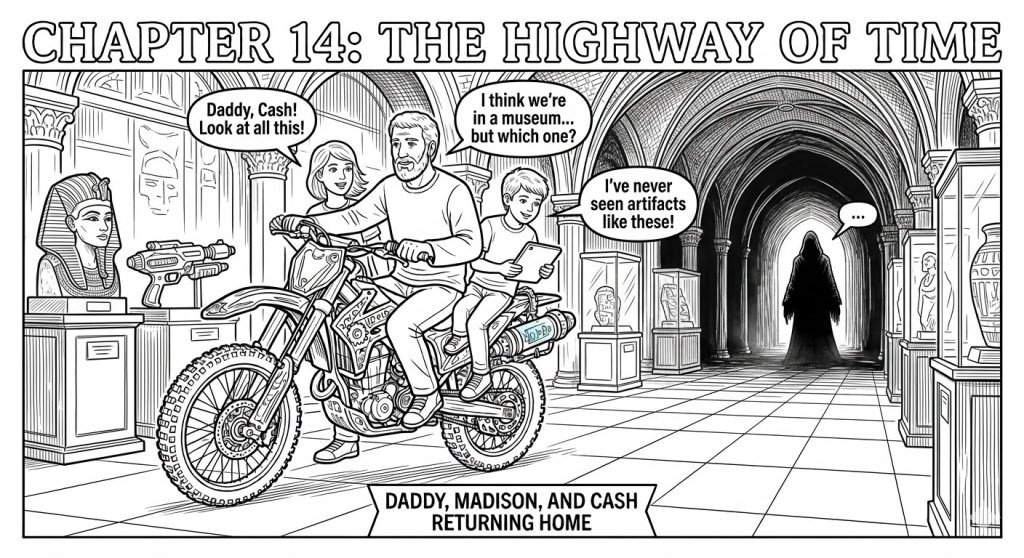
The bike slammed down onto a solid, polished floor, skidding to a sharp halt with a squeal of rubber. As the dust settled, Cash, Madison, and Daddy Swank looked around in utter bewilderment. They weren’t in their Carlsbad garage, nor were they surrounded by ancient stone. Instead, they were standing inside a massive, modern-looking climate-controlled museum vault filled with glass display cases, blinking security sensors, and ancient artifacts.
“Where are we now?” Cash asked, his amazing blue eyes scanning the high-tech security cameras overhead. He kept his hand on the idling throttle, just in case.
“Look at the plaque,” Madison whispered, pointing her stunning blue eyes toward a heavily secured glass display case right in front of them. Inside the case, resting on velvet, was a fragment of ancient, weathered papyrus containing the Greek text of Galatians chapter five.
“We’re in a modern archive,” Daddy Swank said, wiping a layer of first-century dust off his brown t-shirt. He smiled, looking at his kids. “Look at that fragment. It survived all those thousands of years, unchanged. Just like we talked about.”
“Exactly as Paul wrote it,” Madison whispered, tears of awe welling in her eyes. “The letters are identical.”
Suddenly, a heavy steel security door at the back of the vault clicked open with a sharp, mechanical hiss. Out from the shadows stepped a very tall, mysterious man dressed in a flawless, modern charcoal suit. He held a silver pocket watch that ticked with a strange, heavy, unnatural rhythm.
“Ah, the Swank family,” the man said, a cold, calculated smile spreading across his face as his eyes locked onto Madison’s glowing book. “I see you survived Nero and the Gnostics. But you are playing with a timeline that does not belong to you. Hand over the volume.”
 Simply Swank LLC Est. 2018
You must be logged in to post a comment.