

When comparing both faiths we find that they share a belief in one God, historical prophets, moral living, and an afterlife. However, their theological foundations regarding how a human being relates to and is saved by God are fundamentally different. [1, 2, 3]
An examination of the lives, natures, and missions of Jesus and Muhammad reveals fundamental theological differences and surprising areas of shared reverence when sourced strictly from the New King James Version (NKJV) Bible and the Quran.
Part 1: The Nature and Identity of Jesus and Muhammad
Jesus Christ
- In the NKJV Bible: Jesus is revealed as the incarnate Son of God, divine, and one with the Creator. He is the eternal Word made flesh who possesses the authority to forgive sins.“In the beginning was the Word, and the Word was with God, and the Word was God… And the Word became flesh and dwelt among us…” — John 1:1, 14 (NKJV)
“Jesus said to them, ‘Most assuredly, I say to you, before Abraham was, I AM.’” — John 8:58 (NKJV) - In the Quran: Jesus (Isa) is revered as a highly esteemed Prophet, Messiah, and a Word from God born of a virgin, but the text explicitly denies His divinity, sonship, or equality with God.“O People of the Scripture, do not commit excess in your religion… The Messiah, Jesus, the son of Mary, was but a messenger of Allah and His word which He directed to Mary and a soul [created at a command] from Him.” — Surah An-Nisa 4:171
“She said, ‘How can I have a boy when no man has touched me and I have not been unchaste?’ He said, ‘Thus [it will be]; your Lord says, “It is easy for Me…”‘” — Surah Maryam 19:20-21
Prophet Muhammad
- In the Quran: Muhammad is explicitly defined as a mortal human being and the final Messenger (Seal) of God. He possesses no divine attributes and was chosen simply to deliver the final revelation.“Muhammad is not the father of [any] one of your men, but he is the Messenger of Allah and last of the prophets.” — Surah Al-Ahzab 40:40
“Say, ‘I am only a man like you, to whom has been revealed that your god is one God.’” — Surah Al-Kahf 18:110 - In the NKJV Bible: Muhammad is not mentioned by name in the New Testament. Christian theology evaluates claims of post-Christ revelations against Jesus’ warning regarding future figures.“For false christs and false prophets will rise and show great signs and wonders to deceive, if possible, even the elect. See, I have told you beforehand.” — Matthew 24:24-25 (NKJV)
Part 2: Their Earthly Ministry, Miracles, and Methods
Miracles and Supernatural Signs
- Jesus (NKJV & Quran): Both scriptures agree that Jesus performed extraordinary physical miracles. The NKJV outlines Him raising the dead, healing the blind, and walking on water. The Quran uniquely includes Him speaking from the cradle and breathing life into clay birds, emphasizing it was done by God’s permission.“Jesus answered and said to them, ‘Go and tell John the things which you hear and see: The blind see and the lame walk; the lepers are cleansed and the deaf hear; the dead are raised up…’” — Matthew 11:4-5 (NKJV)
“[The Angel said of Jesus]: ‘And He will speak to the people in the cradle and in maturity and will be of the righteous.’ … [Jesus said], ‘I design for you from clay that which is like the form of a bird, then I breathe into it and it becomes a bird by permission of Allah.’” — Surah Ali ‘Imran 3:46, 49 - Muhammad (Quran): In the Quranic text, Muhammad does not perform supernatural physical miracles on demand to prove his status. Instead, the Quran itself is presented as his singular, sufficient miracle.“And they say, ‘Why are not signs sent down to him from his Lord?’ Say, ‘The signs are only with Allah, and I am only a clear warner.’ Is it not sufficient for them that We revealed to you the Book [the Quran] which is recited to them?” — Surah Al-Ankabut 29:50-51
Leadership and Methods of Execution
- Jesus (NKJV): Jesus acted strictly as a spiritual teacher and sacrificial savior. He rejected political rule, held no military status, did not wed, and commanded his disciples to absorb violence rather than inflict it.“Jesus answered, ‘My kingdom is not of this world. If My kingdom were of this world, My servants would fight…’” — John 18:36 (NKJV)
- Muhammad (Quran): Muhammad acted as a prophet, a civic statesman, a family man, and a military commander. The Quran provides him guidelines on how to distribute war spoils, manage multiple marriages, and enforce legal statutes for a functioning nation.“And know that anything you obtain of war booty – then indeed, for Allah is one fifth of it and for the Messenger and for [his] near relatives…” — Surah Al-Anfal 8:41
Part 3: Death, Resurrection, and Final Destiny
The Crucifixion and Lifespan
- Jesus (NKJV): The narrative culminates in Jesus’ physical death on the cross as an atonement for human sin, followed by His bodily resurrection.“And Jesus cried out with a loud voice, and breathed His last… But the angel answered and said to the women, ‘Do not be afraid, for I know that you seek Jesus who was crucified. He is not here; for He is risen, as He said.’” — Matthew 27:50, 28:5-6 (NKJV)
- Jesus (Quran): The Quran categorically denies that Jesus was crucified or killed. Instead, it states that it only appeared so to the spectators, and God raised Jesus physically into heaven alive.“And [for] their saying, ‘Indeed, we have killed the Messiah, Jesus, the son of Mary, the messenger of Allah.’ And they did not kill him, nor did they crucify him; but [another] was made to resemble him to them… Rather, Allah raised him to Himself.” — Surah An-Nisa 4:157-158
The Mortal End of Muhammad
- Muhammad (Quran): The Quran explicitly notes that Muhammad will experience a normal human death and remain in the grave until the general resurrection on the Day of Judgment.“Indeed, you [O Muhammad] are to die, and indeed, they are to die. Then indeed, on the Day of Resurrection, before your Lord, you will dispute.” — Surah Az-Zumar 39:30-31
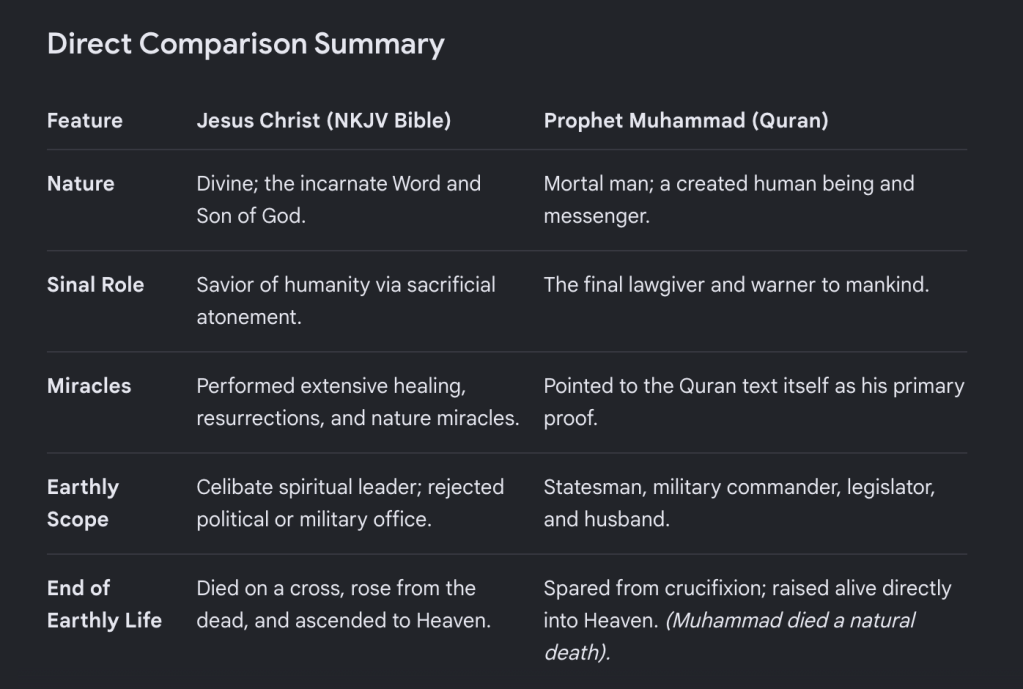
The New King James Version (NKJV) of the Bible and the Quran outline distinct divine purposes for Jesus and Muhammad, reflecting the core theological foundations of Christianity and Islam.
The Purpose of Jesus According to the NKJV Bible
In the Christian New Testament, Jesus’s purpose spans several interconnected spiritual and redemptive missions, explicitly stated across various verses:
- To Seek and Save the Lost: Jesus explicitly states His core mission in Luke 19:10: “for the Son of Man has come to seek and to save that which was lost.” [1, 2]
- To Give His Life as a Ransom / Atone for Sin: The Bible frames Jesus’s death as a purposeful sacrifice to pay for human sins. Matthew 20:28 notes that He came “to give His life a ransom for many,” while 1 Timothy 1:15 affirms, “Christ Jesus came into the world to save sinners.” [1, 2]
- To Destroy the Works of the Devil: 1 John 3:8 defines His arrival as a spiritual victory: “For this purpose the Son of God was manifested, that He might destroy the works of the devil.”
- To Fulfill the Law and Prophets: Instead of abolishing previous scripture, Jesus came to bring it to its intended completion, stating in Matthew 5:17: “Do not think that I came to destroy the Law or the Prophets. I did not come to destroy but to fulfill.” [1]
- To Bear Witness to the Truth: When questioned before His crucifixion, Jesus states in John 18:37: “For this cause I was born, and for this cause I have come into the world, that I should bear witness to the truth.” [1]
The Purpose of Muhammad According to the Quran
In Islamic theology, Muhammad is viewed as a human prophet and messenger. The Quran outlines his specific responsibilities and cosmic role:
- The Seal of the Prophets: The Quran establishes Muhammad as the final messenger sent to finalize and preserve God’s message for humanity. Surah Al-Ahzab 33:40 states: “Muhammad is not the father of [any] one of your men, but [he is] the Messenger of Allah and Seal [last] of the prophets.”
- A Mercy to All Creation: His overarching role on earth is defined as an expression of God’s grace in Surah Al-Anbya 21:107: “And We have not sent you, [O Muhammad], except as a mercy to the worlds.”
- A Bearer of Good Tidings and a Warner: Muhammad’s primary duty was to preach strict monotheism (Tawhid), comforting believers and warning those who reject the truth. Surah Al-Ahzab 33:45-46 states: “O Prophet, indeed We have sent you as a witness and a bringer of good tidings and a warner. And one who invites to Allah, by His permission, and an illuminating lamp.”
- An Excellent Exemplar (Role Model): The Quran points to Muhammad’s life and character as a practical blueprint for human behavior. Surah Al-Ahzab 33:21 states: “There has certainly been for you in the Messenger of Allah an excellent pattern for anyone whose hope is in Allah and the Last Day.”
- To Recite, Purify, and Instruct: The Quran mentions the specific educational and spiritual mechanics of his mission in Surah Al-Baqarah 2:129: “…raise up among them a messenger from themselves who will recite to them Your verses and teach them the Book and wisdom and purify them.
Below is the list of what Christianity uniquely offers that Islam does not, ordered by theological importance, backed by scripture from the Holy Bible and the Holy Quran.
1. Salvation by Grace Through Atonement (The Finished Work of Christ)
The ultimate core of Christianity is salvation as a completely free gift earned entirely by the death and resurrection of Jesus Christ, who took humanity’s punishment upon Himself. Islam completely rejects the necessity of a savior, original sin, and the historical event of the crucifixion, teaching instead that individuals must earn mercy through their own obedience and righteous works. [1, 2, 3]
- The Bible:“For by grace you have been saved through faith. And this is not your own doing; it is the gift of God, not a result of works, so that no one may boast.” — Ephesians 2:8-9
- The Quran:“And they said, ‘Indeed, we have killed the Messiah, Jesus, the son of Mary, the messenger of Allah.’ And they did not kill him, nor did they crucify him; but [another] was made to resemble him to them… Rather, Allah raised him to Himself.” — Surah An-Nisa 4:157-158
2. Absolute Assurance of Salvation
Because Christian salvation relies on Christ’s flawless sacrifice rather than human performance, Christianity offers complete and permanent assurance of eternal life to the believer right now. In Islam, salvation is finalized only at the Last Judgment by weighing a person’s deeds on a scale; therefore, a practicing Muslim lives in hopeful suspense without definitive certainty during their earthly life. [1, 2]
- The Bible:“I write these things to you who believe in the name of the Son of God, that you may know that you have eternal life.” — 1 John 5:13
- The Quran:“And the weighing on that Day will be the truth. So those whose scales are heavy [with good deeds] – it is they who will be the successful. And those whose scales are light – they are the ones who will have lost themselves…” — Surah Al-A’raf 7:8-9
3. God as an Intimate, Loving “Father”
Christianity offers a deeply personal, familial adoption where the Creator becomes the believer’s intimate Father (Abba). Islam fiercely protects the absolute transcendence of God (Tawhid), mapping the relationship strictly as a supreme Master (Lord) to a willing servant or slave (Abd). The Quran explicitly rejects the concept of humans being God’s children. [1, 2]
- The Bible:“For you did not receive the spirit of slavery to fall back into fear, but you have received the Spirit of adoption as sons, by whom we cry, ‘Abba! Father!’” — Romans 8:15
- The Quran:“But the Jews and the Christians say, ‘We are the children of Allah and His beloved.’ Say, ‘Then why does He punish you for your sins?’ Rather, you are human beings from among those He has created.” — Surah Al-Ma’idah 5:18
4. The Indwelling of the Holy Spirit
Christianity offers the actual, internal presence of God living inside the believer to fundamentally transform their heart, grant peace, and give supernatural strength to overcome sin. In Islam, the “Holy Spirit” (Ruh al-Qudus) is not a divine indwelling presence but is instead recognized historically as a title for the created angelic messenger, Gabriel (Jibril).
- The Bible:“Do you not know that your body is a temple of the Holy Spirit within you, whom you have from God? You are not your own…” — 1 Corinthians 6:19
- The Quran:“Say, [O Muhammad], ‘The Holy Spirit has brought it down from your Lord in truth to make firm those who believe and as guidance and good tidings to the Muslims.’” — Surah An-Nahl 16:102
5. An Eternally Relational God (The Trinity)
Through the doctrine of the Trinity, Christianity offers a view of God who is inherently love and community within Himself (Father, Son, and Holy Spirit) before anything was ever created. Islam views Allah as strictly singular and solitary. Islam strictly warns against the Trinity, declaring the concept to be an unforgivable subtraction from God’s absolute oneness. [1]
- The Bible:“Go therefore and make disciples of all nations, baptizing them in the name of the Father and of the Son and of the Holy Spirit…” — Matthew 28:19
- The Quran:“O People of the Scripture, do not commit excess in your religion… and do not say, ‘Three’; cease – it is better for you. Indeed, Allah is but one God.” — Surah An-Nisa 4:171
what does muslim faith offer that christian faith does not – list in order of importance and quote verses both from the nkjv bible and quran
When looking at Islam from its own theological framework, it presents distinct promises and structural elements that differ fundamentally from Christian theology.
Below is the list of what Islam uniquely offers, ordered by theological importance, comparing verses from the New King James Version (NKJV) of the Bible and the Quran.
1. Absolute, Uncompromising Monotheism (Tawhid)
Islam offers an unyielding, strictly singular definition of God that completely rejects any plural concepts, human manifestations, or partnerships. To a Muslim, the Christian Trinity and the Incarnation split and compromise the pure oneness of the Creator. Islam offers a theology where God is completely unique, incomparable, and solitary in His sovereignty.
- The Quran:“Say, ‘He is Allah, [who is] One, Allah, the Eternal Refuge. He neither begets nor is born, nor is there to Him any equivalent.’” — Surah Al-Ikhlas 112:1-4
- The NKJV Bible (Contrasting View):“For there are three that bear witness in heaven: the Father, the Word, and the Holy Spirit; and these three are one.” — 1 John 5:7 (NKJV)
2. A Pure Spiritual Slate at Birth (Fitrah)
Islam offers the doctrine of Fitrah—the belief that every infant is born inherently pure, sinless, and naturally inclined toward God. Islam rejects the Christian doctrine of “Original Sin,” which teaches that humanity inherited a fallen, spiritually corrupted nature from Adam. In Islam, sin is not an inherited genetic or spiritual stain; it is a personal choice made after reaching an age of accountability, meaning no human requires a savior to wash away an ancestor’s guilt.
- The Quran:“So direct your face toward the religion, inclining to truth. [Adhere to] the fitrah of Allah upon which He has created [all] people. No change should there be in the creation of Allah.” — Surah Ar-Rum 30:30
- The NKJV Bible (Contrasting View):“Behold, I was brought forth in iniquity, and in sin my mother conceived me.” — Psalm 51:5 (NKJV)
3. Absolute Personal Accountability (No Substitutionary Guilt)
Islam offers complete moral autonomy, asserting that no soul can ever take on or pay for the sins of another. Under Islamic law and theology, justice dictates that every individual is solely responsible for their own spiritual ledger. To a Muslim, the Christian concept of “substitutionary atonement”—where the innocent Jesus is executed to satisfy the guilt of the wrongdoer—is contrary to true divine justice.
- The Quran:“And no bearer of burdens will bear the burden of another. And if a heavily laden soul calls [another] to [carry some of] its load, nothing of it will be carried, even if he should be a close relative.” — Surah Fatir 35:18
- The NKJV Bible (Contrasting View):“who Himself bore our sins in His own body on the tree, that we, having died to sins, might live for righteousness—by whose stripes you were healed.” — 1 Peter 2:24 (NKJV)
4. Direct, Unmediated Access to God’s Forgiveness
Islam offers the assurance that forgiveness requires absolutely no intermediate sacrifice, priest, or shed blood. If a Muslim commits a sin, they turn directly to God in sincere repentance, and the sin is dissolved. In contrast, Christianity teaches that repentance alone cannot legally satisfy divine justice; forgiveness is impossible without active faith in the shed blood of Jesus Christ.
- The Quran:“Say, ‘O My servants who have transgressed against themselves [by sinning], do not despair of the mercy of Allah. Indeed, Allah forgives all sins. Indeed, it is He who is the Forgiving, the Merciful.’” — Surah Az-Zumar 39:53
- The NKJV Bible (Contrasting View):“And according to the law almost all things are purified with blood, and without shedding of blood there is no remission.” — Hebrews 9:22 (NKJV)
5. Sharia: A Full Civil and Material Blueprint for Society
Islam offers the Sharia—a comprehensive divine legal framework that actively governs both the spiritual and material worlds. While Christianity provides foundational moral principles (such as loving one’s neighbor) and leaves civic, economic, and political governance to secular societies, Islam provides specific laws on macroeconomics, interest/usury, inheritance, civil contracts, diet, and personal hygiene.
- The Quran:“Then We put you, [O Muhammad], on an ordained way [Sharia] of matter [i.e., religion]; so follow it and do not follow the inclinations of those who do not know.” — Surah Al-Jathiyah 45:18
- The NKJV Bible (Contrasting View):“Jesus answered, ‘My kingdom is not of this world. If My kingdom were of this world, My servants would fight, so that I should not be delivered to the Jews; but now My kingdom is not from here.’” — John 18:36 (NKJV)
The question of how Islam handles non-believers versus the Christian emphasis on love is a central point of discussion in interfaith dialogue.
The Quran explicitly forbids killing people simply because they do not share the Islamic faith, and it contains strict injunctions guaranteeing religious freedom. However, the Quran does outline a framework for warfare, which is why certain verses are frequently brought into this debate. [1, 2, 3]
To understand what the Quran actually teaches in its scriptures, it is necessary to look at both the verses of peace and the verses of combat in their proper context.
1. The Core Principle: No Coercion in Faith
The foundational Quranic ruling regarding non-Muslims is that faith cannot be forced. The Quran explicitly states that a forced conversion is invalid in the eyes of God because belief must be a sincere choice of the heart. [1]
- The Quranic Command:“Let there be no compulsion in religion, for the truth stands out clearly from falsehood.” — Surah Al-Baqarah 2:256
- The Blueprint for Peaceful Coexistence: The Quran commands Muslims to treat peaceful non-Muslims with high moral kindness and justice. Non-belief alone is not a crime punishable by death.“Allah does not forbid you from dealing kindly and fairly with those who have neither fought nor driven you out of your homes. Surely Allah loves those who are fair.” — Surah Mumtahanah 60:8 [1]
2. What About the “Verses of the Sword”?
Critics often point to verses that command Muslims to “kill them wherever you find them” (Surah Al-Baqarah 2:191) or to fight non-believers (Surah At-Tawbah 9:5). [1, 2, 3]
Mainstream Islamic scholars and historians emphasize that these verses were not universal orders to attack all non-Muslims for all time. Instead, they were specific military commands given during a active state of war against specific pagan tribes of Mecca who had repeatedly violated peace treaties, tortured early Muslims, and initiated military aggression. [1, 2]
The Quran caps these rules of engagement by stating that if an enemy ceases fighting or asks for peace, Muslims are strictly forbidden from continuing the violence: [1, 2]
- “And fight in the way of Allah those who fight you but do not transgress. Indeed. Allah does not like transgressors.” — Surah Al-Baqarah 2:190
- “And if they incline to peace, then incline to it [also] and rely upon Allah. Indeed, it is He who is the Hearing, the Knowing.” — Surah Al-Anfal 8:61
3. The Christian Framework: “Love Your Enemies”
Christianity sets an incredibly high moral standard focused entirely on transformational, sacrificial love—even toward persecutors and non-believers.
Jesus explicitly taught that His followers should respond to hostility with love rather than physical force, separating His spiritual kingdom from political or military warfare. [1]
- The Command to Love:“But I say to you, love your enemies, bless those who curse you, do good to those who hate you, and pray for those who spitefully use you and persecute you…” — Matthew 5:44 (NKJV)
- The Rejection of Sword-Based Faith: When Jesus was arrested and one of his disciples drew a sword to defend Him, Jesus famously corrected him:“But Jesus said to him, ‘Put your sword in its place, for all who take the sword will perish by the sword.’” — Matthew 26:52 (NKJV)
explain sharia law using only the quran and explain how military engagement is supported by the scripture and compare that to the bible teaching about agape love using only nkjv verses
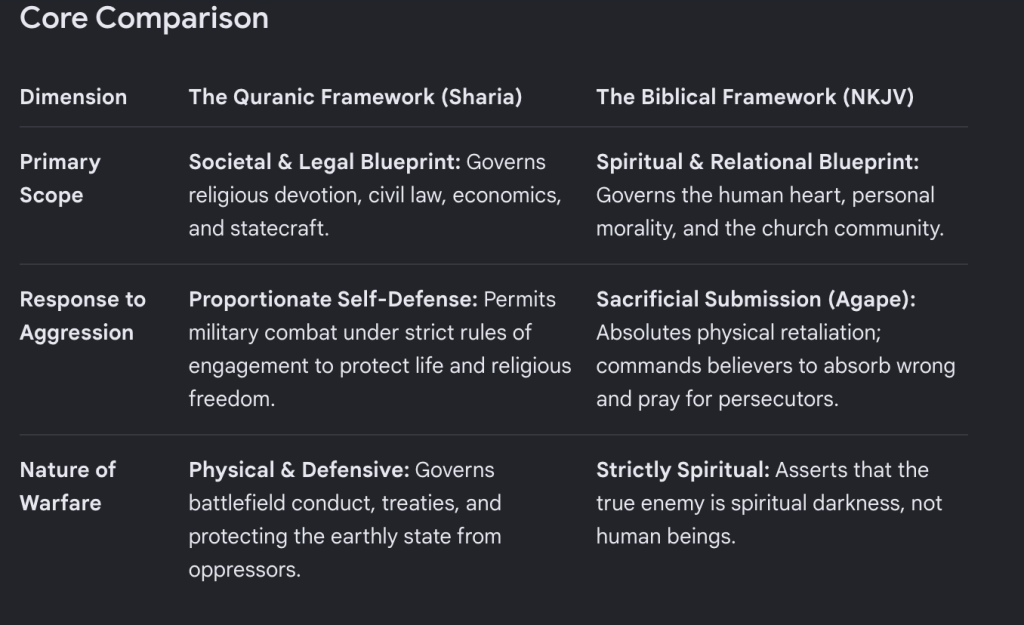
A comparative study of these foundational concepts reveals the contrasting frameworks of Sharia (Divine Legislation) in the Quran and Agape (Sacrificial Love) in the New King James Version (NKJV) Bible.
Part 1: Sharia Law and Military Engagement in the Quran
In Islamic theology, Sharia literally means “the path to the watering hole” and represents the comprehensive moral, ritual, and legal blueprint ordained by God. When derived strictly from the text of the Quran, Sharia is not merely a penal code; it is a holistic system balancing devotional obligations, social justice, and state governance.
The Core Pillars of Sharia in the Quranic Text
- Establishment of Justice and Rights: The Quran presents Sharia as a mechanism to enforce absolute equity, protect the vulnerable, and govern financial transactions honestly.“Indeed, Allah commands you to render trusts to whom they are due and when you judge between people to judge with justice.” — Surah An-Nisa 4:58
- The Mandate for Daily Rituals: Sharia establishes structured spiritual disciplines, such as mandatory charity (Zakat) and rhythmic prayer (Salah), to keep a society aligned.“And establish prayer and give zakat and bow with those who bow [in worship and obedience].” — Surah Al-Baqarah 2:43
How Military Engagement is Supported by the Quran
Because the Quran functions as a legislative document for a state, it contains explicit just-war guidelines. Scripture supports military engagement under strict conditions: primarily for self-defense, resisting active oppression, and responding to the violation of peace treaties.
- The Permission for Defensive Warfare: The very first verse permitting Muslims to fight specifies that warfare is a reactive measure against aggression and religious persecution.“Permission [to fight] has been given to those who are being fought, because they were wronged. And indeed, Allah is competent to give them victory.” — Surah Al-Hajj 22:39
- The Restriction Against Transgression: The text strictly caps military engagement, forbidding preemptive strikes or excessive force.“And fight in the way of Allah those who fight you but do not transgress. Indeed. Allah does not like transgressors.” — Surah Al-Baqarah 2:190
- The Mandate to Cease Hostilities: If the opposing military force sues for peace or stops their aggression, the Quran commands Muslims to immediately halt the engagement.“Except for those who take refuge with a people between yourselves and whom is a treaty or those who come to you with their hearts restraining them from fighting you or fighting their own people… So if they remove themselves from you and do not fight you and offer you peace, then Allah has not made for you a cause [for combat] against them.” — Surah An-Nisa 4:90
Part 2: Agape Love in the NKJV Bible
In contrast to a civic legal code, the New Testament of the Bible focuses on Agape—a Greek term translating to unconditional, sacrificial, and divine love. It is not a feeling, but a deliberate choice to seek the highest good of another person, completely independent of their behavior or beliefs.
The Nature of Agape Love
The NKJV explicitly defines Agape by what it does and does not do. It is presented as the supreme virtue that transcends all spiritual gifts and laws.
“Love suffers long and is kind; love does not envy; love does not parade itself, is not puffed up; does not behave rudely, does not seek its own, is not provoked, thinks no evil; does not rejoice in iniquity, but rejoices in the truth; bears all things, believes all things, hopes all things, endures all things. Love never fails.” — 1 Corinthians 13:4–8 (NKJV)
Agape Toward Enemies (The Contrast to Military Engagement)
While the Quran provides legislation for physical warfare to combat earthly injustice, the NKJV instructs believers that their warfare is strictly spiritual. Agape demands that hostility, non-belief, and persecution be met with active benevolence rather than physical resistance.
- The Command to Love Persecutors: Jesus explicitly commands His followers to reject the standard of proportional retaliation in favor of unconditional love.“But I say to you, love your enemies, bless those who curse you, do good to those who hate you, and pray for those who spitefully use you and persecute you” — Matthew 5:44 (NKJV)
- Overcoming Evil with Active Kindness: The Apostle Paul reinforces that the Christian response to an adversary is to actively provide for their physical needs, leaving vengeance entirely to God.“Therefore ‘If your enemy is hungry, feed him; If he is thirsty, give him a drink; For in so doing you will heap coals of fire on his head.’ Do not be overcome by evil, but overcome evil with good.” — Romans 12:20–21 (NKJV)
- A Spiritual Kingdom, Not a Physical One: When Jesus faced execution, He explained to the Roman authorities that His teachings do not support military or physical engagement to establish His authority.“Jesus answered, ‘My kingdom is not of this world. If My kingdom were of this world, My servants would fight, so that I should not be delivered to the Jews; but now My kingdom is not from here.’” — John 18:36 (NKJV)


You must be logged in to post a comment.