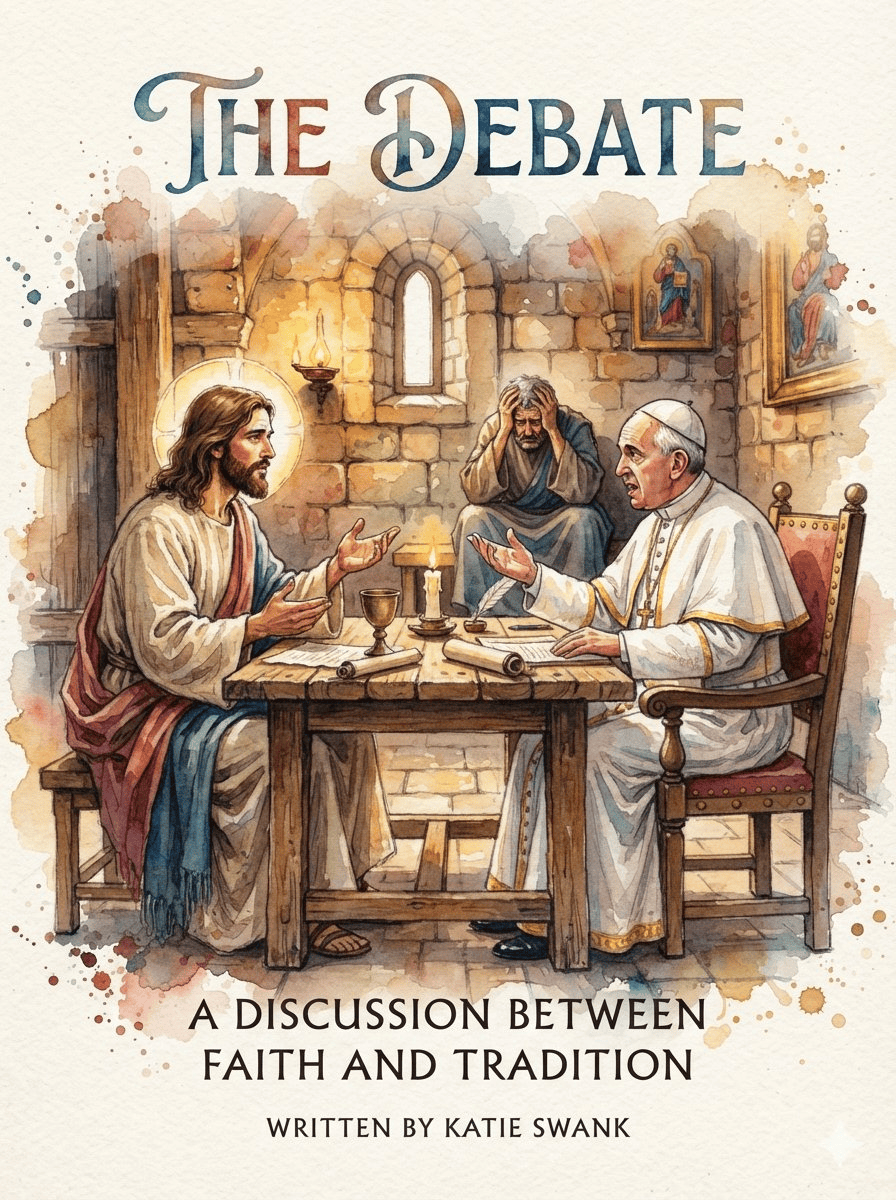


The New King James Version (NKJV) represents a Protestant biblical text focused on sola scriptura (scripture alone) and salvation by grace through faith alone, while Roman Catholic texts and teachings combine scripture with sacred tradition and view faith as living out grace through love and good works. [1, 2, 3]
Biblical (NKJV) View of Faith and Jesus’s Teaching
- Grace and Faith Alone: Protestant texts like the NKJV emphasize passages such as Ephesians 2:8–9, stating that salvation is a free gift received through faith, apart from human works. [1, 2]
- How Jesus Described Faith: Jesus often described faith as a relational trust and reliance on God—sometimes “as small as a mustard seed” (Matthew 17:20) that can move mountains. It is an inward trust in Christ’s finished work rather than an institutional status.
- Direct Access: The NKJV highlights Jesus as the sole mediator between God and humanity (1 Timothy 2:5), granting believers direct access to the Father without earthly priestly intercession. [1]
Roman Catholic Teachings and Textual Differences
- The Canon: Catholic Bibles contain 73 books, including the deuterocanonical books (such as Tobit and Maccabees) which are omitted or placed in an Apocrypha section in standard Protestant editions like the NKJV. [1, 2, 3]
- Faith and Works: The Catholic Church teaches that faith must be active through charity and good works. Citing James 2:24 (“a man is justified by works, and not by faith only”), Catholicism views justification as an ongoing process nourished by the sacraments (like baptism and the Eucharist). [1, 2]
- Scripture and Tradition: Catholic doctrine holds that divine revelation comes through both Sacred Scripture and Sacred Tradition, interpreted authoritatively by the Magisterium (the teaching office of the Pope and bishops) rather than by individual private interpretation
When comparing Roman Catholic practices to the New King James Version (NKJV) text, several core traditions directly clash with the literal teachings and commands of Jesus as recorded in the Gospels.
The most prominent practices that contrast with Jesus’s words in the NKJV include:
1. Calling Priests and Popes “Father”
- Catholic Practice: Catholics routinely address priests, bishops, and the Pope as “Father” as a sign of spiritual fatherhood and respect.
- Jesus’s Teaching (NKJV): Jesus explicitly commanded His followers not to use this title religiously.“Do not call anyone on earth your father; for One is your Father, He who is in heaven.” (Matthew 23:9)
2. Repetitive Prayers (The Rosary)
- Catholic Practice: The Rosary involves repeating the “Hail Mary” 53 times and the “Our Father” multiple times as a structured devotion.
- Jesus’s Teaching (NKJV): Jesus warned against structured, repetitive prayer tracking, explicitly telling His disciples not to pray like the Gentiles.“And when you pray, do not use vain repetitions as the heathen do. For they think that they will be heard for their many words.” (Matthew 6:7)
3. Praying to Mary and Saints
- Catholic Practice: Catholics pray to Mary and deceased saints, asking them to intercede and pray for them to God.
- Jesus’s Teaching (NKJV): Jesus taught that prayer should be directed exclusively to the Father, and he positioned Himself as the only avenue of access.“In this manner, therefore, pray: Our Father in heaven…” (Matthew 6:9)
“I am the way, the truth, and the life. No one comes to the Father except through Me.” (John 14:6)
4. Holy Communion as a Re-Sacrifice (The Mass)
- Catholic Practice: The Catholic Church teaches that the Mass is a literal, unbloody re-presentation of the sacrifice of Christ, where bread and wine become His actual body and blood.
- Jesus’s Teaching (NKJV): When Jesus instituted the Last Supper, He explicitly established it as a memorial, not a continuous sacrifice.“And He took bread, gave thanks and broke it, and gave it to them, saying, ‘This is My body which is given for you; do this in remembrance of Me.’” (Luke 22:19)
5. Elevating Church Tradition Over Scripture
- Catholic Practice: The Catholic Church places Sacred Tradition on equal footing with Sacred Scripture, holding that church councils and papal decrees can establish binding dogma.
- Jesus’s Teaching (NKJV): Jesus heavily rebuked the religious leaders of His day for allowing human traditions to supersede or bypass the written Word of God.“He answered and said to them, ‘Why do you also transgress the commandment of God because of your tradition? … Thus you have made the commandment of God of no effect by your tradition.’” (Matthew 15:3, 6)
The Roman Catholic Church teaches that the Pope holds supreme, universal authority over the global Church, a concept that directly contrasts with Jesus’s teachings in the NKJV, which emphasize servant leadership, equality among believers, and His own exclusive headship over the Church.
Roman Catholic Teachings on the Pope and Hierarchy
- Papal Primacy and Infallibility: The Catholic Church teaches that the Pope is the Vicar of Christ (the earthly representative of Jesus) and the successor of the Apostle Peter. Under the dogma of papal infallibility, when the Pope speaks ex cathedra (from the chair of authority) on matters of faith or morals, his definitions are irreformable.
- Apostolic Succession: Catholicism holds that spiritual authority was passed down from Jesus to the Apostles, and then to the bishops through history. The hierarchy is strictly top-down: the Pope is at the summit, followed by Cardinals, Archbishops, Bishops, Priests, and Deacons.
- The Teaching Office (Magisterium): Only the hierarchy possesses the authority to authentically interpret Scripture and Tradition. Lay Catholics are required to give religious submission of intellect and will to this teaching authority.
Comparison to Jesus’s Teaching in the NKJV Alone
| Topic | Roman Catholic Teaching | Jesus’s Teaching (NKJV) |
|---|---|---|
| Highest Authority | The Pope rules with supreme, full, and immediate power over the entire Church. | Jesus claims all authority for Himself. He is the only shepherd and head; no human is appointed above the rest. (Matthew 28:18; John 10:16) |
| Rank and Status | The hierarchy establishes a clear ranking system of spiritual authority from the Pope down to the laity. | Jesus banned hierarchy and titles among His disciples, teaching that all believers are of equal spiritual status. (Matthew 23:8–11) |
| The Nature of Leadership | Bishops and Popes rule as princes, governors, and judges over their dioceses. | Jesus stated that leadership is servant-hood, strictly forbidding His followers from ruling over others like earthly kings do. (Mark 10:42–44) |
Direct Contrasts with Jesus’s Words in the NKJV
1. Jesus Forbade Ranks and Titles of Superiority
In the NKJV, Jesus explicitly commanded His disciples not to adopt titles that elevated one believer over another:
“But you, do not be called ‘Rabbi’; for One is your Teacher, the Christ, and you are all brethren. … And do not be called teachers; for One is your Teacher, the Christ. But he who is greatest among you shall be your servant.” (Matthew 23:8, 10–11)
2. Jesus Forbade “Lording Over” the Church
When the Apostles argued over who would be the greatest in the kingdom, Jesus directly corrected their desire for a top-down power structure:
But Jesus called them to Himself and said, “You know that the rulers of the Gentiles lord it over them, and those who are great exercise authority over them. Yet it shall not be so among you; but whoever desires to become great among you, let him be your servant.” (Matthew 20:25–26)
3. Jesus Maintained Sole Headship
Catholicism looks to the Pope as the unifying visible head of the Church on earth. In contrast, Jesus told His disciples that He would remain present with them personally, eliminating the need for an earthly vicar to act as an intermediary:
“…and lo, I am with you always, even to the end of the age.” (Matthew 28:20)
Matthew 16:18 — “You are Peter, and on this rock I will build My church”
In the New King James Version (NKJV), Matthew 16:17–18 reads:
Jesus answered and said to him, “Blessed are you, Simon Bar-Jonah, for flesh and blood has not revealed this to you, but My Father who is in heaven. And I also say to you that you are Peter, and on this rock I will build My church, and the gates of Hades shall not prevail against it.”
While this verse is arguably the most famous point of contention between the two traditions, they interpret the identity of the “rock” in completely different ways.
The Roman Catholic Interpretation
The Catholic Church teaches that the rock is Peter himself, establishing him as the first Pope.
- The Name Change: Catholics point out that Jesus changes Simon’s name to Peter (which means rock). They argue Jesus is building a literal, institutional hierarchy on Peter, granting him the “keys of the kingdom” as a prime minister over the Church.
- Succession: They believe this authority did not die with Peter but was passed down to his successors, the subsequent bishops of Rome (the Popes).
The Protestant Interpretation (via the NKJV / Greek Text)
Protestants argue that the rock is Peter’s confession (that Jesus is the Christ) or Jesus Himself, not Peter the man.
- The Greek Wordplay: Protestant scholars point to the original Greek text behind translations like the NKJV. Jesus calls Peter Petros (a masculine noun meaning a detached stone or pebble), but says He will build His church on this petra (a feminine noun meaning a massive, immovable bedrock).
- The Confession as the Bedrock: The Protestant view is that Jesus was drawing a contrast: “You are a small stone (Petros), but upon this massive bedrock (petra)—the truth you just confessed that I am the Messiah—I will build My church.”
- Jesus as the Chief Cornerstone: Protestants rely on other scriptures to interpret this verse, noting that the Bible repeatedly calls Jesus the only true foundation. As Paul wrote in 1 Corinthians 3:11, “For no other foundation can anyone lay than that which is laid, which is Jesus Christ.”
How the Apostles Behaved Toward One Another in the Book of Acts
If Jesus had established Peter as the supreme, infallible Pope with total authority over the other Apostles, the Book of Acts should reflect that hierarchy. However, the NKJV text shows that the Apostles treated each other as equals, and Peter never acted as a monarch.
- Peter Was Sent by Other Apostles: In Acts 8, when the gospel spread to Samaria, the leadership in Jerusalem decided to send delegates.“Now when the apostles who were at Jerusalem heard that Samaria had received the word of God, they sent Peter and John to them.” (Acts 8:14)
- The Contrast: In a hierarchical system, a Pope sends bishops; bishops do not vote to send the Pope.
- Peter Had to Defend His Actions to a Council: In Acts 11, after Peter preached to the Gentiles at Cornelius’s house, the other believers did not accept his actions blindly as coming from an infallible leader. Instead, they criticized him.“And when Peter came up to Jerusalem, those of the circumcision contended with him… But Peter explained it to them from the beginning…” (Acts 11:2, 4)
- The Contrast: Peter did not pull rank or demand submission; he humbly explained the vision God gave him to justify his actions to his peers.
- James led the Jerusalem Council, Not Peter: In Acts 15, the early Church held its first major council to decide if Gentile converts had to follow the Law of Moses. While Peter gave his testimony (Acts 15:7–11), it was James who presided over the meeting, judged the matter, and handed down the final binding decree.“And after they had become silent, James answered, saying: ‘Men and brethren, listen to me… Therefore I judge that we should not trouble those from among the Gentiles who are turning to God…’” (Acts 15:13, 19)
How the Apostle Paul Interacted with Peter (The Galatians 2 Confrontation)
In the New King James Version (NKJV), Galatians 2 provides the clearest look at how the Apostle Paul viewed Peter’s authority. If Peter were the supreme, infallible head of the Church, Paul would have been expected to submit to him. Instead, Paul treated Peter as a spiritual equal who was fully capable of making serious errors.
1. Paul Stated Peter’s Influence Was Not Absolute
When Paul visited the leadership in Jerusalem, he acknowledged that Peter, James, and John were highly respected, but he explicitly noted that their human status meant nothing to his own apostolic calling from God:
“But from those who seemed to be something—whatever they were, it makes no difference to me; God shows personal favoritism to no man—for those who seemed to be something contributed nothing to me.” (Galatians 2:6)
2. Paul Publicly Rebuked Peter for Hypocrisy
The most direct clash occurred in Antioch. Peter had been freely eating and fellowshiping with Gentile Christians. However, when a strict group of Jewish believers arrived from James, Peter panicked and isolated himself from the Gentiles out of fear. Paul did not stay silent or defer to Peter’s rank; he confronted him face-to-face in front of the entire church:
“Now when Peter had come to Antioch, I withstood him to his face, because he was to be blamed… But when I saw that they were not straightforward about the truth of the gospel, I said to Peter before them all, ‘If you, being a Jew, live in the manner of Gentiles and not as the Jews, why do you compel Gentiles to live as Jews?’” (Galatians 2:11, 14)
- The Protestant Interpretation: This text shows Peter was not viewed as an infallible Pope on matters of faith and practice. He made a massive theological blunder regarding the Gospel of grace, and a newer apostle (Paul) had the authority to publicly correct him.
- The Roman Catholic Interpretation: Catholic theologians argue this was a failure of Peter’s personal behavior (conduct), not his doctrinal teaching. They argue Paul was correcting Peter’s hypocrisy, which does not violate the doctrine of Papal Infallibility (as infallibility only applies to formal, official doctrinal definitions).
How Peter Describes Himself and His Own Rank in His Letters
If Peter knew he was the supreme earthly leader of Christ’s Church, his own written letters to the early Christians would likely reflect that unique status. However, in his New Testament epistles, Peter describes himself with humility and positions himself as an equal among peers.
1. He Calls Himself a “Fellow Elder”
When addressing the leaders of the local churches in 1 Peter, he does not claim a higher office or command them using papal authority. Instead, he places himself right alongside them:
“The elders who are among you I exhort, I who am a fellow elder and a witness of the sufferings of Christ, and also a partaker of the glory that will be revealed:” (1 Peter 5:1)
2. He Explicitly Warns Leaders Against “Lording It Over” the Church
In the very next verses, Peter echoes Jesus’s teachings from the Gospels, warning church leaders never to act like rulers or monarchs over the people under their care:
“Shepherd the flock of God which is among you… not as being lords over those entrusted to you, but being examples to the flock; and when the Chief Shepherd appears, you will receive the crown of glory that does not fade away.” (1 Peter 5:2–4)
- The Key Distinction: Peter points away from himself as the head of the Church. He assigns the title of “Chief Shepherd” strictly and exclusively to Jesus Christ.
In Roman Catholic tradition, the Eucharist (Holy Communion) is considered the “source and summit of the Christian life”. It means that the bread and wine consecrated by a priest miraculously change substance to become the literal body, blood, soul, and divinity of Jesus Christ (a doctrine known as transubstantiation). Every Mass is viewed as a mystical “re-presentation” of Christ’s one-time sacrifice on the Cross. [1, 2, 3]
Tracing this tradition through historical documents reveals a progression from basic ritual practices to highly defined legal and theological dogmas.
Phase 1: The New Testament Foundations (c. 55–100 AD)
The earliest recorded historical documents detailing the Eucharist are found within the New Testament itself. [1]
- The Earliest Extant Text: The Apostle Paul wrote the oldest written account of the Eucharist around 55 AD in his first letter to the Corinthians.“The cup of blessing which we bless, is it not the communion of the blood of Christ? The bread which we break, is it not the communion of the body of Christ?” (1 Corinthians 10:16, NKJV) [1, 2, 3]
- The Gospels: The Gospels of Matthew, Mark, and Luke record the institution of the meal at the Last Supper. John’s Gospel (specifically John 6, written toward the end of the 1st century) records Jesus saying, “Unless you eat the flesh of the Son of Man and drink His blood, you have no life in you” (John 6:53, NKJV). [1]
Phase 2: Extra-Biblical Documents (c. 70–150 AD)
Immediately following the Apostles, early Christian handbooks and letters reveal that the Eucharist was already being treated as a sacred, non-symbolic sacrifice. [1, 2]
- The Didache (c. 70–120 AD): The oldest known extra-biblical Christian text, The Didache (“The Teaching of the Twelve Apostles”), outlines how to perform the ritual. It commands that only baptized believers can consume it and explicitly calls the Eucharist a “sacrifice”.“On the Lord’s own day, assemble in common to break bread and offer thanks; but first confess your sins, so that your sacrifice may be pure.” (Didache, Ch. 14) [1, 2, 3]
- St. Ignatius of Antioch (c. 110 AD): A disciple of the Apostle John, Ignatius wrote letters on his way to martyrdom. He explicitly targeted early heretics (Gnostics) for denying that the Eucharist was literally Jesus.“They abstain from the Eucharist and from prayer, because they confess not the Eucharist to be the flesh of our Saviour Jesus Christ…” (Letter to the Smyrnaeans, Ch. 7) [1]
Phase 3: Detailed Liturgical Descriptions (c. 155 AD)
- St. Justin Martyr (c. 155 AD): In his First Apology written to the Roman Emperor, Justin provided the earliest detailed layout of what a Christian church service looked like. He explained that the food consumed is not ordinary bread.“…the food which has been blessed by the prayer of His word… is the flesh and blood of that Jesus who was made flesh.” (First Apology, Ch. 66) [1]
Phase 4: Formal Dogmatic Definitions (1215 AD & 1551 AD)
While the early historical documents prove a foundational belief in the “Real Presence,” the precise theological mechanisms were not legally codified by the Catholic hierarchy until centuries later: [1, 2]
- The Fourth Lateran Council (1215 AD): This official Church council officially adopted and consecrated the word “Transubstantiation” into formal Catholic dogma to define how the bread and wine change substance.
- The Council of Trent (1551 AD):
The practice of Confession (the Sacrament of Penance or Reconciliation) transformed from an occasional, public event in the early church into the private, required ritual known today during the Middle Ages. For Roman Catholics, it is vital because it is the unique institutional channel through which post-baptismal mortal sins are forgiven and the soul is restored to a state of grace.
When evaluated through the New King James Version (NKJV) alone, this hierarchical practice directly contrasts with Jesus’s teaching on direct access to God, His sole authority to forgive sins, and the finished work of the cross.
The History: When Did Confession Begin?
The concept of confessing sins has existed since the first century, but the modern Catholic practice of private confession to a priest developed gradually through distinct historical phases:
- Early Church (1st – 2nd Century): Confession was primarily public and community-focused. Early documents like The Didache mention confessing transgressions in church before praying, but there were no private confession booths or sacramental absolutions by a single priest.
- The Patristic Period (3rd – 5th Century): Forgiveness for severe sins (like murder, adultery, or apostasy) required a rigorous, public system of penance. A sinner confessed publicly to the bishop, joined the “order of penitents,” wore sackcloth, and performed public penance for months or years before being readmitted to communion. This could only be done once in a lifetime.
- The Irish Monastic Influence (6th – 11th Century): Irish and Celtic monks began practicing private, repeatable confession to a spiritual mentor or monk. They brought this practice to continental Europe. It quickly became popular because it was private and could be performed multiple times.
- The Formal Mandate (1215 AD): Private confession was officially codified into Catholic canon law at the Fourth Lateran Council in 1215 AD under Pope Innocent III. The Council decreed that every Catholic must confess their sins privately to their local parish priest at least once a year.
Why Confession is Essential to Roman Catholicism
In Catholic theology, confession is not just a healthy psychological release; it is a matters-of-salvation necessity.
- Dealing with “Mortal Sin”: Catholicism divides sin into venial (minor) and mortal (grave/deadly). If a Catholic commits a mortal sin (e.g., missing Sunday Mass intentionally, committing adultery, theft), they instantly lose their “justifying grace.” If they die in this state, they go to hell. Confession is the ordinary mechanism instituted by Christ to restore that grace.
- The Role of Absolution: Catholics believe the priest acts in persona Christi (in the person of Christ). When the priest pronounces the words of absolution (“I absolve you from your sins…”), God legally wipes away the eternal guilt of the sin through the execution of the priest’s office.
Direct Contrasts with Jesus’s Teaching in the NKJV Alone
When evaluating Catholic confession against the words of Jesus in the NKJV, major contradictions emerge regarding who has the authority to forgive, how we access God, and what is required after sinning.
1. Jesus is the Only Mediator and Direct Intercessor
- Catholic Practice: A believer must go through a human priest to receive sacramental forgiveness from God.
- Jesus’s Teaching (NKJV): Jesus eliminated the need for human intermediaries. He taught that believers have direct access to the Father. He positioned Himself as the exclusive way to God, a truth later solidified by the Apostles who designated Him as the only mediator.“Jesus said to him, ‘I am the way, the truth, and the life. No one comes to the Father except through Me.’” (John 14:6)
“For there is one God and one Mediator between God and men, the Man Christ Jesus…” (1 Timothy 2:5)
2. Only God Has the Power to Forgive Sins
- Catholic Practice: Priests possess the structural authority delegated by the Church to absolve or withhold forgiveness.
- Jesus’s Teaching (NKJV): Throughout the Gospels, Jesus’s enemies correctly noted that only God can forgive sins. Jesus then healed people to prove that He Himself was God, thereby possessing that divine prerogative. He never taught that ordinary human leaders could independently wipe away a person’s moral debt to God.“Why does this Man speak blasphemies like this? Who can forgive sins but God alone?” (Mark 2:7)
“But that you may know that the Son of Man has power on earth to forgive sins…” (Matthew 9:6)
3. Jesus Required Faith, Not Performance (Penance)
- Catholic Practice: After confessing, the priest assigns “penance” (praying a specific number of Hail Marys, doing a good deed, etc.) to satisfy the temporal punishment due to the sin.
- Jesus’s Teaching (NKJV): When individuals approached Jesus in repentance, He forgave them freely on the spot based on their faith. He never assigned tasks, mandatory prayers, or retributive works to complete or secure their forgiveness.“Then He said to the woman, ‘Your sins are forgiven.’ … ‘Your faith has saved you. Go in peace.’” (Luke 7:48, 50)
To understand why Roman Catholic teachings permit praying to Mary, it is necessary to examine the official declarations of the Church’s teaching office. The official Catechism of the Catholic Church explains this practice by explicitly framing the meaning of “prayer to Mary” through the lens of communion, intercession, and submission to Christ. [1, 2]
1. Roman Catholic Teachings: Why It Is Taught to Be Okay
Catholic teaching defines prayer to Mary as asking for her intercession rather than offering divine worship. [1, 2]
- Mary as an Intercessor: The Catechism views Mary as a primary partner in prayer and an advocate who continues her saving office in heaven. Full text excerpts regarding her role as the Orans and her titles such as Advocate and Mediatrix can be found in the referenced documents.
- Subordinate to Christ: The Church emphasizes that Mary’s intercession does not rival Jesus, but rather flows from His unique mediation. [1, 2, 3]
2. Does This Contrast with the Teaching of Jesus in the NKJV Bible?
When compared with the New King James Version (NKJV) Gospels, directing requests to heavenly figures other than God presents several distinct contrasts:
- Exclusive Prayer to the Father: Jesus instructed His followers to pray directly to God: “In this manner, therefore, pray: Our Father in heaven…” (Matthew 6:9). [1]
- Exclusive Mediation: Jesus stated that He is the sole pathway to God: “No one comes to the Father except through Me.” (John 14:6), and 1 Timothy 2:5 affirms there is “one Mediator between God and men, the Man Christ Jesus.”
- Redirecting Honor: When a crowd member praised His mother, Jesus responded: “More than that, blessed are those who hear the word of God and keep it!” (Luke 11:27–28).
The New King James Version (NKJV) does not teach that Mary was divine, nor does it assign her any structural, spiritual, or legal authority in faith, in heaven, or on earth.
Instead, the NKJV consistently describes Mary as a human woman who was highly honored by God to bear the Messiah, but who herself required salvation and held no special authority over Jesus or the early Church. [1, 2]
The specific ways the NKJV text addresses her nature and authority include:
1. Mary’s Nature: Human and in Need of a Savior
The NKJV does not ascribe attributes of divinity (like sinlessness, omniscience, or heavenly power) to Mary. In her own hymn of praise (the Magnificat), Mary explicitly acknowledges her own human lowliness and her need for God to save her: [1]
“My soul magnifies the Lord, and my spirit has rejoiced in God my Savior. For He has regarded the lowly state of His maidservant…” (Luke 1:46–48) [1]
2. No Authority Over Jesus’s Ministry
When Mary attempted to initiate or influence Jesus’s divine ministry, Jesus gently but firmly established a boundary, showing that her maternal relationship did not give her authoritative sway over His actions. At the wedding in Cana, when she noted they were out of wine, Jesus responded: [1, 2]
Jesus said to her, “Woman, what does your concern have to do with Me? My hour has not yet come.” (John 2:4)
(Note: Mary’s immediate response to the servants was to defer entirely to Jesus’s authority, saying, “Whatever He says to you, do it” in John 2:5). [1]
3. Spiritual Equality, Not Higher Rank
On multiple occasions recorded in the NKJV, Jesus explicitly downplayed biological family ties—including Mary’s—in favor of universal spiritual obedience.
- When a woman in a crowd cried out to bless Mary’s role as His mother, Jesus redirected the honor:And He said, “More than that, blessed are those who hear the word of God and keep it!” (Luke 11:28) [1]
- When His mother and brothers stood outside wanting to speak to Him, Jesus defined His true “family” based on faith, not blood status:“He stretched out His hand toward His disciples and said, ‘Here are My mother and My brothers! For whoever does the will of My Father in heaven is My brother and sister and mother.’” (Matthew 12:49–50) [1]
4. No Authority in the Early Church or in Heaven
The NKJV contains no text indicating that Mary was given a leadership rank, apostolic authority, or a throne in heaven.
- On Earth: The final time Mary is mentioned by name in the New Testament is in Acts 1:14. She is not leading the Apostles; rather, she is simply listed as one of many believers gathering humbly to pray before Pentecost: “These all continued with one accord in prayer and supplication, with the women and Mary the mother of Jesus, and with His brothers.” [1]
- In Heaven: The epistles (letters outlining church doctrine) and the Book of Revelation never describe Mary ruling in heaven, ascending bodily, or acting as a “Queen of Heaven”. The NKJV repeatedly states that all authority in heaven and earth belongs exclusively to Jesus Christ: “And Jesus came and spoke to them, saying, ‘All authority has been given to Me in heaven and on earth.’” (Matthew 28:18). [1, 2]
If you are putting together a study framework, would you like to explore how the title “Mother of God” historically developed outside of the Bible, or look at how other women in the NKJV (like Elizabeth or Anna) recognized Jesus’s divinity?
http://www.theshepherds.churchHow Should We Regard Mary? – The Shepherd’s ChurchJesus refers to Mary using the impersonal term “woman” her status as His mother did not grant her any special standing with Him or…
GotQuestions.orgWhat does the Bible say about the virgin Mary? – Got QuestionsJul 24, 2026 — Mary’s words align perfectly with the testimony of Scripture that worship belongs to God alone (Revelation 19:10; 22:9).
JW.ORGIs Mary the Mother of God? – JW.ORGNo, the Bible does not teach that Mary is the mother of God, nor does it suggest that Christians should either worship or venerate…


Show all
what faith describes mary as the “queen of heaven”
The title “Queen of Heaven” (Regina Caeli) is used primarily by the Roman Catholic Church [1]. It is also recognized and used in liturgical traditions within Eastern Orthodoxy and some high-church branches of Anglicanism [1].
In Roman Catholicism, this title is rooted in several specific theological beliefs:
- The Queenship of Mary: In 1954, Pope Pius XII formalized the feast of the Queenship of Mary in his encyclical Ad Caeli Reginam. Catholic theology teaches that because Jesus is the King of kings, His mother is naturally the Queen Mother (Gebirah), drawing on Old Testament traditions where the king’s mother held an authoritative royal status rather than his wife.
- The Assumption: Catholicism teaches that Mary was taken body and soul into heaven at the end of her earthly life, where she was crowned by God as Queen of heaven and earth.
- Interpretation of Revelation 12: Catholic theologians often interpret the “woman clothed with the sun, with the moon under her feet, and on her head a crown of twelve stars” in Revelation 12:1 as a literal description of Mary reigning in heaven.
(Note: In contrast, Protestant denominations reading the NKJV reject this title entirely. They interpret Revelation 12 as a symbol for Israel or the Church, and they point out that the only time the phrase “queen of heaven” appears in the Bible is in Jeremiah 7:18 and Jeremiah 44, where God heavily condemns the Israelites for pagan idolatry and offering sacrifices to a false Babylonian/Canaanite goddess called the “Queen of Heaven”).
1. The Term “Saint” in Roman Catholic History (According to Catholic Documents)
According to official Catholic resources like the Catholic Encyclopedia, the word “saint” evolved through distinct phases within Church history. [1]
- The Early Church & Martyr Cults (1st–4th Century): Originally, the term was applied generally to all the faithful. However, early records show that public veneration (cultus) quickly narrowed to focus on martyrs—those who died for Christ. Local churches kept catalogs of their specific martyrs, recognizing them as holy individuals who had directly entered heaven and could intercede for the living. [1, 2]
- Bishops and Confessors (5th–10th Century): As religious persecution ended, the Church extended the title to “confessors”—monks, bishops, and virgins who lived lives of heroic virtue. During this era, a person was recognized as a saint through a local bishop’s approval or popular local acclaim (vox populi). [1]
- The First Papal Canonization (993 AD): According to the Decree of Pope John XV issued at a Roman synod on January 31, 993 AD, Bishop Ulrich of Augsburg became the very first individual formally cataloged as a saint via a centralized papal decree. [1, 2]
- The Papal Monopoly (1234 AD): To maintain doctrinal control and prevent regional myths or folk characters from being venerated, Pope Gregory IX published the Decretals in 1234 AD. This document legally decreed that only the Pope had the authority to canonize someone. [1]
Why it happened: The Catholic Church formalized this strict legal process to regulate public worship, ensure that only individuals who aligned perfectly with Vatican doctrine were held up as universal models, and require proof of post-mortem miracles. [1, 2]
2. Is “Saint” Used in the NKJV Bible?
Yes, the term “saint” or “saints” appears nearly 100 times in the NKJV Bible. [1]
In the original Greek text behind the NKJV, the word is hagios, which means “holy,” “set apart,” or “consecrated.” In the NKJV, the word is never used as a singular posthumous title granted by a council to an elite dead believer. Instead, it is always used in the plural to address ordinary, living everyday Christians. For example: [1, 2]
- “To the church of God which is at Corinth… called to be saints…” (1 Corinthians 1:2)
- “To the saints who are in Ephesus…” (Ephesians 1:1)
3. Does Jesus Identify Who the Saints Are?
In the Gospels of the NKJV, Jesus does not use the specific English word “saint,” but He clearly defines the exact identity of His holy, set-apart people. According to His words, His “saints” are not an elite tier of dead humans chosen by a screening panel; they are everyday believers identified by these biblical markers:
- They are Sanctified by Truth: Jesus stated that His followers are set apart (sanctified) from the world by God’s Word, not human titles: “Sanctify them by Your truth. Your word is truth.” (John 17:17).
- They Directly Hear and Follow Him: Jesus pointed to an intimate, personal relationship rather than an institutional structure: “My sheep hear My voice, and I know them, and they follow Me.” (John 10:27).
- They are Saved Freely by Faith: Jesus established that anyone who genuinely believes in Him is instantly given eternal life and righteous standing before the Father: “For God so loved the world that He gave His only begotten Son, that whoever believes in Him should not perish but have everlasting life.” (John 3:16).
- The Definition in Revelation: The Book of Revelation (the Revelation of Jesus Christ) explicitly wraps up Jesus’s definition of a saint: “Here is the patience of the saints; here are those who keep the commandments of God and the faith of Jesus.” (Revelation 14:12).
No, the Bible does not define any governing authority for deceased saints over the living, nor does it ever authorize humans on earth to pray to them.
When evaluated strictly by the text of Scripture, prayer is presented as an act of worship reserved exclusively for God, and attempting to contact the deceased is explicitly forbidden.
The biblical definitions regarding the state of deceased believers and the boundaries of prayer include:
1. The Exclusive Object of Prayer is God
Throughout both the Old and New Testaments, prayer is defined as a direct vertical communication between humans and God. There is no scripture, command, or narrative example in the entire Bible where a believer directs a prayer to a deceased prophet, king, or holy person.
- Jesus’s Direct Directive: When teaching His followers how to pray, Jesus pointed to one exclusive recipient:“In this manner, therefore, pray: Our Father in heaven, hallowed be Your name.” (Matthew 6:9)
- The Promise of the Holy Spirit: The Bible teaches that if a living believer is struggling to pray, they do not need to seek a deceased saint; the Holy Spirit directly assists them:“Likewise the Spirit also helps in our weaknesses. For we do not know what we should pray for as we ought, but the Spirit Himself makes intercession for us with groanings which cannot be uttered.” (Romans 8:26)
2. Jesus is the Sole Heavenly Mediator
The Bible teaches that Jesus’s death and resurrection completely removed the need for any secondary heavenly advocates or intermediaries. Assigning a mediatorial role to deceased saints directly clashes with the exclusive role given to Christ.
- The Unique Route: Jesus stated that no secondary channels exist to reach the Father:“Jesus said to him, ‘I am the way, the truth, and the life. No one comes to the Father except through Me.’” (John 14:6)
- The Single Representative: The Apostle Paul explicitly restricted the number of mediators in heaven to exactly one:“For there is one God and one Mediator between God and men, the Man Christ Jesus.” (1 Timothy 2:5)
3. Contacting the Deceased is Strictly Forbidden
The Bible draws a strict, unyielding boundary between the realm of the living and the realm of the dead. Attempting to speak to, request favors from, or communicate with those who have passed away—regardless of how holy they were in life—is classified in scripture as necromancy and is condemned.
- The Old Testament Law:“There shall not be found among you anyone who… calls up the dead. For all who do these things are an abomination to the Lord…” (Deuteronomy 18:10–12)
- The New Testament Reality: In Jesus’s parable of the Rich Man and Lazarus (Luke 16:19–31), Jesus illustrates that a great, uncrossable chasm separates the living from the dead, and the deceased are completely unable to interact with or send messages to the living world.
4. What Authority Do Saints Have in Heaven?
While the Bible does not give deceased saints authority to act as guardians, intercessors, or rulers over humans on earth right now, it does promise that believers will eventually share in Christ’s future kingdom rule.
- Future Reign: The Book of Revelation speaks of a future time after Christ’s return when believers will rule: “And they lived and reigned with Christ for a thousand years.” (Revelation 20:4).
- Current Status: Until that future kingdom is established, the Bible describes deceased believers in heaven as resting from their labors, worshipping around the throne of God, and waiting for the final resurrection—not running earthly affairs or listening to human prayers.


You must be logged in to post a comment.