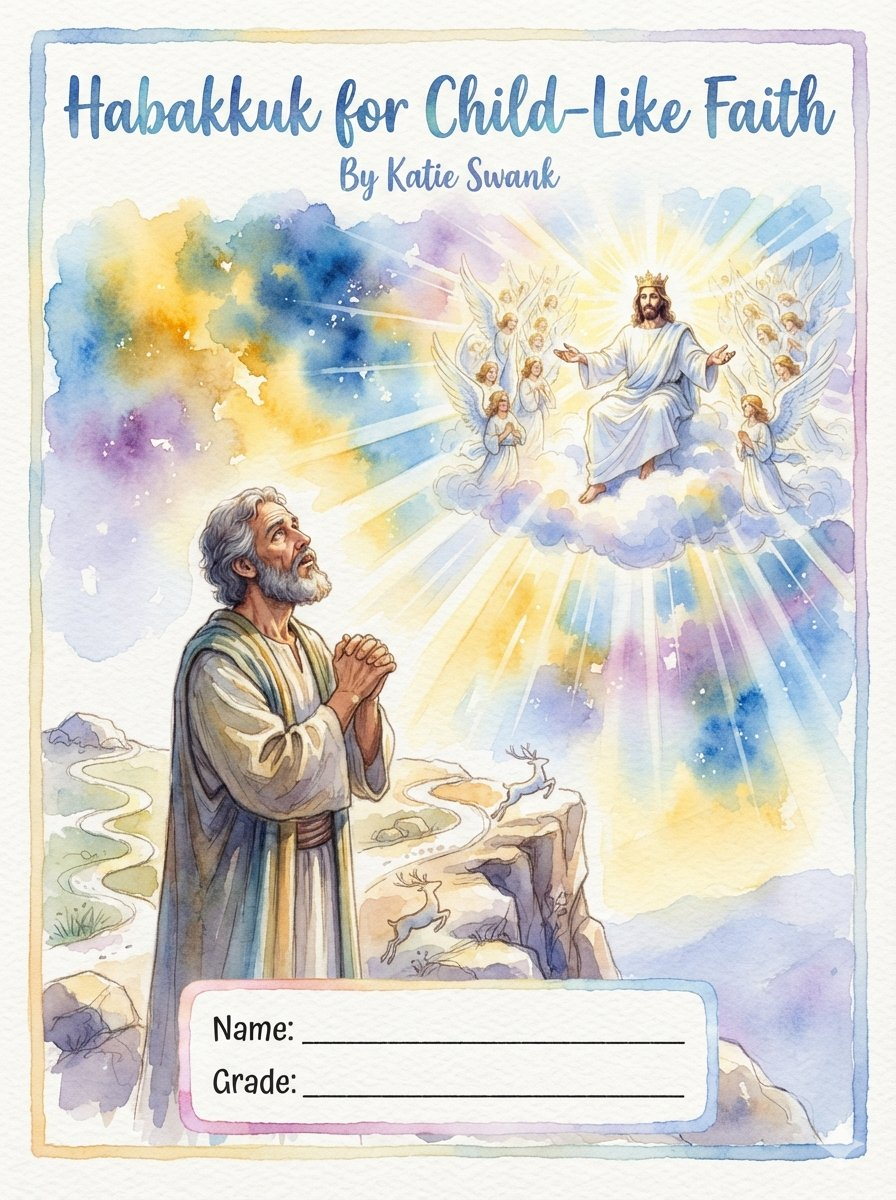


Who Wrote It?
All three ministries explicitly attribute authorship to the prophet Habakkuk. [1, 2, 3]
- Got Questions notes that he was likely a “professional prophet” formally trained or serving in a religious leadership position in Judah, exhibiting great literary prowess and poetic skill.
- BJU Press resources point out that while little biographical detail is known, his text unique because it is structured as an intimate, gritty dialogue between the prophet and God rather than a sermon preached outward to the people. [1, 2, 3, 4]
2. When Was It Written?
The consensus is that it was written in the pre-exilic period, shortly before the Babylonian invasion, ranging between 612 BC and 605 BC. [1, 2, 3]
- Got Questions targets the date precisely between 610 and 605 BC, as the book speaks directly to the impending rise of the Chaldeans (Babylon) as an instrument of divine judgment.
- Ken Ham’s Answers in Genesis places the timeline around 609–605 BC, pointing to the historical period where God’s people were spiraling into rampant ungodliness right before being meted out their “last terrible measure of chastisement”.
- BJU Press similarly dates the text to this era of moral decay—specifically during the reign of King Jehoiakim or following the broken covenants after King Josiah’s death. [1, 2, 3, 4, 5, 6]
According to the New King James Version (NKJV), the message of God was given to Habakkuk through a prophetic vision that he “saw,” delivered within an intense, direct conversational dialogue with God.
The text outlines three specific ways the message was communicated and received:
1. It Was Given as a Weighty Oracle That Was “Seen”
The very first verse of the book defines how the message arrived: “The burden which the prophet Habakkuk saw“ (Habakkuk 1:1).
- The “Burden”: The NKJV uses the word “burden” (translated from the Hebrew massa) to describe a heavy, pressing prophetic utterance or oracle from God.
- The Visual Nature: Even though the book contains a conversation, the NKJV notes that Habakkuk saw this burden, indicating it was accompanied by vivid spiritual or mental imagery of the geopolitical shifts God was orchestrating.
2. It Was Given as a Response to Watchful Waiting
The message was not forced upon a passive prophet. Habakkuk received the core of God’s revelation only after he intentionally postured himself to look and listen:
“I will stand at my guard post and station myself on the ramparts; and I will keep watch to see what He will say to me, and what I will answer when I am corrected.” (Habakkuk 2:1)
3. It Was Given with a Command to Physically Record It
When God spoke the central message of the book, He explicitly instructed Habakkuk to capture the vision in written, readable form so it could be easily shared and preserved:
“Then the Lord answered me and said: ‘Write the vision and make it plain on tablets, that he may run who reads it.’” (Habakkuk 2:2)
This verse-by-verse breakdown and cross-reference of the Book of Habakkuk relies exclusively on the scriptural content and thematic markers found in the New King James Version (NKJV) text hosted on Bible Gateway.
📖 Habakkuk Chapter 1: The Prophet’s Question and The Lord’s Reply
The chapter records an direct dialogue where the prophet questions God’s silence over local corruption, and God responds by introducing an unexpected external agent of judgment.
- Verse 1:“The burden which the prophet Habakkuk saw.”
- NKJV Cross-Reference: Nahum 1:1 & Malachi 1:1 — Explicitly matches the prophetic designation of an oracle as a heavy “burden.” [1]
- Verses 2–4: Habakkuk cries out over domestic “violence,”“plundering,” paralyzed law, and perverse judgment where “the wicked surround the righteous.”
- NKJV Cross-Reference: Psalm 13:1–2 — David’s scriptural parallel crying out, “O Lord, how long?” over prevailing trouble. [1]
- Verses 5–11: The Lord answers, “For indeed I am raising up the Chaldeans, a bitter and hasty nation” executing swift, terrifying military conquest.
- NKJV Cross-Reference: 2 Kings 24:2 — The biblical historical record fulfilling this exact phrase as bands of Chaldeans are sent against Judah. [1]
- Verses 12–17: Habakkuk questions God’s purity, asking why the “Holy One” remains silent while a wicked empire treats men like helpless “fish of the sea” gathered in a dragnet.
- NKJV Cross-Reference: Jeremiah 16:16 — The matching prophetic imagery of God bringing in “fishermen” to capture and discipline His people. [1]
📖 Habakkuk Chapter 2: The Watchtower, The Vision, and The Woes
The prophet steps back to wait for a reply, and God commands him to preserve the message, laying down a core spiritual boundary before listing a series of divine judgments.
- Verse 1:“I will stand my watch and set myself on the rampart, and watch to see what He will say to me…”
- NKJV Cross-Reference: Isaiah 21:8 — The exact imagery of a dedicated watchman stationing himself day and night on a watchtower. [1]
- Verses 2–3: The Lord answers: “Write the vision and make it plain on tablets… For the vision is yet for an appointed time.”
- NKJV Cross-Reference: Daniel 8:17 — Explicit verification that biblical prophetic visions point to a specific, determined end. [1]
- Verse 4:“Behold the proud, his soul is not upright in him; but the just shall live by his faith.”
- NKJV Cross-Reference: Romans 1:17, Galatians 3:11, and Hebrews 10:38 — Three unique New Testament citations that structurally build doctrines of justification and endurance directly upon this single NKJV phrase. [1]
- Verses 5–19: A sequence of five systematic woes targeting extortion, covetousness, violent city-building, exploitation, and silent idols.
- NKJV Cross-Reference: Isaiah 14:4 — The scriptural paradigm of raising up a “taunting proverb” against an oppressive king. [1]
- Verse 20:“But the Lord is in His holy temple. Let all the earth keep silence before Him.”
- NKJV Cross-Reference: Zephaniah 1:7 — The precise thematic echo commanding all the earth to “Be silent in the presence of the Lord God.” [1]
📖 Habakkuk Chapter 3: The Prophet’s Prayer and Triumph of Faith
The final section transitions into a structured liturgical prayer (“on Shigionoth”), recounting God’s historical deeds before concluding with absolute confidence. [1]
- Verses 1–2:“O Lord, revive Your work in the midst of the years… In wrath remember mercy.”
- NKJV Cross-Reference: Psalm 85:6 — The identical communal petition asking God to “revive us again” so His people can find joy. [1]
- Verses 3–15: A highly descriptive historical song tracing God marching from Teman and Paran, shaking the hills, parting rivers, and altering the course of the sun and moon.
- NKJV Cross-Reference: Deuteronomy 33:2 & Judges 5:4 — Foundational textual parallels singing of God marching out from the fields of Edom and Sinai.
- NKJV Cross-Reference: Joshua 10:12–13 — The historical fulfillment of verse 11 where the sun and moon stood still in their habitation. [1]
- Verses 16–19: Habakkuk declares that even if the fig tree does not blossom, fields yield no food, and flocks are cut off, “Yet I will rejoice in the Lord… He will make my feet like deer’s feet.”
The Book of Habakkuk teaches us about the coming of Christ primarily through the principle of justification by faith, His role as the ultimate bringer of justice and salvation, and the visual foreshadowing of His second coming as a conquering King.
While Habakkuk does not explicitly use the name “Jesus,” trusted evangelical and fundamentalist authorities—including Bob Jones University (BJU), Got Questions Ministries, Ken Ham (Answers in Genesis), and John MacArthur (Grace to You)—highlight several core connections between this prophecy and Jesus Christ:
1. The Foundation of the Gospel: “The Just Shall Live by Faith”
The most prominent connection to Christ is found in Habakkuk 2:4, which states that “the just shall live by his faith.” [1, 2]
John MacArthur and Got Questions: Both ministries emphasize that this verse serves as the structural seed for the New Testament Gospel. The Apostle Paul quotes Habakkuk 2:4 three times (Romans 1:17, Galatians 3:11, and Hebrews 10:38) to prove that salvation cannot be earned by human works or the law. It is only through faith in the first coming, death, and resurrection of Jesus Christ that a person is declared righteous before God. [1, 2]
2. Christ as the Answer to Injustice and Judgment
Habakkuk begins with a heavy burden, questioning why God allows evil and violence to go unpunished. God responds that He is raising up the ruthless Babylonians (Chaldeans) as an instrument of temporary judgment. [1, 2, 3, 4]
- BJU / Fundamentalist Perspective: Commentators aligned with the scriptural worldview taught at BJU note that God’s methods often shock human logic. Just as God used an evil nation to bring about ultimate correction in Habakkuk’s day, He used the ultimate, shocking injustice—the crucifixion of His perfect Son, Jesus Christ—to satisfy divine justice, bear our judgment, and permanently defeat evil.
- John MacArthur: MacArthur notes that Habakkuk teaches believers to look past temporary, earthly chaos and trust in God’s sovereign timeline. Christ’s first coming provided the spiritual rescue from sin, while establishing the promise that all physical and social injustice will be completely crushed at His return. [1, 2]
3. Prophetic Foreshadowing of the Second Coming
In Habakkuk 3, the prophet transitions from complaining to a poetic prayer of praise, describing God arriving in terrifying glory and cosmic splendor to judge the nations and rescue His people. [1, 2, 3]
- Got Questions: Got Questions connects the localized “theophany” (a visible manifestation of God) in Habakkuk 3:3–4 to the grand reality of the Second Coming of Jesus Christ. While Jesus arrived quietly as a suffering servant in a manger during His first coming, Habakkuk’s imagery parallel New Testament prophecies (like Revelation 19) depicting Christ returning in undeniable power as the conquering King to execute final judgment and deliver the faithful. [1, 2]
4. Literal Fulfilment of God’s Word
- Ken Ham / Answers in Genesis: While Ken Ham’s primary focus is on Genesis and biblical authority, the foundational principle his ministry defends—taking God’s Word literally and trusting His historical promises—directly mirrors Habakkuk’s conclusion. Habakkuk teaches that even when the “fig tree does not blossom” (Habakkuk 3:17), God’s promises of a coming Redeemer and a restored creation are absolute and mathematically certain.

