

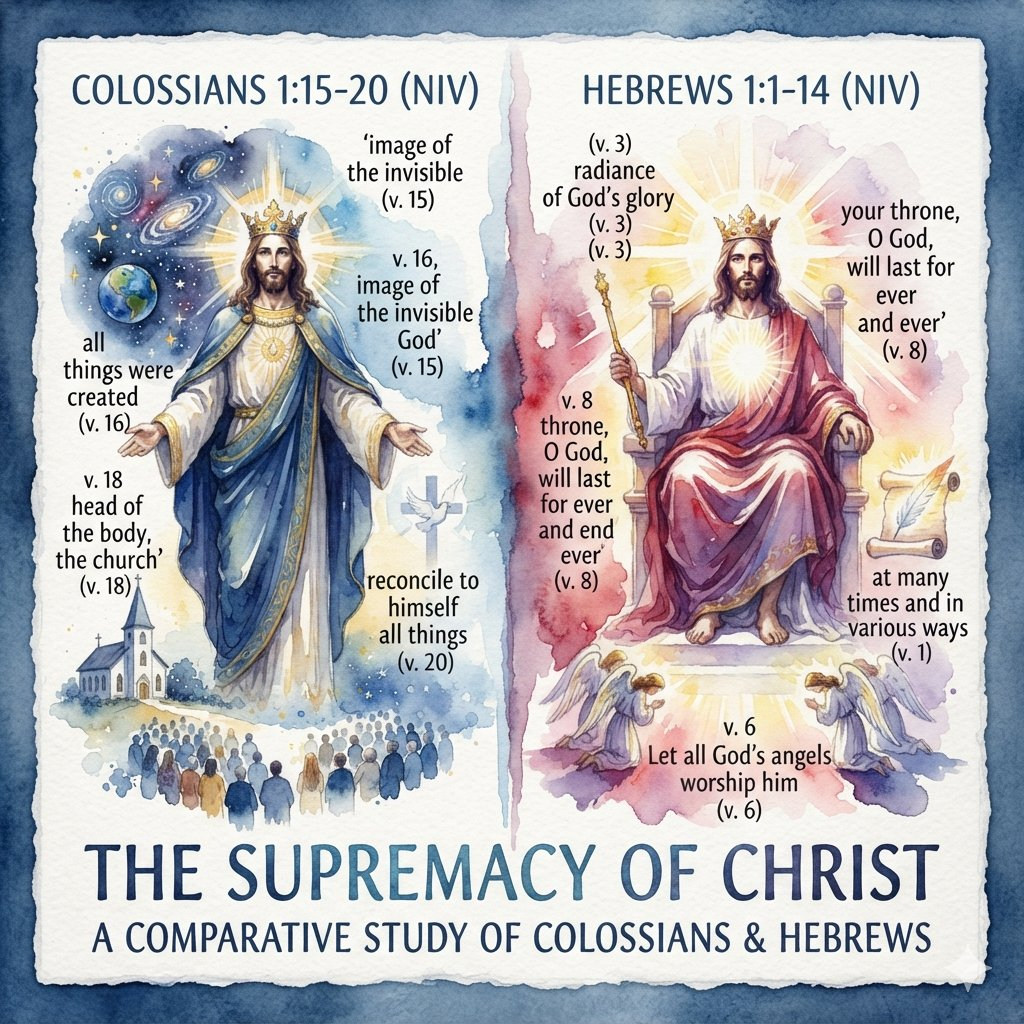
Both Colossians 1:15-20 and Hebrews 1:1-14 stand as two of the highest and most concentrated descriptions of Christology (the theology of Jesus Christ) in the entire New Testament. Both passages utilize majestic, poetic language to establish the absolute supremacy, preeminence, and divine nature of Jesus, connecting Him explicitly to creation, revelation, and redemption.
A direct comparison of their key theological themes highlights their profound overlap and distinct emphases:
Core Comparison Overview
| Theological Theme | Colossians 1:15-20 | Hebrews 1:1-14 |
|---|---|---|
| The Nature of the Son | “The image of the invisible God” | “The radiance of God’s glory and the exact representation of his being” |
| Relationship to Creation | All things were created through him and for him; he holds all things together. | The one through whom also he made the universe; sustains all things by his powerful word. |
| Cosmic Title | “The firstborn over all creation” and “firstborn from among the dead”. | Appointed heir of all things; the firstborn brought into the world. |
| The Work of Salvation | Making peace and reconciling all things through his blood shed on the cross. | Sat down at the right hand of Majesty after providing purification for sins. |
| Unique Focal Contrast | Compares Christ’s supremacy over earthly and heavenly rulers/authorities. | Compares Christ’s supremacy explicitly over angels. |
Key Similarities
- Exact Representation of God: Both texts use unique terminology to explain that Jesus is the perfect visual representation of the invisible God. Colossians calls Him the “image (eikon) of the invisible God,” while Hebrews describes Him as the “radiance of God’s glory and the exact representation of his being.” [1, 2]
- Cosmic Creator and Sustainer: Neither passage treats Jesus as merely a good moral teacher or an afterthought in history. In both, He is the active agent of creation. Furthermore, both credit Him with keeping the universe functioning right now: Colossians notes that “in him all things hold together,” and Hebrews asserts He is “sustaining all things by his powerful word.” [1, 2]
- The “Firstborn” Status: Both use “firstborn” not to imply a chronological birth or a status of being created, but as an Old Testament reference to royal inheritance, supreme rank, and total ownership over creation. [1, 2]
- Exaltation Following Sacrifice: Both trajectories move from cosmic status, down to earthly sacrifice, and back up to cosmic authority. Colossians grounds this in His resurrection (“firstborn from among the dead”) and the blood of the cross. Hebrews grounds it in His priestly work (“provided purification for sins”) followed by His royal enthronement (“he sat down at the right hand of the Majesty in heaven”). [1, 2]
Key Differences in Focus and Context
- The Problem of Angels vs. Worldly Rulers: The author of Hebrews writes to Jewish Christians tempting a return to old covenants. He spends the vast majority of chapter 1 stringing together Old Testament quotes to prove Jesus is vastly superior to angels (who are merely “ministering spirits”). Paul, writing to the Colossians, is combating a local heresy involving asceticism and cosmic forces, so he focuses on Christ’s supremacy over all invisible cosmic powers, “whether thrones or powers or rulers or authorities.”
- The Church vs. The Prophets: Colossians explicitly ties Jesus’ supremacy to His role as the “head of the body, the church.” Hebrews does not explicitly reference the church in this opening chapter; instead, its opening pivot contrasts Jesus with the Old Testament prophets, framing Jesus as God’s ultimate, final speech to mankind.
- Reconciliation vs. Purification: Colossians has a heavy emphasis on cosmic reconciliation—bringing a broken, fractured universe back into harmony with God through the cross. Hebrews uses temple/sacrificial language, focusing heavily on the legal and ceremonial purification of personal sins
Colossians 1:15–20 and Hebrews 1:1–14 are two of the most profound Christological passages in the New Testament, both serving to establish the absolute supremacy, divinity, and cosmic authority of Jesus Christ. Scholars frequently pair them together because they utilize near-identical theological frameworks to describe who Jesus is in relation to God, creation, and redemption. [1, 2, 3]
The structural and thematic comparisons between these two New Testament passages highlight their shared focus on the supremacy of Christ.
Shared Theological Themes
| Theme | Colossians 1:15–20 (NIV) | Hebrews 1:1–14 (NIV) |
|---|---|---|
| The Exact Visual of God | He is the “image of the invisible God” (v. 15). | The Son is the “radiance of God’s glory and the exact representation of his being” (v. 3). |
| Cosmic Creator | “…in him all things were created: things in heaven and on earth…” (v. 16). | “…through whom also he made the universe” (v. 2). |
| Sustainer of Reality | “…in him all things hold together” (v. 17). | “…sustaining all things by his powerful word” (v. 3). |
| Supreme Inheritance | He is the “firstborn over all creation” (v. 15), meaning supreme rank. | He is the “heir of all things” (v. 2). |
| Work of Atonement | Making peace and reconciling all things “through his blood, shed on the cross” (v. 20). | “After he had provided purification for sins…” (v. 3). |
| Exalted Status | “…so that in everything he might have the preeminence” (v. 18). | “…he sat down at the right hand of the Majesty in heaven” (v. 3). |
Key Distinctions in Focus and Context
While their foundational theology is identical, the writers deploy these truths to answer different pastoral problems.
1. The Literary Context: Early Hymn vs. Rhetorical Prologue
- Colossians 1 reads like poetry and is widely believed to be an early Christian hymn adapted by Paul. It uses beautifully balanced stanzas to celebrate Christ’s dual supremacy: first over the old creation (vv. 15–17), and second over the new creation via the resurrection (vv. 18–20). [1, 2, 3]
- Hebrews 1 serves as a majestic rhetorical prologue to a long sermon. It sets up the overarching argument of the entire book: Jesus is better. The author quotes a dense string of Old Testament Psalms to build a logical, scriptural argument for Christ’s superiority. [1]
2. The Target Audience and Purpose
- Colossians was written to combat a local “Colossian heresy”—a blend of mysticism, legalism, and the worship of spiritual powers. Therefore, Paul explicitly emphasizes that Jesus created and rules over all “thrones or powers or rulers or authorities”—meaning Christians do not need to fear or placate lesser cosmic spirits. [1, 2, 3]
- Hebrews was written to Jewish Christians tempted to drift back to Judaism to avoid persecution. The author focuses on showing how Jesus is superior to old covenants. He specifically spends the bulk of chapter 1 (vv. 4–14) proving Jesus is far superior to angels, noting that angels are merely servants, whereas the Son is the eternal, unchanging King God who lays the foundations of the earth.
Summary of the Comparison
If Colossians 1 is a song declaring that Jesus is the head of the church and the ultimate reconciler of the cosmos, Hebrews 1 is a legal brief declaring that Jesus is the final word of God. Together, they stand as the pillars of New Testament Christology, leaving no room to view Jesus as a mere prophet, angel, or created being
Using the exact text found in the New International Version (NIV) from Bible Gateway, a direct comparison reveals that Colossians 1:15–20 and Hebrews 1:1–14 are both deeply focused on establishing the absolute supremacy, divinity, and universal authority of Jesus Christ. [1, 2]
The exact vocabulary from the Bible Gateway NIV text shows how these two passages parallel each other across major theological themes.
🤝 Direct Shared Themes (NIV Text Only)
| Theological Concept | Colossians 1:15–20 (NIV) | Hebrews 1:1–14 (NIV) |
|---|---|---|
| The Visual Blueprint of God | “The Son is the image of the invisible God” (v. 15). | “The Son is the radiance of God’s glory and the exact representation of his being” (v. 3). |
| The Power of Creation | “…for in him all things were created: things in heaven and on earth, visible and invisible…” (v. 16). | “…through whom also he made the universe” (v. 2) and “…Lord, you laid the foundations of the earth…” (v. 10). |
| Sustaining the Universe | “…and in him all things hold together” (v. 17). | “…sustaining all things by his powerful word” (v. 3). |
| Status of Inheritance | “…the firstborn over all creation” (v. 15). | “…whom he appointed heir of all things” (v. 2). |
| Dealing with Human Sin | “…making peace through his blood, shed on the cross” to reconcile all things (v. 20). | “After he had provided purification for sins…” (v. 3). |
| The Highest Throne | “…so that in everything he might have the supremacy” (v. 18). | “…he sat down at the right hand of the Majesty in heaven” (v. 3) and “Your throne, O God, will last for ever and ever” (v. 8). |
⚖️ Major Contextual Differences
While the core identity of Jesus matches perfectly between the two accounts, the Bible Gateway search text points out distinct local arguments the writers were addressing.
1. Rulers and Powers vs. Angels and Prophets
- Colossians 1: Focuses heavily on planetary and spiritual authority. The text emphasizes that everything was created by Him, “whether thrones or powers or rulers or authorities” (v. 16). The goal is to prove that local cosmic forces or dark spirits have no hold over believers, because Christ rules them all. [1]
- Hebrews 1: Focuses heavily on the Jewish religious heritage. It begins by contrasting how God spoke “in the past through the prophets” (v. 1) with how He speaks now through His Son. The vast majority of the chapter (vv. 4–14) is systematically structured to prove that Jesus is vastly superior to angels, reinforcing this by quoting Old Testament text directly to show that angels worship Him (v. 6). [1, 2]
2. The Head of the Church vs. The Eternal King
- Colossians 1: Brings the cosmic ruler down to the local church level. It explicitly highlights His identity as “the head of the body, the church” and “the firstborn from among the dead” (v. 18). [1]
- Hebrews 1: Focuses primarily on His royal majesty and timelessness. The text reminds the reader that while the heavens and earth “will perish… you remain the same, and your years will never end” (vv. 11–12). [1]
💡 Core Takeaway
According to the NIV documentation on Bible Gateway, Colossians 1:15–20 presents Jesus as the cosmic force holding creation together and head of the new body, while Hebrews 1:1–14 builds a scriptural legal case that Jesus is the final, supreme King who outranks any prophet, angel, or celestial being.


You must be logged in to post a comment.