

The core reason for adapting this classic work for a younger audience is that the spiritual battleground has changed, and children face highly sophisticated, quiet traps every single day. While C.S. Lewis originally framed these themes around adult complexities—like 1940s British high-society politics and deep theological arguments—an adaptation for kids translates those exact same spiritual principles into things they experience firsthand: group chat exclusions, social media pressures, school anxieties, and changing family dynamics.
Understanding the specific nature of these deceptions is critical for young minds for several key reasons:
1. Recognizing That Evil Works Through “The Slow Slide”
Most young children think of bad choices or spiritual attacks as big, scary, obvious sins—like robbing a store or becoming a movie villain. However, as C.S. Lewis famously highlighted, the safest road to destruction is actually “the gentle slope, soft underfoot, without sudden turnings.” In a kid-friendly version, this translates to the danger of a double life—laughing at a mean joke just to fit in, staying quiet when a classmate is bullied, or trading real values for temporary popularity. Kids need to realize that small, unnoticed habits can slowly pull them away from who they are meant to be.
2. Identifying Distraction as a Weapon
We live in an incredibly noisy world filled with endless scrolling, push notifications, and non-stop entertainment. A key lesson of this book is that the biggest threat isn’t necessarily a direct argument against faith; it is sheer distraction. By teaching children that constant digital “noise” can be a deliberate trap to keep them from thinking deeply or reflecting in quiet moments, they learn the value of stopping to breathe, think, and listen.
3. Exposing the Weapon of “Expectations vs. Reality”
Middle school and late elementary years are prime times for cynicism to take root. When children look at the adults or peers around them at church, home, or school, they quickly spot hypocrisies and minor flaws. Without guidance, they might assume that because people are flawed, truth itself must be a fake. Exposing this trick ahead of time prepares kids to guard their hearts. It teaches them to expect that people are human and imperfect, preventing those normal friction points from damaging their own growth or faith.
4. Guarding Against Tone and Domestic Bitterness
Family relationships are often where children experience their earliest, most frequent conflicts. By showing kids how easily an everyday conversation can be derailed just by over-analyzing a parent’s or sibling’s tone of voice, they gain emotional intelligence. They learn to step back from an argument, see it as a potential trap, and choose peace over escalation.
Summary: Flipping the Script
Ultimately, adapting this perspective acts like giving kids a peek at an opponent’s playbook. Once children see how predictable and devious these subtle traps are, the deceptions completely lose their power. They learn to recognize a bad attitude, a sudden wave of boredom, or peer pressure not just as a random feeling, but as a specific challenge that they have the strength to overcome.
The Setup: Welcome to the Underground Academy
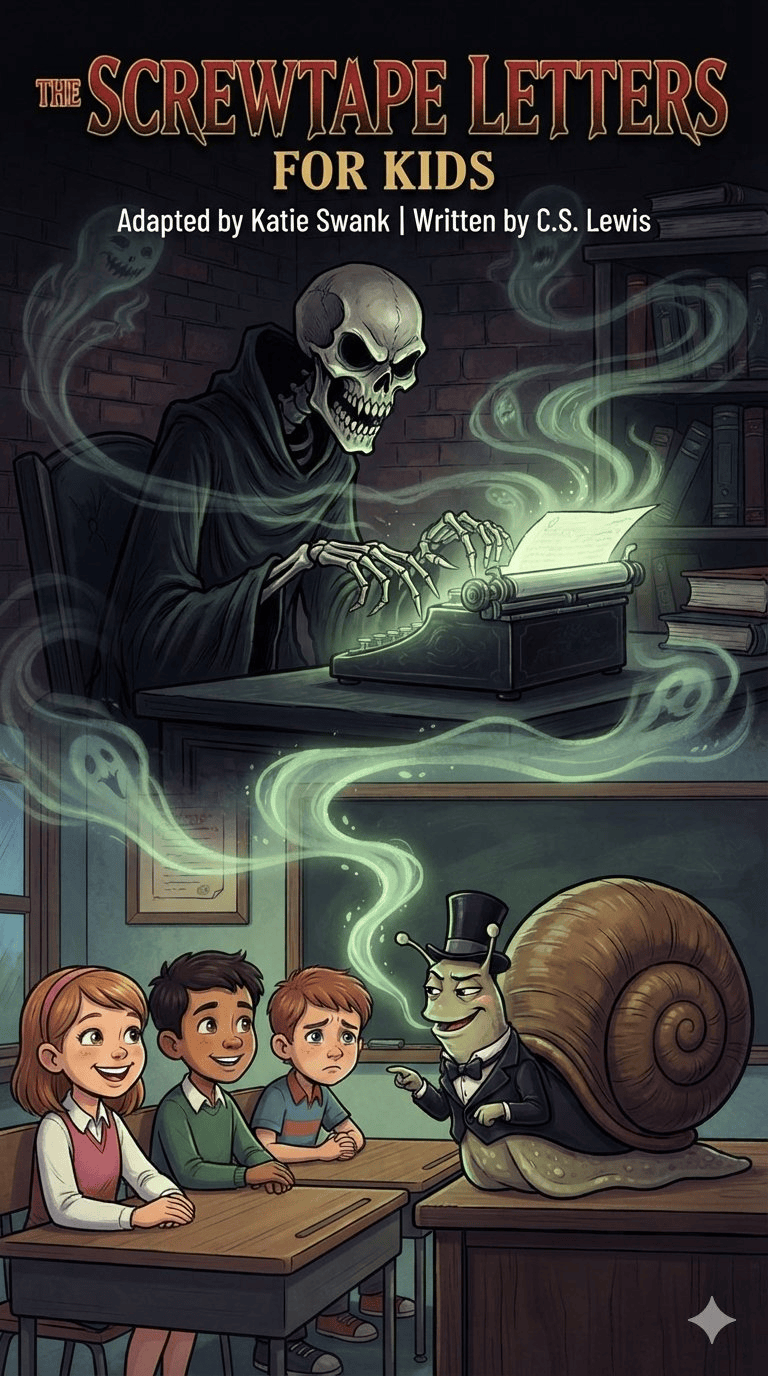
Imagine getting a series of emails from your older, much more experienced cousin who is a master at making bad choices. In this book, an older demon named Screwtape writes letters to his young nephew, Wormwood. Wormwood’s new “homework assignment” is an ordinary human teenager (called “the Patient”). Screwtape’s job is to coach Wormwood on how to secretly nudge this kid away from doing good and toward doing wrong—without the kid ever realizing he’s being manipulated
Letter 1: The Danger of Thinking Too Deeply
My dear Wormwood,
I noticed you’ve been trying to convince your Patient to start big, dramatic arguments about what is true and what is false. Stop doing that immediately! You are acting like he lives in the 1800s.
Back then, humans actually changed their lives based on what they believed was true. Today, things are totally different. Thanks to the internet, social media, and constant streams of information, humans don’t look at ideas as “true” or “false.” Instead, they categorize them as “academic,” “practical,” “outdated,” or “trending.” Your job isn’t to prove that bad things are true; your job is to keep him focused on what is popular or comfortable.
Don’t waste your time trying to use science to mess with his head. Science actually encourages people to look at the real world and think deeply, which is the last thing we want. If he starts thinking about real science, he might start thinking about the Creator.
Instead, keep him hooked on the “ordinary life.” Let me show you what I mean:
Years ago, I was looking after a guy who liked to read in a quiet library. One day, I noticed he started thinking deeply about the meaning of life. I could feel my control slipping away! If I tried to argue with him, I would have lost, because he was a smart guy.
So, what did I do? I didn’t argue. I attacked his stomach instead. I made him suddenly think, “Man, I am getting kind of hungry. I should go grab lunch.”
He tried to shake it off and go back to his deep thoughts, but I nudged him again: “You can always think about this deep stuff after lunch. Don’t want to get a headache.”
By the time he walked out the door and saw a bus driver and a newsboy, he completely forgot about his deep thoughts. The noisy, busy, ordinary world convinced him that his quiet thoughts weren’t real. Today, he’s safe in our basement.
Do you see the trick? Humans naturally think that the loud, busy, everyday stuff around them is the “real world.” Never let him wonder what is actually real. Keep him staring at his phone, worrying about his social status, and thinking about what he’s going to eat next. Teach him to call that “the real world,” and he will never look up to see the truth.
Your affectionate uncle,
Screwtape


You must be logged in to post a comment.