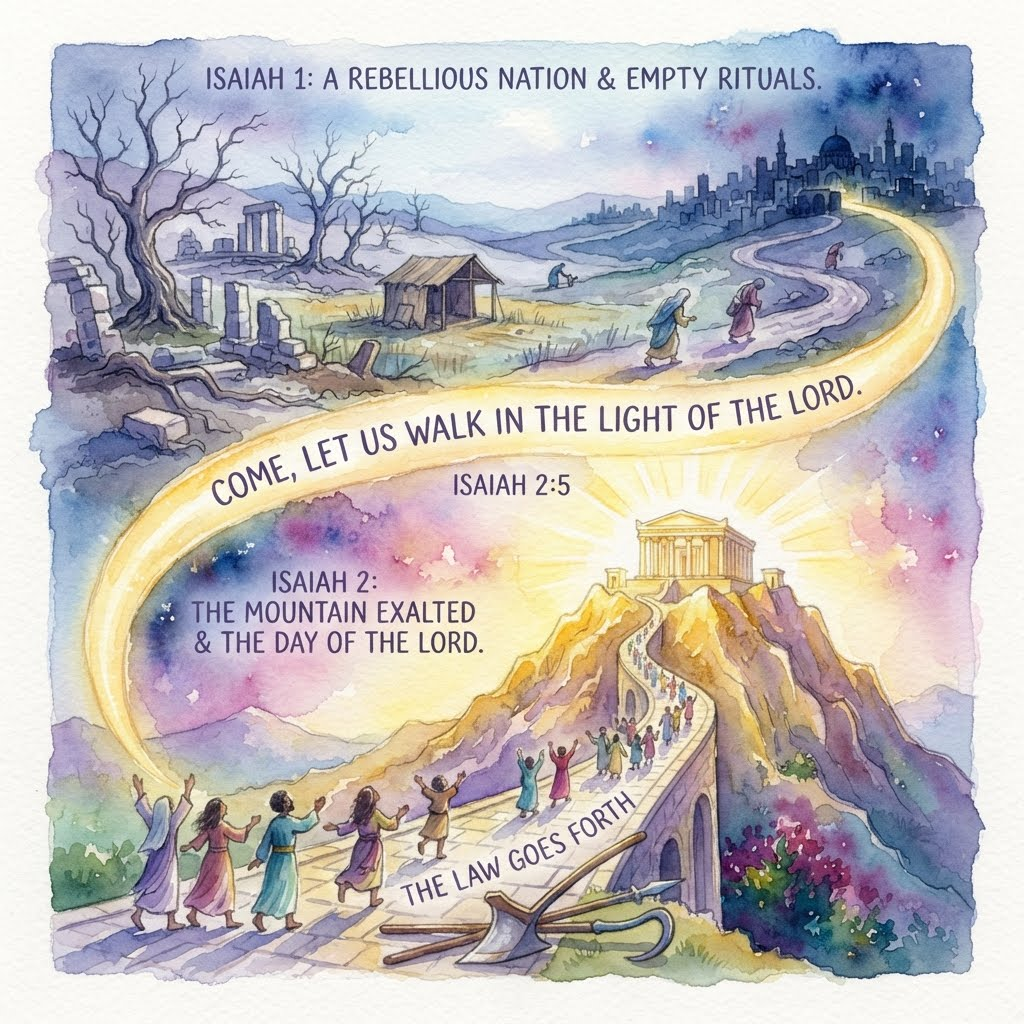


In Isaiah 1 (NIV), God brings a formal legal indictment against the Southern Kingdom of Judah. Grounded strictly in a literal, covenantal interpretation (aligned with the text-driven principles of Got Questions, Bob Jones University, and Answers in Genesis / Ken Ham Ministries), this chapter sets the stage for the entire book. It exposes human depravity, rejects hollow religious ritualism, and introduces the stark choice between divine cleansing by grace or ultimate destruction.
Verse-by-Verse Commentary
The Indictment of a Rebellious Nation (Verses 1–4)
- Verse 1:“The vision concerning Judah and Jerusalem that Isaiah son of Amoz saw during the reigns of Uzziah, Jotham, Ahaz and Hezekiah, kings of Judah.”
- Explanation: Isaiah’s long ministry (approx. 739–681 BC) spans four kings of Judah. The term “vision” anchors the text as direct divine revelation, not human philosophy or political imagination.
- Verse 2:“Hear, me, heavens! Listen, earth! For the Lord has spoken: ‘I reared children and brought them up, but they have rebelled against me.’”
- Explanation: God summons creation itself as a grand jury to witness Israel’s violation of the Mosaic Covenant. The sin is framed as family betrayal; they are ungrateful children rebelling against their Father.
- Verse 3:“The ox knows its master, the donkey its owner’s manger, but Israel does not know, my people do not understand.”
- Explanation: Dumb farm animals inherently recognize who feeds and cares for them. Tragically, Israel possesses less spiritual awareness and gratitude toward their Creator than beasts of burden.
- Verse 4:“Woe to the sinful nation, a people whose guilt is great, a brood of evildoers, children given to corruption! They have forsaken the Lord; they have spurned the Holy One of Israel and turned their backs on him.”
- Explanation: Isaiah uses four titles of shame (“sinful nation,” “guilt is great,” “brood of evildoers,” “corrupt children”) to demonstrate total generational depravity. They have outright rejected God’s character as the “Holy One of Israel”.
The Picture of Spiritual and National Sickness (Verses 5–9)
- Verses 5–6:“Why should you be beaten any more? Why do you persist in rebellion? Your whole head is injured, your whole heart afflicted. From the sole of your foot to the top of your head there is no soundness—only wounds and welts and open sores, not cleansed or bandaged or soothed with olive oil.”
- Explanation: Sin has left the nation physically and spiritually devastated, resembling a severely beaten person covered in untreated, festering wounds. Yet, they stubbornly persist in the behavior causing their pain.
- Verses 7–8:“Your country is desolate, your cities burned with fire; your fields are being devoured by foreigners right before you, as if overthrown by strangers. Daughter Zion is left like a shelter in a vineyard, like a hut in a cucumber field, like a city under siege.”
- Explanation: This describes literal historical judgments (such as the Assyrian invasions). Jerusalem (“Daughter Zion”) stands completely isolated, vulnerable, and frail, like a flimsy temporary shack left behind after a harvest.
- Verse 9:“Unless the Lord Almighty had left us some survivors, we would have become like Sodom, we would have been like Gomorrah.”
- Explanation: Judah deserved the total physical annihilation suffered by Sodom and Gomorrah. It is exclusively by God’s sovereign grace and mercy that a righteous remnant is preserved to carry on His covenant promises.
The Condemnation of Empty Religion (Verses 10–15)
- Verse 10:“Hear the word of the Lord, you rulers of Sodom; listen to the instruction of our God, you people of Gomorrah!”
- Explanation: Isaiah addresses the leaders and citizens of Jerusalem by the titles of the most wicked cities in history, exposing their internal spiritual rot.
- Verses 11–13:“‘The multitude of your sacrifices—what are they to me?’ says the Lord. ‘I have more than enough of burnt offerings… I have no pleasure in the blood of bulls and lambs and goats. When you come to appear before me, who has asked this of you, this trampling of my courts? Stop bringing meaningless offerings! Your incense is detestable to me…’”
- Explanation: God did command these sacrifices in Leviticus, but performing them mechanically while continuing to harbor unrepentant sin makes the rituals a mockery and an abomination.
- Verses 14–15:“Your New Moon feasts and your appointed festivals my soul hates… When you spread out your hands in prayer, I will hide my eyes from you; even if you offer many prayers, I will not listen. Your hands are full of blood!”
- Explanation: God rejects external religious actions when the heart is corrupt. Spreading hands in prayer is completely invalidated because those same hands are actively guilty of violence, injustice, and oppression.
The Call to True Repentance and Cleansing (Verses 16–20)
- Verses 16–17:“Wash and make yourselves clean. Take your evil deeds out of my sight; stop doing wrong. Learn to do right; seek justice. Defend the oppressed. Take up the cause of the fatherless; plead the case of the widow.”
- Explanation: True repentance must show outward fruit. External rituals must be replaced by ethical justice, specifically by protecting the most defenseless members of society (orphans and widows).
- Verse 18:“‘Come now, let us settle the matter,’ says the Lord. ‘Though your sins are like scarlet, they shall be as white as snow; though they are red as crimson, they shall be like wool.’”
- Explanation: God issues a legal invitation to reason together. Scarlet and crimson represent deep, permanent stains of sin that human effort cannot wash away. Only direct divine grace can completely purify the sinner.
- Verses 19–20:“‘If you are willing and obedient, you will eat the good things of the land; but if you resist and rebel, you will be devoured by the sword.’ For the mouth of the Lord has spoken.”
- Explanation: A clear, absolute condition is set forth. Absolute obedience brings physical and spiritual covenant blessing, while continued rebellion guarantees execution and destruction.
The Purging and Redemption of Zion (Verses 21–31)
- Verses 21–23:“See how the faithful city has become a prostitute! She once was full of justice; righteousness used to dwell in her—but now murderers! Your silver has become dross, your choice wine is diluted with water. Your rulers are rebels, partners with thieves; they all love bribes and chase after gifts…”
- Explanation: Jerusalem has spiritually committed adultery by abandoning her covenant vows. Metaphors of dross (metallic impurities) and watered-down wine illustrate how completely the nation’s morality and leadership have deteriorated.
- Verses 24–26:“Therefore the Lord, the Lord Almighty, the Mighty One of Israel, declares: ‘Ah, I will vent my wrath on my foes and avenge myself on my enemies. I will turn my hand against you; I will thoroughly purge away your dross and remove all your impurities. I will restore your leaders as in days of old…’”
- Explanation: God uses His supreme titles of power to guarantee judgment. He will act as a refiner, using a painful, hot fire to burn away corrupt leaders (“dross”) so that a holy, restored city can emerge.
- Verses 27–28:“Zion will be delivered with justice, her repentant ones with righteousness. But rebels and sinners will both be broken, and those who forsake the Lord will perish.”
- Explanation: Divine judgment yields two distinct outcomes: the repentant remnant will be bought back (redeemed) through God’s righteous standard, while unrepentant sinners face final destruction.
- Verses 29–31:“You will be ashamed because of the sacred oaks in which you delighted… You will be like an oak with fading leaves, like a garden without water. The mighty man will become tinder and his work a spark; both will burn together, with no one to quench the fire.”
- Explanation: The “sacred oaks” point directly to pagan idolatry and false nature-worship. Those who trusted in their own strength and false gods will become completely dry and combustible. Their own sinful deeds act as the spark that ignites an unquenchable fire of judgment.
Isaiah Chapter 1: Personal Application for a Christian Homeschool Mother
As a wife, a mother of two, and a home educator, Isaiah 1 (NIV) offers a profound framework for your daily life. It transitions from a national courtroom drama into a powerful, intimate handbook on family discipleship, intentional parenting, and guarding your household against empty, mechanical routines.
When we read this chapter through a literal, covenantal lens, we discover how God models perfect parental love, how children naturally drift, and how we must prioritize genuine heart transformation over external checklists.
Verse-by-Verse Life Application
1. The Standard of Divine Instruction (Verse 1)
- Verse 1: “The vision concerning Judah and Jerusalem that Isaiah son of Amoz saw…”
- Motherhood Application: Isaiah’s ministry was grounded in a clear “vision” received directly from God’s Word. As a homeschool mother, your educational and spiritual vision for your two children cannot be driven by cultural trends, comparison with others, or worldly standards of success. Your daily curriculum and family culture must be anchored explicitly in divine truth.
2. The Reality of Free Will and Rebellion (Verse 2)
- Verse 2: “Hear, me, heavens! Listen, earth! For the Lord has spoken: ‘I reared children and brought them up, but they have rebelled against me.’”
- Motherhood Application: God is the only perfect parent in history, yet His children rebelled against Him. This provides immense theological comfort and a reality check for a homeschooling mother. When your children misbehave, throw tantrums, or resist your authority, it is not always a sign that your teaching methods have failed. Human nature is inherently fallen. This verse frees you from the burden of false guilt, reminding you to point your children constantly to their need for a Savior, rather than relying on flawless parenting formulas.
3. The Discipline of Spiritual Recognition (Verse 3)
- Verse 3: “The ox knows its master, the donkey its owner’s manger, but Israel does not know, my people do not understand.”
- Motherhood Application: Livestock naturally look to the hand that feeds them. In your home, you provide your children with physical food, shelter, clothing, and an education. However, this verse challenges you to ask: Are my children learning to recognize their ultimate Master? In your daily homeschool schedule, cultivate an environment of gratitude where your children learn to see God as the primary provider of every breath, meal, and mathematical breakthrough.
4. Guarding Against Generational Decay (Verse 4)
- Verse 4: “Woe to the sinful nation… a brood of evildoers, children given to corruption! They have forsaken the Lord…”
- Motherhood Application: Sin and rebellion are progressive and easily passed down through generations if unchecked. Homeschooling gives you the unique, high-leverage privilege of intervening in this cycle daily. By teaching your children to love the “Holy One of Israel” early on, you are actively erecting a spiritual hedge around your household, working to ensure they do not become “children given to corruption.”
5. Healing the Root, Not Just the Symptoms (Verses 5–6)
- Verses 5–6: “Why should you be beaten any more? Why do you persist in rebellion?… From the sole of your foot to the top of your head there is no soundness—only wounds and welts and open sores…”
- Motherhood Application: When disciplining your two children, do not merely focus on behavioral modification (wiping away the “sores”). If a child is argumentative, lazy with their chores, or unkind to a sibling, address the underlying heart issue (“the whole heart afflicted”). Deal with the root causes of pride, selfishness, or anger with gospel-centered correction, rather than just treating the outward symptoms with cold rules.
6. Protecting the Sanctity of the Home (Verses 7–8)
- Verses 7–8: “Your country is desolate… Daughter Zion is left like a shelter in a vineyard, like a hut in a cucumber field…”
- Motherhood Application: This imagery represents isolation and vulnerability. In a world hostile to biblical values, your home should feel like a secure haven, not a fragile, temporary hut easily blown over by the winds of cultural change. Use your role as a wife and mother to build a robust, joyful home life where your children feel secure, loved, and structurally protected by clear spiritual boundaries.
7. The Power of a Faithful Remnant (Verse 9)
- Verse 9: “Unless the Lord Almighty had left us some survivors [remnant], we would have become like Sodom…”
- Motherhood Application: Sometimes, choosing to homeschool and live distinctively Christian lives can feel incredibly isolating. You might look around at the culture and feel like you are in the extreme minority. Remember that God has always preserved a remnant of faithful believers to carry out His truth. Your family is part of that living legacy. Take courage; your quiet, daily obedience inside the walls of your home has cosmic and generational value.
8. Exposing “Checklist” Christianity (Verses 10–15)
- Verses 10–15: “‘The multitude of your sacrifices—what are they to me?’ says the Lord… ‘Stop bringing meaningless offerings!’… When you spread out your hands in prayer, I will hide my eyes…”
- Motherhood Application: This is perhaps the most critical warning for a homeschooling family. It is incredibly easy to turn homeschooling into an idol of religious checklist behavior: doing Bible copywork, singing hymns, and checking off character-building boxes, while hearts remain distant. God openly states He detests religious routines devoid of true devotion. Ensure that your family’s morning devotions or prayer times are authentic, relational encounters with a living God, rather than a rigid chore done simply to check off the day’s schedule.
9. The Action Items of Holy Living (Verses 16–17)
- Verses 16–17: “Wash and make yourselves clean… Learn to do right; seek justice. Defend the oppressed. Take up the cause of the fatherless; plead the case of the widow.”
- Motherhood Application: True faith must have hands and feet. As you educate your children, teach them that learning is not just for personal advancement or high test scores—it is for serving others. Build service projects into your homeschool curriculum. Encourage your children to look out for the vulnerable, share their toys, write cards to widows in your local church body, and actively practice compassion.
10. The Gospel Paradigm of Grace (Verse 18)
- Verse 18: “‘Come now, let us settle the matter,’ says the Lord. ‘Though your sins are like scarlet, they shall be as white as snow…’”
- Motherhood Application: This verse is a beautiful tool for your household. When your children mess up, rebel, or lie, model this divine invitation. Sit them down and say, “Come now, let’s talk about this and resolve it.” Extend gospel-centered grace. Show them that while their sins are vivid and real, Jesus’ sacrifice offers complete, total washing. Let your home be defined by a culture of swift confession, genuine repentance, and complete forgiveness.
11. Cultivating Willing Obedience (Verses 19–20)
- Verses 19–20: “‘If you are willing and obedient, you will eat the good things of the land; but if you resist and rebel, you will be devoured…’”
- Motherhood Application: Notice the phrase “willing and obedient.” It is possible for a child to obey outwardly while dragging their feet and harboring resentment internally. As a mother, aim for the heart. Teach your children that true obedience is prompt, thorough, and wrapped in a joyful attitude. Remind them that God honors a cheerful giver and a willing heart.
12. Restoring Purity to Relationships (Verses 21–23)
- Verses 21–23: “See how the faithful city has become a prostitute!… Your silver has become dross, your choice wine is diluted with water.”
- Motherhood Application: Dross and diluted wine represent compromise and a loss of integrity. In a marriage and in parenting, small compromises (unresolved bitterness, white lies, harsh words, or letting media consume family time) gradually dilute the purity of your home. Guard your marriage relationship fiercely, communicating openly with your husband, and keep account short with your children to ensure your household “silver” stays pure.
13. Embracing the Refining Process (Verses 24–26)
- Verses 24–26: “…I will thoroughly purge away your dross and remove all your impurities. I will restore your leaders as in days of old…”
- Motherhood Application: Homeschooling is a massive mirror that constantly exposes our own lack of patience, selfishness, and weaknesses as mothers. When you have a difficult day where your patience fails, see it as God’s loving refining fire. He is using the challenges of motherhood to burn away your personal dross and mold you into a more submissive, reliant, and holy leader for your children.
14. Living in the Reality of Consequences (Verses 27–31)
- Verses 27–31: “Zion will be delivered with justice… But rebels and sinners will both be broken… You will be ashamed because of the sacred oaks in which you delighted…”
- Motherhood Application: The people turned to “sacred oaks” (false idols) for security and delight, but it led to shame and unquenchable fire. In your home, teach your children the immutable law of sowing and reaping. If they trust in worldly things or hidden disobedience, it leads to brokenness. Show them that finding delight exclusively in the Lord brings lasting peace, protection, and true joy.
To deepen your study of Isaiah Chapter 1, we can look at how the rest of the Holy Scriptures utilize this opening indictment. New Testament authors and other biblical prophets frequently pull from the themes, vocabulary, and direct declarations of Isaiah 1 to explain the gospel of grace, human depravity, and the preservation of a holy remnant.
Below is a comprehensive cross-reference guide showing where Isaiah 1 is directly quoted, explicitly echoed, or fulfilled across the NIV Bible, along with practical insights for your family, home, and homeschool days.
Direct New Testament Citations of Isaiah 1
1. The Preservation of the Remnant (Isaiah 1:9 quoted in Romans 9:29)
- The Isaiah Source: “Unless the Lord Almighty had left us some survivors, we would have become like Sodom, we would have been like Gomorrah.” (Isaiah 1:9)
- The New Testament Citation: “It is just as Isaiah said previously: ‘Unless the Lord Almighty had left us descendants, we would have become like Sodom, we would have been like Gomorrah.’” (Romans 9:29, NIV)
- The Theological Meaning: The Apostle Paul under divine inspiration quotes Isaiah 1:9 exactly to prove his doctrine of sovereign election and grace. Paul argues that Israel’s physical heritage does not guarantee salvation; rather, God always preserves a small, chosen remnant by His grace to keep His promises alive, preventing total spiritual and physical destruction.
- Motherhood & Homeschool Application: When you look at a shifting culture and worry about the world your two children are growing up in, read Romans 9:29 alongside Isaiah 1:9. Remind yourself that God does not need a massive, culturally dominant majority to achieve His purposes. He works through the faithful few. Your quiet, daily efforts to train your children to love the Lord are part of His eternal work of preserving a holy remnant in this generation.
Explicit Cross-References and Direct Echoes in the NIV
While Romans 9:29 is the most explicit direct quote, several other prominent passages directly reference or dynamically pull from the specific imagery of Isaiah 1:
2. The Metaphor of Scarlet Sins (Isaiah 1:18 echoed in Revelation 17 and Psalm 51)
- The Isaiah Source: “Though your sins are like scarlet, they shall be as white as snow; though they are red as crimson, they shall be like wool.” (Isaiah 1:18)
- The Scripture Connections:
- Psalm 51:7 (NIV): “Cleanse me with hyssop, and I will be clean; wash me, and I will be whiter than snow.” David uses the exact same linguistic contrast—blood guilt turned whiter than snow through divine cleansing.
- Revelation 17:3–4 (NIV): The ultimate personification of rebellion and spiritual apostasy—Babylon the Great—is depicted riding a “scarlet beast” and dressed in “purple and scarlet.”
- The Theological Meaning: In biblical imagery, scarlet and crimson represent the indelible, bright, permanent stain of sin, rebellion, and spiritual adultery. Human effort can never wash out a deep scarlet dye; only an act of God’s sovereign grace can transform that permanent stain into pristine white snow or wool.
- Wife & Homemaker Application: Use this profound cross-reference during times of family confession or when dealing with marital friction. When offenses happen in the home, the stain can feel deep or permanent (“scarlet”). Isaiah 1:18 and Psalm 51:7 remind us that the gospel provides real, supernatural washing. Cultivate a household atmosphere where forgiveness is deep, erasing the stain of offenses completely rather than letting bitterness linger like old dye.
3. The Rejection of Hollow Worship (Isaiah 1:11–15 echoed in Amos 5, Micah 6, and Matthew 23)
- The Isaiah Source: “‘The multitude of your sacrifices—what are they to me?’ says the Lord… ‘Stop bringing meaningless offerings! Your incense is detestable to me…’” (Isaiah 1:11,13)
- The Scripture Connections:
- Amos 5:21–22 (NIV): “I hate, I despise your religious festivals; your assemblies are a stench to me. Even though you bring me burnt offerings… I will not accept them.”
- Micah 6:6–8 (NIV): “With what shall I come before the Lord…? Will the Lord be pleased with thousands of rams…? He has shown you, O mortal, what is good. And what does the Lord require of you? To act justly and to love mercy and to walk humbly with your God.”
- Matthew 23:23 (NIV): Jesus echoes this exact structural warning to the Pharisees: “Woe to you… You give a tenth of your spices—mint, dill and cumin. But you have neglected the more important matters of the law—justice, mercy and faithfulness.”
- The Theological Meaning: God consistently rejects external, checklist-oriented performance when the heart is unrepentant. The prophets and Jesus harmoniously state that ritualistic compliance mixed with ongoing personal compromise is an abomination.
- Homeschool Integration: This is a vital baseline for your homeschool lesson planning. It is easy to make Bible memorization, worldview classes, and theological reading a series of academic checkboxes for your kids. This cross-reference shows that God looks at the intent and the heart over the performance. Ensure your kids understand that learning Scripture is meant to transform how they treat their siblings, obey their parents, and love God—not just to get an “A” on a worksheet.
4. The Faithful City Turned Harlot (Isaiah 1:21 echoed in Jeremiah 2 and Ezekiel 16)
- The Isaiah Source: “See how the faithful city has become a prostitute! She once was full of justice; righteousness used to dwell in her…” (Isaiah 1:21)
- The Scripture Connections:
- Jeremiah 2:20–21 (NIV): “Long ago you broke off your yoke… You lay down as a prostitute on every high hill… I had planted you like a choice vine… How then did you turn against me into a corrupt, wild vine?”
- Ezekiel 16:32 (NIV): “You adulterous wife! You prefer strangers to your own husband!”
- The Theological Meaning: God frames Israel’s spiritual compromise not merely as a legal contract breach, but as an agonizing marital betrayal. Because God entered into a covenant with His people, their turning to false idols or worldly safety was equivalent to a wife committing adultery against a loving husband.
- Wife & Homemaker Application: This intense metaphor underscores the high value God places on covenant loyalty and fidelity. As a wife, your marriage is an earthly mirror of Christ and the Church (Ephesians 5). Guarding your marriage against small compromises—such as emotional distance, lack of respect, or letting household busywork crowd out your relationship with your husband—preserves the purity of that reflection.
Summary Table: Isaiah 1 in the Scope of Scripture
| Isaiah 1 Verse | Cross-Reference Passage | Connection Type | Core Theme |
|---|---|---|---|
| Isaiah 1:9 | Romans 9:29 | Direct Quote | God’s sovereign grace preserves a small, faithful remnant. |
| Isaiah 1:11–15 | Matthew 23:23 / Amos 5:21 | Thematic Echo | Outward religious checklists are useless without inner heart obedience. |
| Isaiah 1:18 | Psalm 51:7 / Revelation 17:3 | Linguistic Link | Scarlet sins are completely purified and washed white by divine grace. |
| Isaiah 1:21 | Jeremiah 2:20 / Ezekiel 16:32 | Metaphorical Echo | Covenant unfaithfulness is viewed by God as spiritual adultery. |

